

Home
Class 11
PHYSICS
A ball of mass m moving with velocity ve...

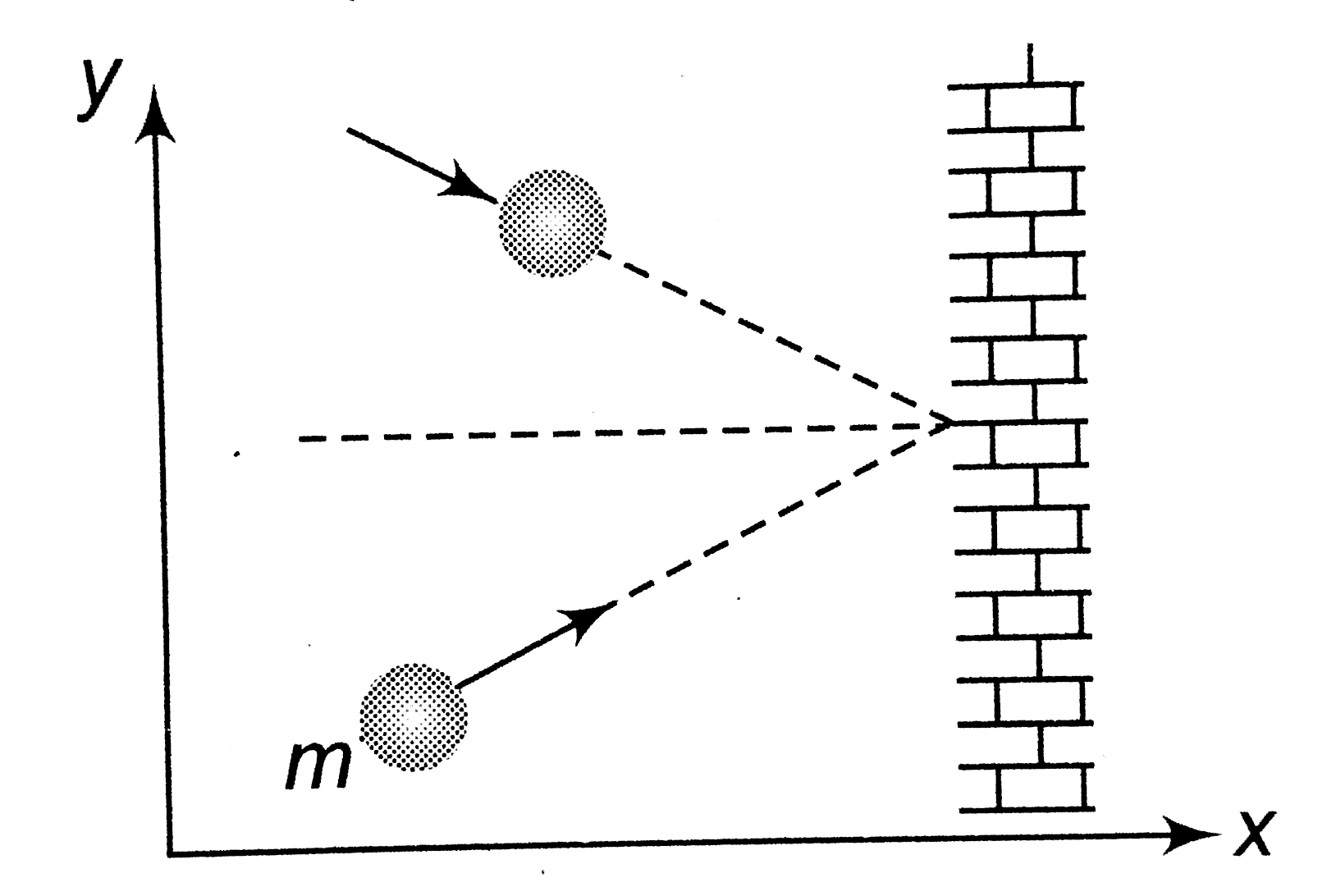
A ball of mass `m` moving with velocity `vecu = u_(x) hati + u_(y) hatj` hits a vertical wall of infinite mass as shown in the figure. The ball slips up along the wall for the duration of collision and there is friction between the ball and the wall. Neglect the effect of gravity. Pick up the correct alternative.

A

The wall provides the ball with net impulse along the negative x-axis for the duration of collision.

B

The collision change only the x-component of velocity of thr ball

C

The collision change only the y-component of velocity of thr ball

D

The impulse provides by friction force to the ball for the duration of collision cannot be neglected in comparison to impulse provided by normal reaction

Text Solution

Verified by Experts

The wall exterts an impulsive normal reaction `N` on the ball along negative x-direction. Hence wall also exerts a friction force `mu N` on the ball in negative y-direction. Hence both `x and y` components of velocities are changed. Hence `d` is only correct choose.
Promotional Banner

Topper's Solved these Questions

  • WORK, ENERGY, POWER AND COLLISION

    A2Z|Exercise AIIMS Questions|20 Videos
  • WAVES AND ACOUSTICS

    A2Z|Exercise Chapter Test|30 Videos

Similar Questions

Explore conceptually related problems

A ball of mass m moving with velocity v , collide with the wall elastically as shown in the figure. After impact the change in angular momentum about P is : .

A ball of mass 1 kg moving with velocity vecv = 3hati + 4 hatj collides with a wall and after collision velocity of the ball is -2 hati + 6 hatj . Which of the following unit vectors is perpendicular to wall?

Two balls each of mass 'm' are moving with same velocity v on a smooth surface as shown in figure. If all collisions between the balls and balls with the wall are perfectly elastic, the possible number of collisions between the balls and wall together is

A ball of mass m moves with speed v and stricks a wall having infinite mass and it returns with same speed then the work done by the ball on the wall is

A ball of mass m moving with velocity v_(0) collides with a wall as shown in Fig. After impact it rebounds with a velocity' (v_(0))//2 The component of impulse acting on the ball along the wall is

A particle of mass m strikes a wall with speed v at an angle 30^(@) with the wall elastically as shown in the figure. The magnitude of impulse imparted to the ball by the wall is

A ball of mass m moving with velocity u strikes another identical ball at rest. Find the velocities of the balls after the collision if the coefficient of restitution is e and the collision is head -on. Also , calculate the loss in K.E.

A ball of mass 0.5 kg moving with a velocity of 2 ms^(-1) strikes a wall normally and bounces back with the same speed. If the time of contact between the ball and the wall is one millisecond, the average force exerted by the wall on the ball is

A2Z-WORK, ENERGY, POWER AND COLLISION-Chapter Test
  1. A block is moved from rest through a distance at 4 m along a string li...

    Text Solution

    |

  2. An object of mass m is allowed to fall from rest along a rough inclin...

    Text Solution

    |

  3. Given that the position of the body in m is a function of time as foll...

    Text Solution

    |

  4. If v be the instantaneous velocity of the body dropped from the top of...

    Text Solution

    |

  5. Two springs have their force constant as k(1) and k(2) (k(1) gt k(2))...

    Text Solution

    |

  6. The power of a water pump is 2 kW. If g = 10 m//s^2, the amount of wat...

    Text Solution

    |

  7. Water is flowing in a river at 2 ms^(-1). The river is 50 m wide and h...

    Text Solution

    |

  8. The potential energy of a partical veries with distance x as shown in ...

    Text Solution

    |

  9. Which of the following graph is correct between kinetic energy E, pote...

    Text Solution

    |

  10. A ball hits a floor and rebounds after an inelastic collision. In this...

    Text Solution

    |

  11. The graph between the resistive force F acting on a body and the dista...

    Text Solution

    |

  12. In the figure shown, a spring of spring constant K is fixed at on end...

    Text Solution

    |

  13. Two identical balls A and B are released from the position shown in Fi...

    Text Solution

    |

  14. Two equal sphere A and b lie on a smooth horizontal circle groove at o...

    Text Solution

    |

  15. Two bodies of mass m and 4m are attached with string of length l is ex...

    Text Solution

    |

  16. A ball of mass m moving with velocity vecu = u(x) hati + u(y) hatj hit...

    Text Solution

    |

  17. A set of a identical cubical blocks lies at rest parallel to each othe...

    Text Solution

    |

  18. Assertion : For two bodies, the sum of the mutual forces exerted betwe...

    Text Solution

    |

  19. Assertion: According to law of conservation of machainical energy chan...

    Text Solution

    |

  20. Assertion : The work done by the spring force in a cyclic process is z...

    Text Solution

    |