Home
Class 11
PHYSICS
A slab X of thickness 't', thermal condu...

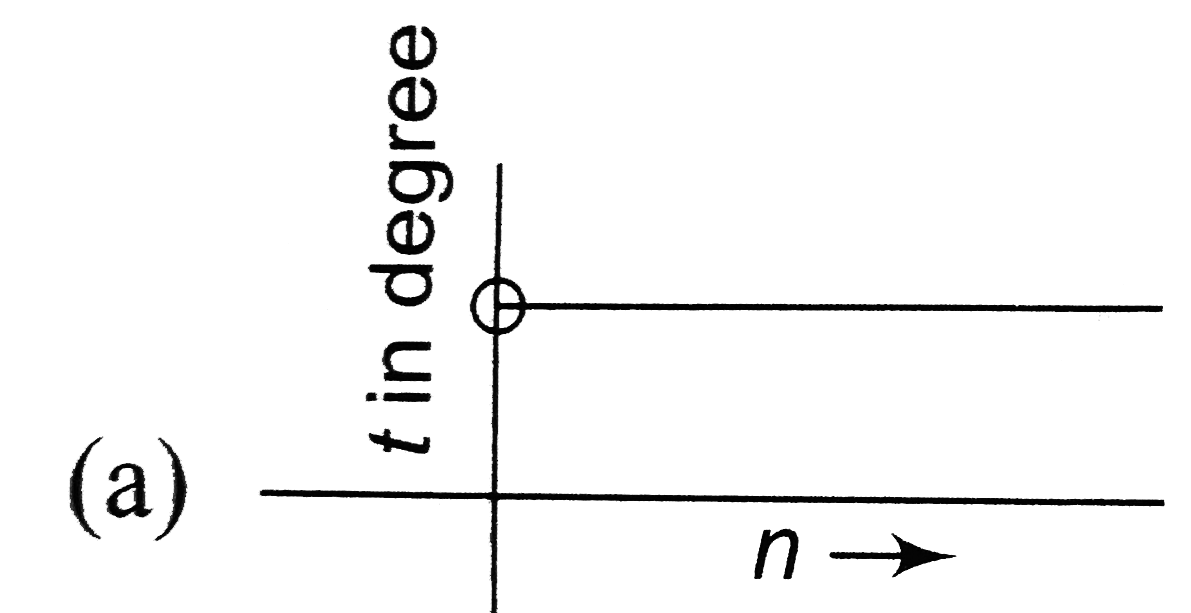
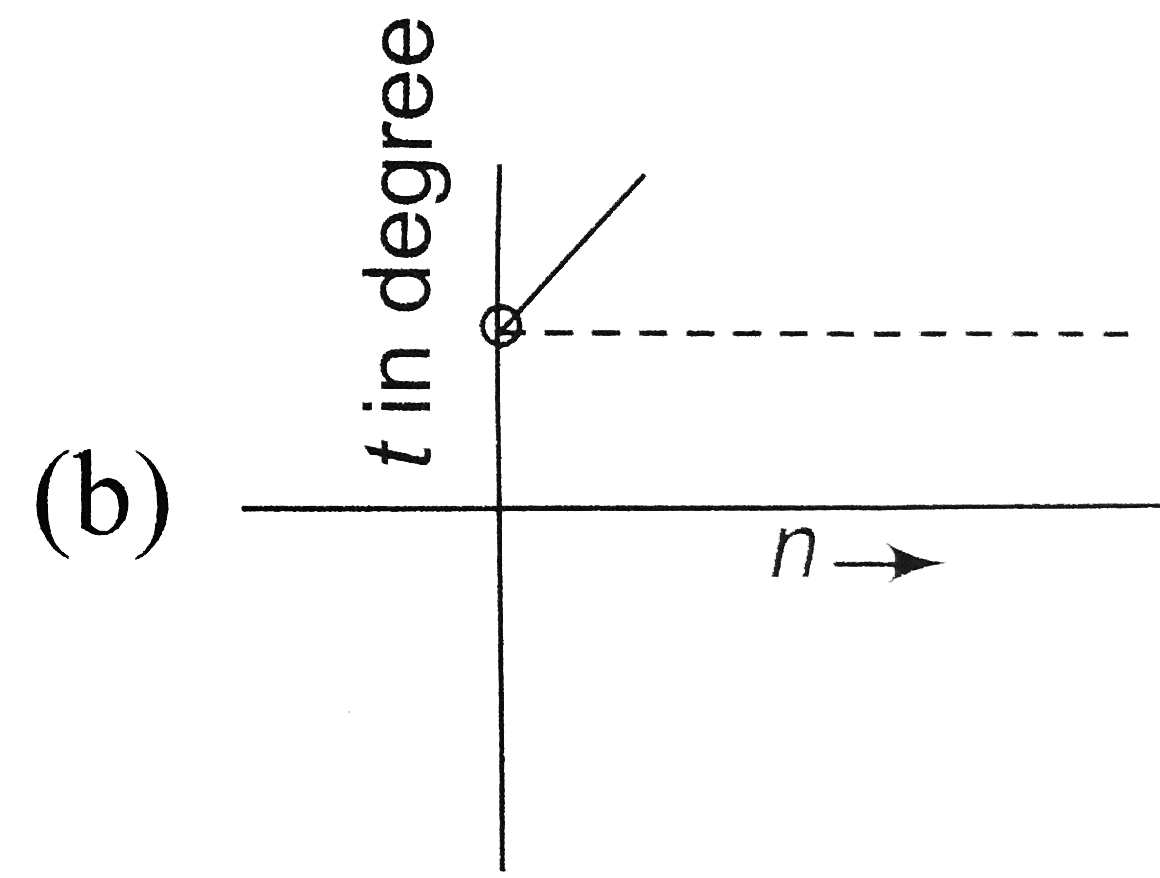
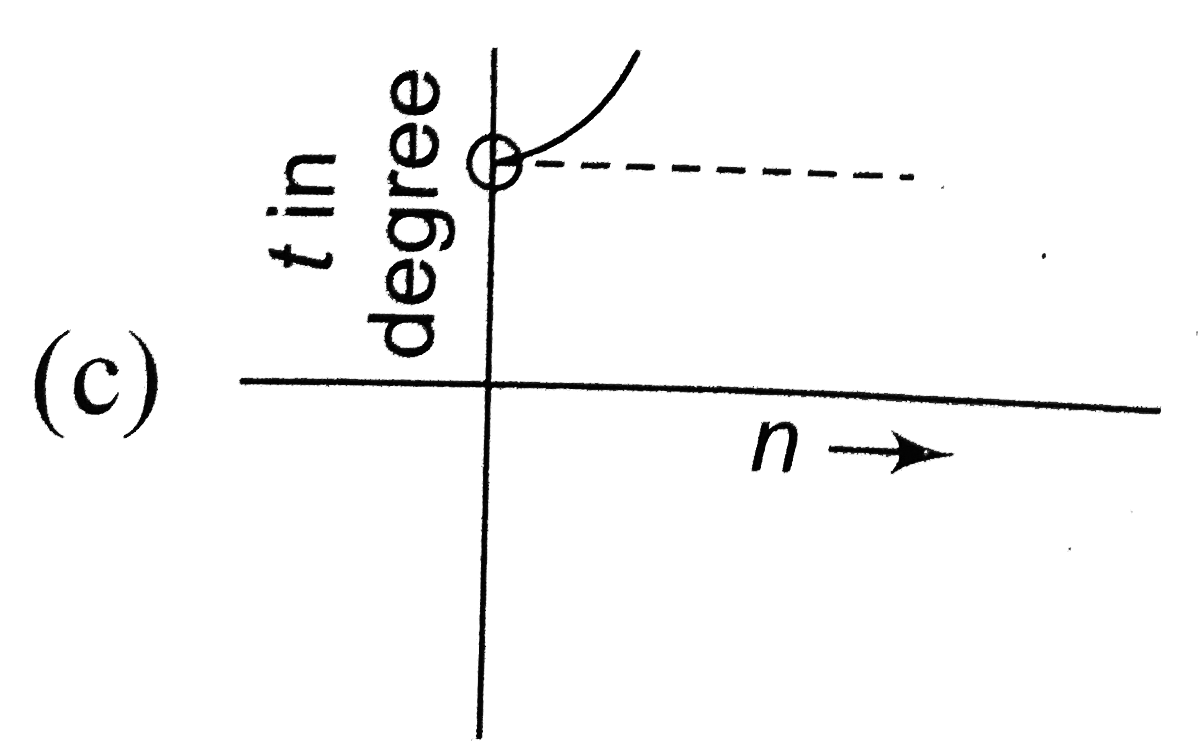
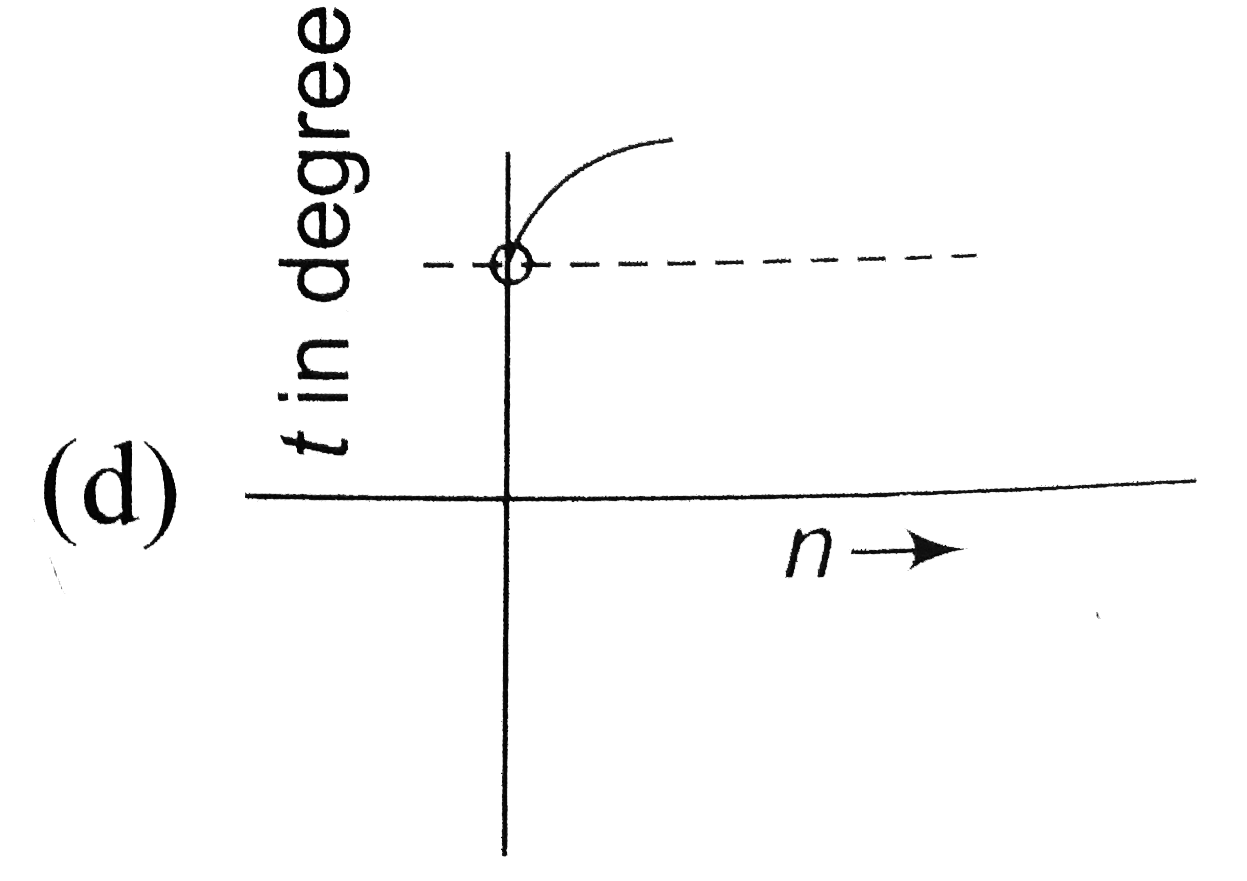
A slab `X` of thickness `'t'`, thermal conductivity `'K'` and area of cross-section `'A'` is placed in thermal contact with another slab `Y` which is `2n^(2)` times thicker, `4n` times conductive and having `n` times larger cross-section area. If the outside face of `X` is maintained at `100^(@)C`, the outside face of `Y` at `0^(@)C`, then the temperature of the junction is represented by the graph `(ngt0)`

A

B

C

D

Text Solution

Verified by Experts

The correct Answer is:

A

At equilibrium :`overset(.)(Q_(1))=overset(.)(Q_(2))`
`rArr (KA(t-0))/(l) = (4n k An(100-t))/(2n^(2)l) rArr t=200//3`.
Promotional Banner

Topper's Solved these Questions

  • THERMAL PROPERTIES OF MATTER

    A2Z|Exercise Transmission Of Heat : Radiation|28 Videos
  • THERMAL PROPERTIES OF MATTER

    A2Z|Exercise Problems Baesd On Mixed Concepts|18 Videos
  • THERMAL PROPERTIES OF MATTER

    A2Z|Exercise Calorimetry|41 Videos
  • ROTATIONAL DYNAMICS

    A2Z|Exercise Chapter Test|29 Videos
  • UNIT, DIMENSION AND ERROR ANALYSIS

    A2Z|Exercise Chapter Test|28 Videos

Similar Questions

Explore conceptually related problems

Two plates of same area are placed in contact. Their thickness as well as thermal conductivities are in the ratio 2:3 . The outer surface of one plate is maintained at 10^(@) C and that of the other at 0^(@) C. What is the temperature at the common surface?

Two rods having thermal conductivity in the ratio of 5 : 3 having equal lengths and equal cross-sectional area are joined by face to face. If the temperature of the free end of the first rod is 100^(@)C and free end of the second rod is 20^(@)C . Then temperature of the junction is

Two rods of material, x and two of y are connected as shown in the figure. All the rods are indentical in length and cross-sectional area. If the end A is maintained at 80^(@)C and the end D is maintained at 10^(@)C , calculate the temperature of the junctions B and C in the steady state. Thermal conductivity of x is double that of y .

A slab consists of two parallel layers of copper and brass of the same thichness and having thermal conductivities in the ratio 1:4 If the free face of brass is at 100^(@)C anf that of copper at 0^(@)C the temperature of interface is .

Seven identical rods of matrical of thermal conductivity k are connected as shown in All the rod are of identical length l and cross sectional area A if the one end b is kept at 100^(@)C and the other end is kept at 0^(@)C The temperatures of the junctions C,D and E(theta_(D)andtheta_(E)) be in the steady state .

The thermal conductivity of copper is four times that of brass. Two rods of copper and brass of same length and cross-section are joined end to end. The free end of copper rod is at 0^(@)C and that of brass rod at 100^(@)C . Calculate the temperature of junction at equilibrium. neglect radiation losses.

Two parallel plates A and B are joined together to form a compound plate . The thicknesses of the plate are 4.0cm and 2.5cm respectively and the area of cross section is 100cm^(2) for each plate. The thermal conductivities are K_(A)=200Wm^(-1) ^(@)C^(-1) for the palte B. The outer surface of the plate A is maintainned at 100^(@)C and the outer surface of the plate A is maintained at 100^(@)C . and the outer surface of the plate B is maintained at 0^(@)C. Find (a) the rate of heat flow through any cross section, (b) the temperature at the interface and (c) the equivalent thermal conductivity of the compound plate.

Three rods of the same dimensions have thermal conductivities 3 k , 2 k and k . They are arranged as shown, with their ends at 100^(@)C, 50^(@)C and 0^(@)C . The temperature of their junction is :-

Two slabs A and B of equal surface area are placed one over the other such that their surfaces are completely in contact The thickness and coefficient of thermal conductivities of slab A is twice that B The first surface of slab A is maintained at 100^(@) C while the second surface of slab B is maintained at 25^(@)C The temperature at the contact of their surfaces is .

A2Z-THERMAL PROPERTIES OF MATTER-Transmission Of Heat : Conduction
  1. If l is the length, A is the area of cross-section and K the thermal c...

    Text Solution

    |

  2. A wall has two layers A and B each made of different materials. The la...

    Text Solution

    |

  3. Two rods (one semi-circular and other straight) of same material and o...

    Text Solution

    |

  4. Two spheres of different materials one with double the radius and one-...

    Text Solution

    |

  5. A wall has two layers A and B each made of different materials. The th...

    Text Solution

    |

  6. A cylinder of radius R made of a material of thermal conductivity K1 i...

    Text Solution

    |

  7. Two ends of a conducting rod of varying cross-section are maintained a...

    Text Solution

    |

  8. One end of conducting rod is maintained at temperature 50^(@)C and at ...

    Text Solution

    |

  9. A wall has two layers A and B each made of different materials. Both t...

    Text Solution

    |

  10. Three rods made of the same material and having the same cross-section...

    Text Solution

    |

  11. All the rods have same conductance 'K' and same area of cross section ...

    Text Solution

    |

  12. Two identical long, solid cylinders are used to conduct heat from temp...

    Text Solution

    |

  13. Two identical rectangular rods of metal are welded end to end in serie...

    Text Solution

    |

  14. Figure shows in cross section a wall consisting of four layers with th...

    Text Solution

    |

  15. The temperature of the interface between layer 2 and 3 is:

    Text Solution

    |

  16. If layer thickness L(2) is 1.4 cm, then its thermal conductivity K(2) ...

    Text Solution

    |

  17. A cylinder A of a material of thermal conductivity K(1) is surrounded ...

    Text Solution

    |

  18. Ice starts forming in lake with water at 0^(@)C and when the atmospher...

    Text Solution

    |

  19. A slab X of thickness 't', thermal conductivity 'K' and area of cross-...

    Text Solution

    |

  20. The graph shown gives the temperature along an X axis that extends dir...

    Text Solution

    |
