Home
Class 11
PHYSICS
Three rods of identical cross-sectional ...

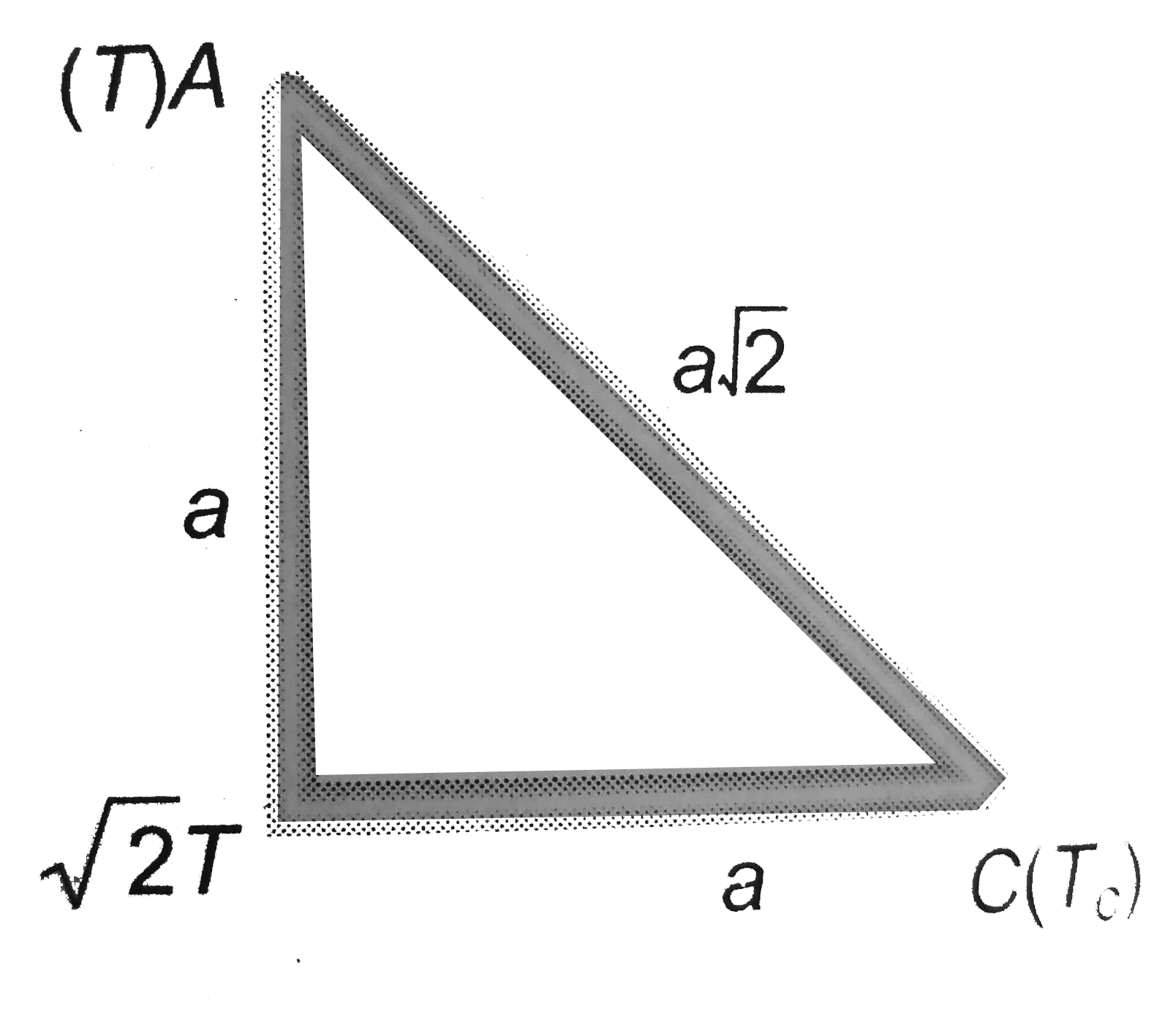
Three rods of identical cross-sectional area and made from the same metal from the sides of an isosceles triangle ABC, right-angled at B. The point A and B are maintained at temperatures T and `sqrt(2)` T respectively. In the steady state, the temperature of the point C is `T_c.` Assuming that only heat conduction takes places, `T_c//T` is

A

`(1)/((sqrt(2) + 1))`

B

`(3)/((sqrt(2) + 1))`

C

`(1)/(2(sqrt(2) - 1))`

D

`(1)/(sqrt(3) (sqrt(2) + 1))`

Text Solution

Verified by Experts

The correct Answer is:
B

`:. T_(B) gt T_(A)rArr` Heat will flow `B` to `A` via two paths (i) `B` to `A` (ii) and along `BCA` as shown.
Rate of flow of heat in path `BCA` will be same
i.e., `((Q)/(t))_(BC) = (Q/t)_(CA)`

`rArr (K(sqrt(2)T - T_(C))A)/(a) = (k(T_(C)-T)A)/(sqrt(2)a)`
`rArr (T_C)/(T) = (3)/(1+sqrt(2))`.
Promotional Banner

Topper's Solved these Questions

  • THERMAL PROPERTIES OF MATTER

    A2Z|Exercise AIIMS Questions|28 Videos
  • ROTATIONAL DYNAMICS

    A2Z|Exercise Chapter Test|29 Videos
  • UNIT, DIMENSION AND ERROR ANALYSIS

    A2Z|Exercise Chapter Test|28 Videos

Similar Questions

Explore conceptually related problems

Three rods of identical area of cross-section and made from the same metal from the sides of an isosceles triangle. ABC, right angled at B. The points A and B are maintained at temperatures T and sqrt 2T RESPECTIVELY. In the steady state the temperature of the point C is T_(C) . Assuming that only heat conduction takes place , T_(C) / T is equal to

Three rods of identical cross-sectional area and made from the same metal form the sides of an equilateral triangle ABC The points A and B are maintained at temperature sqrt3 T and T respectively In the steady state, the temperature of the point C is T_(C) Assuming that only heat conduction takes place, the value of T_(C)//T is equal to .

Three rods of identical cross-sectional area and made from the same metal form the sides of an insosceles triangle ABC right angled at B The pints A and B are maintained at temperatures T and sqrtT respectively in the steady state Assuming that only heat conduction takes place, temperature of point C is . .

Three rods of identical cross-sectional area and made from the same metal form the sides of an isosceles triangle ABC right angled at B as shown in the figure. The points A and B are maintained at temperature T and (sqrt2)T respectively in the steady state. Assuming that only heat conduction takes place, temperature of point C will be

Three rods of identical cross-sectional area and made from the same metal form the sides of an isosceles Delta ABC right angled at B. The points A and B are maintained at temperetures T and sqrt(2)T , respectively in the steady state. Assuming that only heat conduction takes place, temperature of point C is

Three rods of identical cross-sectional area and made from the same metal, from the sides of an isosceles triangle ABC right angled at B, as shown in Fig .7(CF).23. The points A and B are maintained at temperature T and sqrt(2)T respectively in the steady. Assuming that only heat conduction takes place, temperature of point C will be

Three rods of same cross sectional area are made of same material and form the sides of a right-angled isosceles triangle PQR, right angled at Q. P and Q are maintained at temperature T and 2T, respectively. If the temperature of end R is T', then what is the ratio of T'/T. Assume that only heat conduction takes place.

Four rods of identical cross-sectional area and made from the same metal form the sides of square. The temperature of two diagonally opposite points are T and sqrt( 2)T respectively in the steady state. Assuming that only heat conduction takes place, what will be the temperature difference between other two points

The three rods of same meterial and crosssectional area from the sides of a triangle ABC The points A,B and C are maintained at temperature T T sqrt2 and (3T)/((sqrt2 +1)) respectively Assuming that only heat conducting takes place the system is in steady state, find the angle at B The temperature difference per unit length along SB and CA is equal .

A2Z-THERMAL PROPERTIES OF MATTER-Chapter Test
  1. According to Newton's law of cooling, the rate of cooling of a body is...

    Text Solution

    |

  2. If the temperature of the sun were to increase form T to 2T and its ra...

    Text Solution

    |

  3. The temperature of the two outer surfaces of a composite slab consisti...

    Text Solution

    |

  4. A sphere a cube and thin circular plate, all made of the same material...

    Text Solution

    |

  5. A slab consists of two parallel layers of copper and brass of the time...

    Text Solution

    |

  6. A solid copper sphere (density rho and specific heat c) of radius r at...

    Text Solution

    |

  7. Two metallic spheres S1 and S2 are made of the same material and have ...

    Text Solution

    |

  8. Three rods of identical cross-sectional area and made from the same me...

    Text Solution

    |

  9. Two metal cubes A and B of same size are arranged as shown in Figure. ...

    Text Solution

    |

  10. The intensity of radiation emitted by the sun has its maximum value at...

    Text Solution

    |

  11. A spherical black body with a radius of 12 cm radiates 450 W power at ...

    Text Solution

    |

  12. A black body is at a temperature of 5760 K. The energy of radiation em...

    Text Solution

    |

  13. The plots of intensity versus wavelength for three black bodies at tem...

    Text Solution

    |

  14. An ideal Black-body at room temperature is thrown into a furnace. It i...

    Text Solution

    |

  15. Figure shows three temperature scales with the freezing and boiling po...

    Text Solution

    |

  16. A composite bar of length L = L(1) + L(2) is made up from a rod of mat...

    Text Solution

    |

  17. A rail track made of steel having length 10 m is clamped on a railway ...

    Text Solution

    |

  18. Assertion: According to Newton's law of cooling, the rate of loss of h...

    Text Solution

    |

  19. Assertion : In change of state from solid to liquid the temperature de...

    Text Solution

    |

  20. Assertion : A change in the temperature of a body cause change in dime...

    Text Solution

    |

