Home
Class 9
PHYSICS
Two particles are moving with constant s...

Two particles are moving with constant speed `v` such that they are always at a constant distance `d` apart and their velocities are always equal and opposite. After what time will they return to their initial positions ?

Text Solution

Verified by Experts
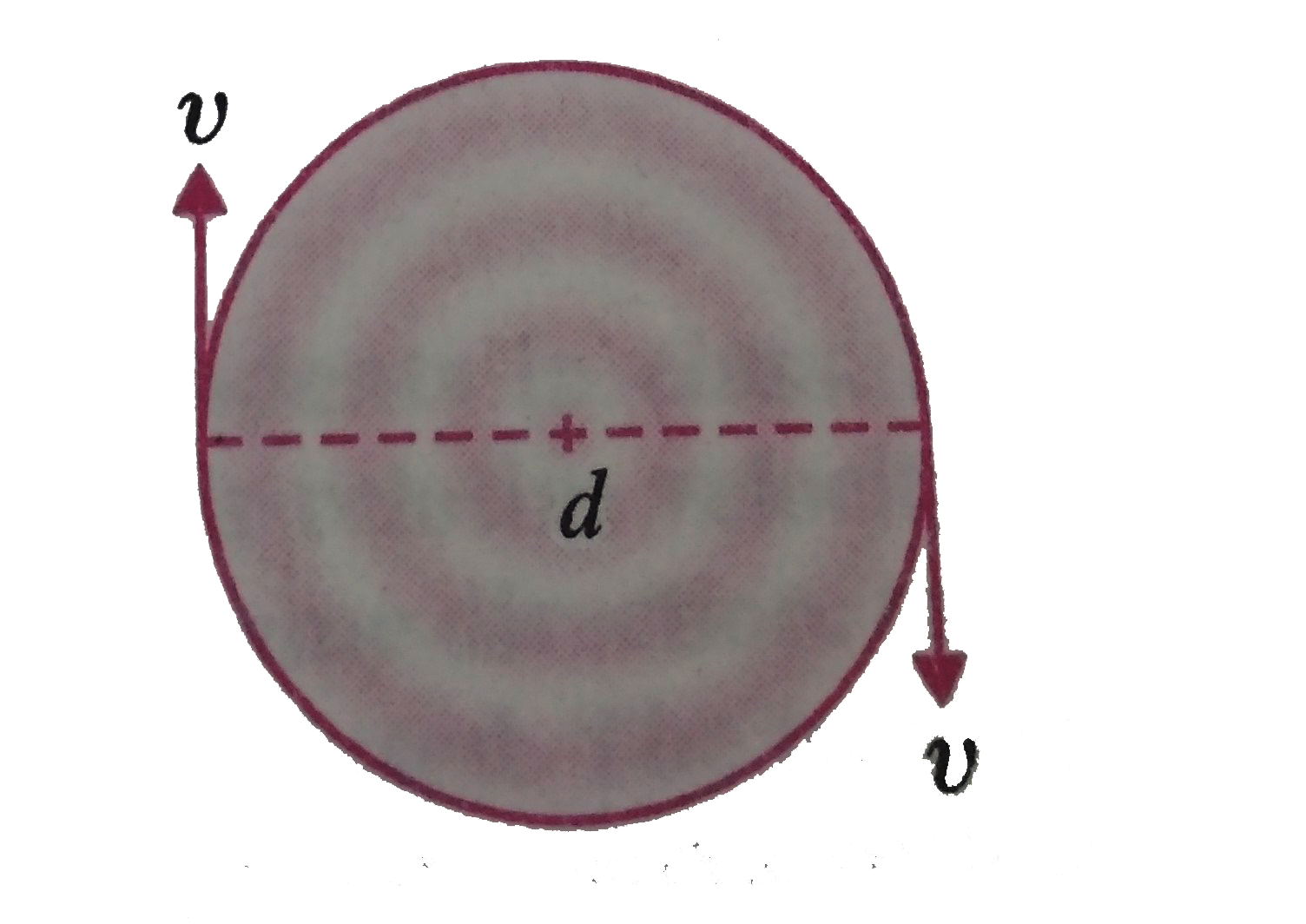
As the two particles moving with constant speeds are always at a constant distance `d`, they must be at the two ends of diameter of a circular path as shown in Figure. Each particle will return to its initial positon after completing the circular path `= 2pi r = pi d`
`"Time interval" = ("distance")/("speed") = (pi d)/(v)`
Promotional Banner

Topper's Solved these Questions

  • MOTION

    PRADEEP|Exercise value based question|4 Videos
  • MOTION

    PRADEEP|Exercise Problem for practice|32 Videos
  • MOTION

    PRADEEP|Exercise Short answer questions|9 Videos
  • GRAVITATION

    PRADEEP|Exercise Model Test paper (1)|36 Videos
  • SOUND

    PRADEEP|Exercise Model Test (sec - B)|12 Videos

Similar Questions

Explore conceptually related problems

If a particle is moving with a constant velocity, what is its acceleration?

A particle is moving with a constant speed v in a circle. What is the magnitude of average velocity after half rotation?

Four particles A, B, C and D are moving with constant speed v each at the instant shown relative velocity of A with respect to B, C and D are in directions

A particle is moving with constant speed v in xy plane as shown in figure. The magnitude of its angular velocity about point O is

Two bodies are moving with constant speed v clockwise and are initially diagonally opposite. The particle B now acheives a tangential acceleration of a m//s^(2) . Then :

A particle moves with constant speed v along a circular path of radius r and completes the circle in time T. The acceleration of the particle is

A circle of radius unity is centered at thet origin. Two particles tart moving at the same time from the point (1, 0) and move around the circle in opposite direction. One of the particle moves anticlockwise with constant speed v and the other moves clockwise with constant speed 3v. After leaving (1, 0), the two particles meet first at a point P, and continue until they meet next at point Q . The coordinates of the point Q are

A particle is moving with constant speed v along x - axis in positive direction. Find the angular velocity of the particle about the point (0, b), when position of the particle is (a, 0).

