Home
Class 9
PHYSICS
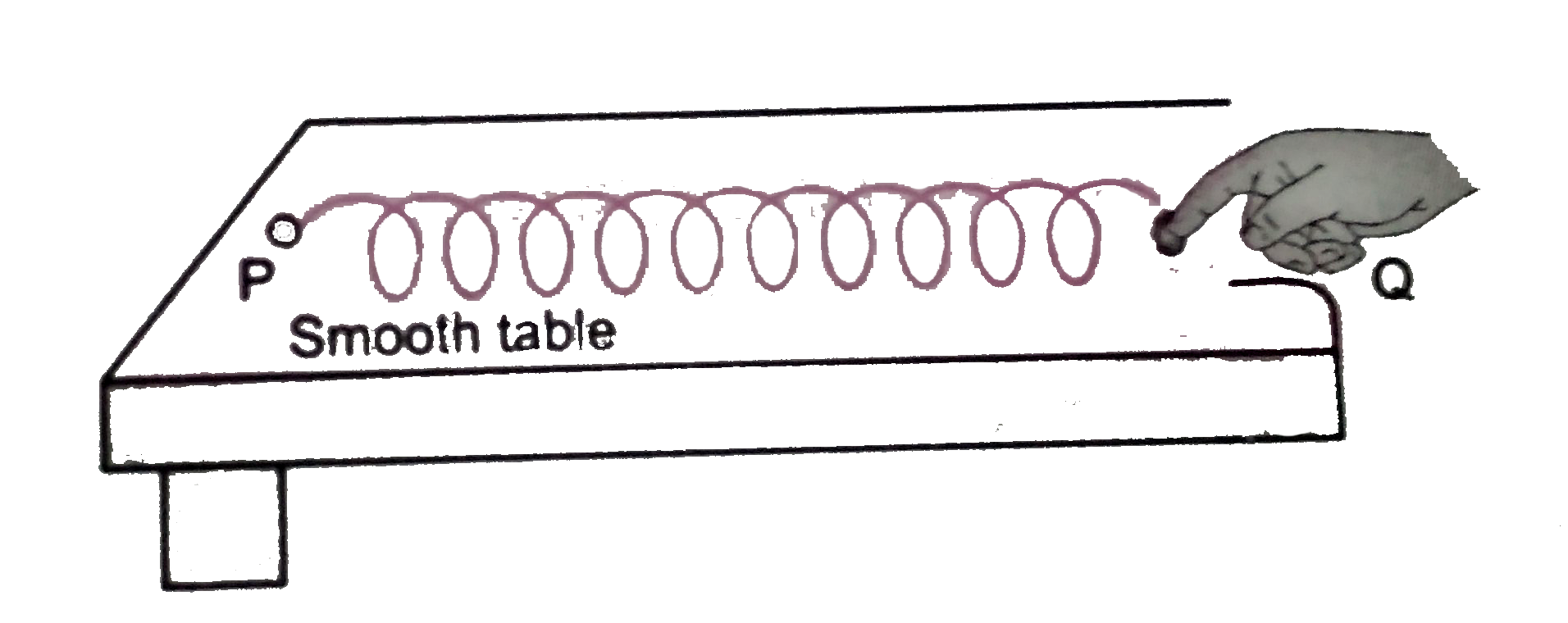
A student sets uo a slinky PQ on a smoot...

A student sets uo a slinky `PQ` on a smooth table top in the manner
How can he produce transverse waves in the slinky by moving its free end `Q` ?
.

A

at an angle of `45^@` with the table top

B

backward and forward along the length of the slinky

C

up and down

D

left and right.

Text Solution

Verified by Experts

The correct Answer is:

C
Promotional Banner

Topper's Solved these Questions

Similar Questions

Explore conceptually related problems

A string has a linear mass density mu . The ends of the string are joined to form a closed loop and is given the shape of a circular ring of radius R. this ring is now rotated about its axis with an angular velocity omega Q. The velocity of the transverse wave set up in the string, with respect to an observer at the centre of

A string has a linear mass density mu . The ends of the string are joined to form a closed loop and is given the shape of a circular ring of radius R. this ring is now rotated about its axis with an angular velocity omega Q. The velocity of a transverse wave set up in the string, with respect to the string is

When a particle is restricted to move along x-axis between x=0 and x=a , where alpha if of nenometer dimension, its energy can take only certain specific values. The allowed energies of the particle moving in such a restricted region, correspond to the formation of standing waves with nodes at its ends x=0 and x=a . The wavelength of this standing wave is related to the linear momentum p of the particle according to the de Broglie relation. The energy of the particle of mass m is related to its linear momentum as E=(p^2)/(2m) . Thus the energy of the particle can be denoted by a quantum number n taking values 1,2,3, ...( n=1 , called the ground state) corresponding to the number of loops in the standing wave. Use the model described above to answer the following three questions for a particle moving along the line from x=0 to x=alpha . Take h=6.6xx10^(-34)Js and e=1.6xx10^(-19) C Q. The speed of the particle that can take discrete values is proportional to

When a particle is restricted to move along x-axis between x=0 and x=a , where alpha if of nenometer dimension, its energy can take only certain specific values. The allowed energies of the particle moving in such a restricted region, correspond to the formation of standing waves with nodes at its ends x=0 and x=a . The wavelength of this standing wave is related to the linear momentum p of the particle according to the de Broglie relation. The energy of the particle of mass m is related to its linear momentum as E=(p^2)/(2m) . Thus the energy of the particle can be denoted by a quantum number n taking values 1,2,3, ...( n=1 , called the ground state) corresponding to the number of loops in the standing wave. Use the model described above to answer the following three questions for a particle moving along the line from x=0 to x=alpha . Take h=6.6xx10^(-34)Js and e=1.6xx10^(-19) C. Q. If the mass of the particle is m=1.0xx10^(-30) kg and alpha=6.6nm , the energy of the particle in its ground state is closest to

When a particle is restricted to move along x-axis between x=0 and x=a , where alpha if of nenometer dimension, its energy can take only certain specific values. The allowed energies of the particle moving in such a restricted region, correspond to the formation of standing waves with nodes at its ends x=0 and x=a . The wavelength of this standing wave is related to the linear momentum p of the particle according to the de Broglie relation. The energy of the particle of mass m is related to its linear momentum as E=(p^2)/(2m) . Thus the energy of the particle can be denoted by a quantum number n taking values 1,2,3, ...( n=1 , called the ground state) corresponding to the number of loops in the standing wave. Use the model described above to answer the following three questions for a particle moving along the line from x=0 to x=alpha . Take h=6.6xx10^(-34)Js and e=1.6xx10^(-19) C. Q. The allowed energy for the particle for a particular value of n is proportional to

A chain (AB) of length l loaded in a smooth horizontal table so that its fraction of length h hangs freely and toucher the surface of the table with its end B. At a certain moment ,the end A of the chain is set free. With what velocity will this end the chain slip out of the table ? .

A wheel of rdius r and moment of inertia I about its axis is fixed at top of an inclined plane of inclination theta as shownin figure. A string is wrapped round the wheel and its free end supports a block of mass M which can slide on the plane. INitialy, tehwheel is rotating at a speed omega in direction such that the block slides pu the plane. How far wil the block move before stopping?

A particle of mass m is attached to one end of a weightless and inextensible string of length L. The particle is on a smooth horizontal table. The string passes through a hole in the table and to its other and is attached a small particle of equal mass m. The system is set in motion with the first particle describing a circle on the table with constant angular velocity omega_(1) and the second particle moving in the horizontal circle as a conical pendulum with constant angular velocity omega_(2) Show that the length of the portions of the string on either side of the hole are in the ratio omega_(2)^(2): omega_(1)^(2)

PRADEEP-SOUND-(Assessment) Multiple choice
  1. While doing experiment on verifying the laws of reflection of sound, f...

    Text Solution

    |

  2. A laboratory had the folowing apparatus available in it : (A) Two th...

    Text Solution

    |

  3. Four students did their experiments on measuring the speed of a pulse ...

    Text Solution

    |

  4. Which of the following statements is incorrect ?

    Text Solution

    |

  5. Ultrasound waves are those waves :

    Text Solution

    |

  6. Which of the following frequencies is audible to human beings ?

    Text Solution

    |

  7. An observer standing at the sea coast observes 54 waves reaching the c...

    Text Solution

    |

  8. When a sound wave goes from air into water, the quantity that remains ...

    Text Solution

    |

  9. The wavelength of an ultrasonic wave is :

    Text Solution

    |

  10. The frequency of a man's voice is 200 Hz and its wavelength is 2 m. If...

    Text Solution

    |

  11. A sound of frequency 5 Hz.

    Text Solution

    |

  12. The distance from crest to crest of any wave is :

    Text Solution

    |

  13. The speed of sound waves having a frequency of 256 Hz compared with th...

    Text Solution

    |

  14. A sound wave of wavelength 90 cm in glass is reflected into air. If th...

    Text Solution

    |

  15. The distance between two consecutive crests in a wave train produced i...

    Text Solution

    |

  16. A boat at anchor is rocked by waves whose crests are 100 m apart and w...

    Text Solution

    |

  17. The waves produced by a motor boat sailing in water are :

    Text Solution

    |

  18. Which one of the following statement is correct ?

    Text Solution

    |

  19. In a rope or a slinky :

    Text Solution

    |

  20. A student sets uo a slinky PQ on a smooth table top in the manner How...

    Text Solution

    |
