Home
Class 11
PHYSICS
A man can swim at the rate of 5 kmh^(-1)...

A man can swim at the rate of `5 kmh^(-1)` in still water A. One km wide river flows at the rate of ` 3 kmh^(-1)` . The man wishes to swim across the river directly opposite to the starting point. How much time will be take to cross the river

Text Solution

Verified by Experts
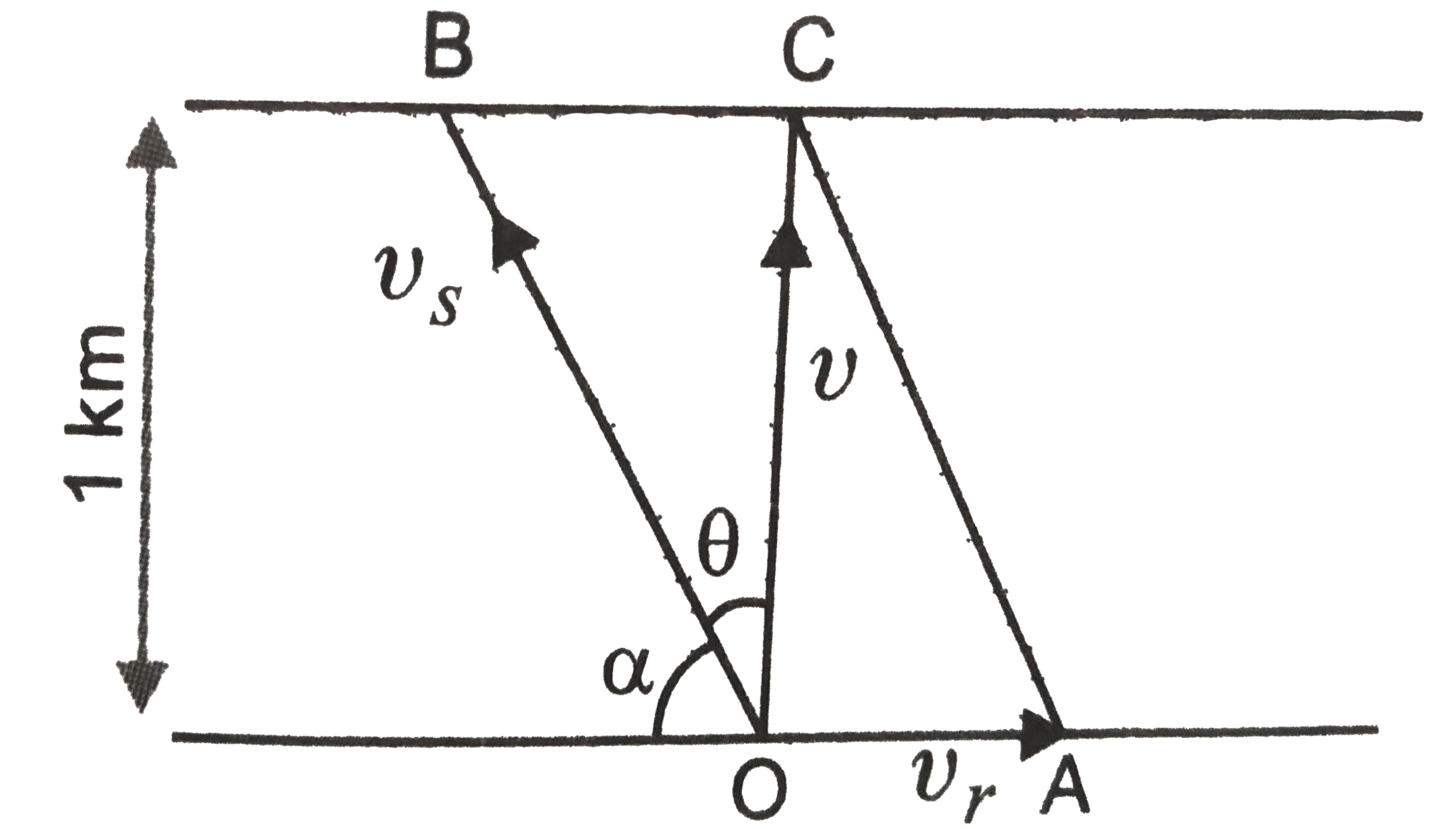
Given, width of rivet ` =1 km`.
Velocity of swimmer, ` v_s = 5 km//h , Velocity of water flowing in river, ` v_r =3 km h^(-1)` along ` OA`.
(a) The swimmer will cross straight if the resultant velocity of river flow and swimmer acts perpendicular to the dierction of river flow i.e. along ` OC`. It will be so if swimmer moves making an angle ` alpha` with upstream i.e. goes along ` OB` Refer to Fig. 2 (c ) . 48. Here, theta _ alpha= 90^@ or theta = (90^@ -alpha) `
.
In ` Delta OBC, sin theta = sin ( 90^@-alpha)`
`= cos alpha = (BC)/(OB) = v_r/v_s = 3/5 = 0.6`
or ` cos alpha = cos 53^@ 8'`
or ` alpha =53^@ 8'` upstream.
(b) Let (v) be the resultant velcity along ` OC`, then
` v = sqrt 9 v-s ^2 -v_r ^20 = sqrt 5^2-3^2) = 4 km//h`
(c ) Time taken by swimmer to cross the river is
` t = (1 km)/( 4 km //h) = 1/4 h =15 minutes.
Promotional Banner

Topper's Solved these Questions

  • KINEMATICS

    PRADEEP|Exercise 4 SolvedExamples|31 Videos
  • KINEMATICS

    PRADEEP|Exercise 1 Conceptual Problems|2 Videos
  • KINEMATICS

    PRADEEP|Exercise 2 SolvedExamples|31 Videos
  • GRAVIATION

    PRADEEP|Exercise Assertion-Reason Type Questions|19 Videos
  • LAWS OF MOTION

    PRADEEP|Exercise Assertion- Reason Type Questions|17 Videos

Similar Questions

Explore conceptually related problems

A man can swim at the rate of 5 km h^-1 in still water. A 1 - km wide river flows at the rate of 3 km h^-1 The man wishes to swim across the river directly opposite to the starting point. (a) Along what direction must the man swim ? (b) What should be his resultant velocity ? ( c) How much time will he take to cross the river ?

A man wishes to swim across a river 0.5km. wide if he can swim at the rate of 2 km/h. in still water and the river flows at the rate of 1km/h. The angle (w.r.t. the flow of the river) along which he should swin so as to reach a point exactly oppposite his starting point, should be:-

A river 600 m wide wide flows at the rate of 8 km h^(-1). Still water, wishes to cross the river straight (i) Along what direction must be strike ? What will be his resultant velcity ? (ii) How much time he will take to cross the river ?

A man can swim with a speed of 4kmh^(-1) in still water. He crosses a river 1km wise that flows steadly at 3kmh^(-1) . If he makes his strokes normal to the river current, how far down the river does he go when he reaches the other bank?

A man can swim at a speed of 3 km h^-1 in still water. He wants to cross a 500-m wide river flowing at 2 km h^-1 . He keeps himself always at an angle to 120^@ with the river flow while swimming. The time taken to cross the river is.

A man can swim at a speed of 3 km/h in still water. He wants t cross a 500 m wide river flowing at 2 km/h. He flow at an angle of 120 with the river flow while swimming. A. Find the time he takes to cross the river. b.At what point on the opposite bank will he arrive?

A boatman can row with a speed of 10 kmh^(-1) in still water. River flows at 6 km h^(-1) . If he crosses the river from one bank to the other along the shortest possible path, time taken to cross that river of width 1 km is

A man can swim at a speed of 5km//h in the still water. He wants to cross a 1600m wide river flowing at 4 km//h . He keeps himself at an angle 127^(@) with the river flow while swimming. (a) Find the time he takes to cross the river. (b) Find the distance traveled by him along the flow.

A boat man can rown with a speed of 10 km h^(-1) in still water. If the river flows steadily at 5 km //h , in which direction showld the boatman row in order to reach a point on the other bank directly opposite to the point from wher he stared ? The width of the river is 2km .

A ,man wishing to cross a river flowing with velocity u jumps at an angle theta with the river flow. (a) Find the net velocity of the man with respect to ground if he can swim with speed v in still water. (b) In what direction does the boat actually move ? ( c) Find how far from the point directly opposite to the starting point does the boat reach the opposite bank, if the width of the river is d .

PRADEEP-KINEMATICS-3 SolvedExamples
  1. The sum of the magnitudes of two forces acting at a point is 18 and th...

    Text Solution

    |

  2. A person rows a boat in a water with a speed of 4 ms^(-1). Water in th...

    Text Solution

    |

  3. A man can swim at the rate of 5 kmh^(-1) in still water A. One km wide...

    Text Solution

    |

  4. A river 600 m wide wide flows at the rate of 8 km h^(-1). Still water,...

    Text Solution

    |

  5. Derermine the horizontal force required to displace a mass of 0.03 kg ...

    Text Solution

    |

  6. The position of of a particle is given by vec r =3.0 t hat I + 2.0 t^(...

    Text Solution

    |

  7. Rain is falling vertically with a speed fo 35 ms^(-1). Winds starts bl...

    Text Solution

    |

  8. A car travelling at a speed of 30 ms^(-1) due north along the highway ...

    Text Solution

    |

  9. Rain is falling vertically with a speed fo 35 ms^(-1). Winds starts bl...

    Text Solution

    |

  10. To a person going westwards with a speed of 6 km h^(-1), rain appears ...

    Text Solution

    |

  11. A train is moving due East and a car is moving due North, both with th...

    Text Solution

    |

  12. A person standing on a road has to hold his umbrella at 60^(0) with th...

    Text Solution

    |

  13. To a person going East in a car with a velocity of 50 km h^(-1), a bus...

    Text Solution

    |

  14. A tran is moving with a velcoty 72 km h^(-1) in the Noth-East directio...

    Text Solution

    |

  15. A force is inclened at 60 ^(@) to the horizontal . If its horizontal c...

    Text Solution

    |

  16. A ball is acted upon by the following velocities. (i) 3 ms^(-1) due Ea...

    Text Solution

    |

  17. What is the distance travelled by a point during the time oita if it m...

    Text Solution

    |

  18. Give vrc A =2 jati -hatj+3 hat k and vec B =3 hat I -2 hat j -2 hat k...

    Text Solution

    |

  19. A vector vec C when added to the resultant of the vectors vec A = 3 ha...

    Text Solution

    |

  20. If vec A =3 hat I + 4 hat j and vec B =7hat I + 14 hat j, find a vect...

    Text Solution

    |

