Home
Class 11
PHYSICS
The distance coverd by an object between...

The distance coverd by an object between times ` t_(1) and t_(2)` is given by the area under the ` v-t` gaph between ` t_(1) and t_(2)` Prove this staement for an object moving with negative acceleration and gaving and having a positive velocity at time ` t_(1) and and negative velocity at time `t_(2)`.

Text Solution

Verified by Experts
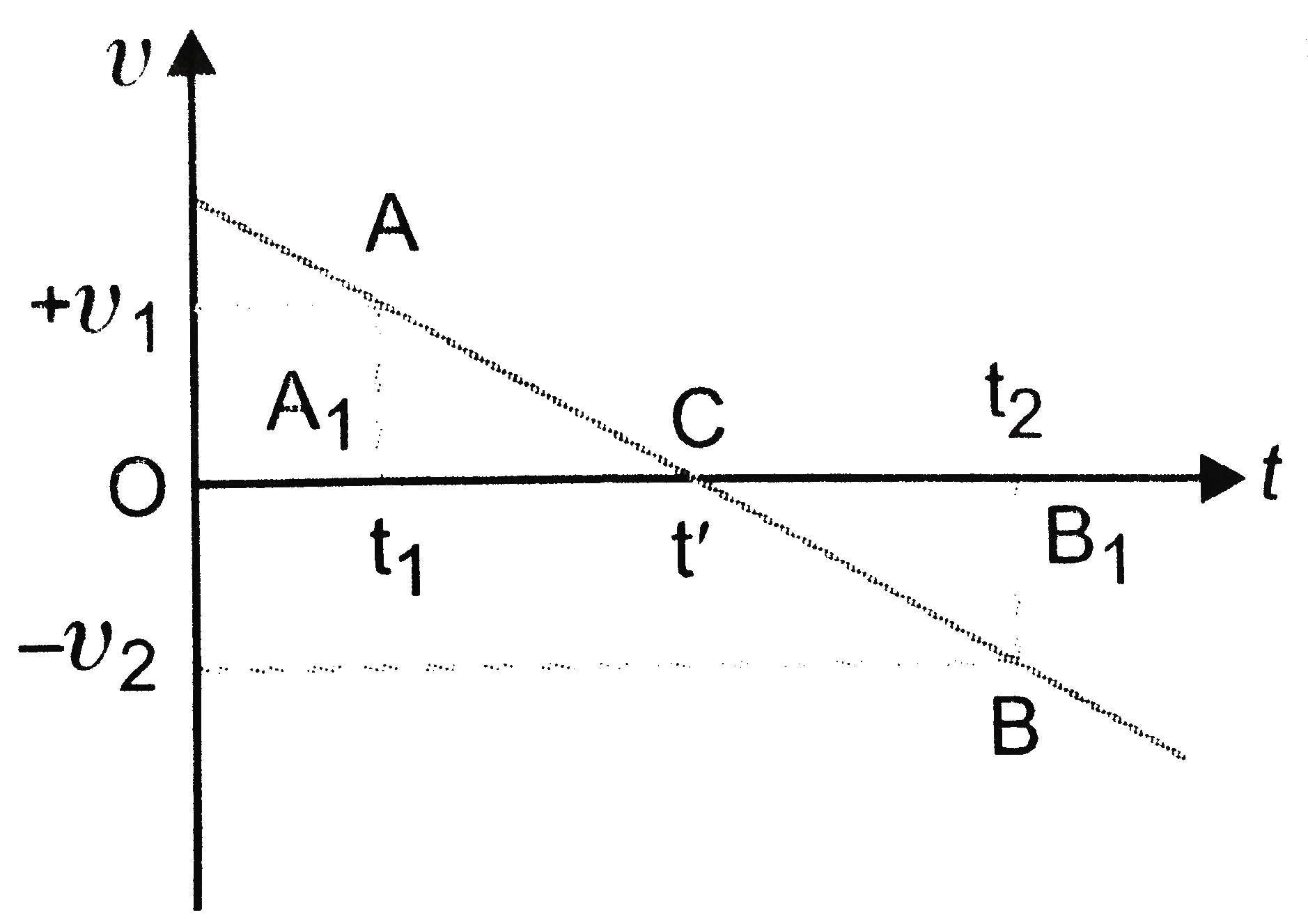
The velocity-time graph for the motion of object as per question is shown in Fig. 2 (b) . 28 . Let ` v_(1) be the velocity of object at time ` T_(1) and -v_(2) ` be the velocity of object at time ` t_(2)`.
.
Let (S) be the distance travelled in between timings ` t_(1) and t_(2)`. Let `C` be a point on the straight line ` AB`, where the graph cuts the time axis and (t') be the time corresponding to point ` C`.
Area under the ` u-t`grapg b between timings `t_(1)` and `t_(2)` is
A =area ` AA_1 C + area CBB_1`
`= 1/2 A_1 C xx AA_1 + 1/2 CB_1 xx BB_1`
`= 1/2 (t' -t') xx v-1 + 1/2 (_2 -t') xx (-v_2)`
`= 1/2 v_1 (t' -t_1) - 1/2 v-2 (t _2 - t')` ...(i)
We know that the acceleration (a) of an object is equal to the slope of ` v-t` graph. Taking slope the ` v-t` graph betweem the points ` A and C` , we have
` a= (velocity at t'-velocity at t_1)/(t'-t_1)`
`= (o-v_1)/(t'-t') =- v_1/(t'-t_1) or t' -t =- v_1/a`
Slope of ` v-t` graph between the points ` B and C`, we have
` a= (velocity at t'-velocity at t_')/(t_2-t')`
` = (-v_2)-0)/9t_2 -t' ) =- v_2/(t_2 -t') or t_2 -t' =- v_2/a`
Pittomg tje va,ies in (i), we get
` A= 1/2 v_1 (- v_1/a) - 1/2 v_2 (- v_2/a)`
`=- v_1^2/(2 a) + v_2^2/(2 a) = (v_2^2-v_1^2)/92 a) = (2 a S) /(2 a) =S`
Hence area under ` v-t` graph between timings ` t_1 and t_2` is equal to the distance coverd by object between timings ` t_1 and t-2`.
Promotional Banner

Topper's Solved these Questions

  • KINEMATICS

    PRADEEP|Exercise 3 Short answer|37 Videos
  • KINEMATICS

    PRADEEP|Exercise 4 Short answer|30 Videos
  • KINEMATICS

    PRADEEP|Exercise 1 Short answer|25 Videos
  • GRAVIATION

    PRADEEP|Exercise Assertion-Reason Type Questions|19 Videos
  • LAWS OF MOTION

    PRADEEP|Exercise Assertion- Reason Type Questions|17 Videos

Similar Questions

Explore conceptually related problems

Time taken by an object falling from rest to cover the height of h_(1) and h_(2) is respectively t_(1) and t_(2) then the ratio of t_(1) to t_(2) is

Velocity is given by v=4t(1-2t), then find time at which velocity is maximum

A body is moving with variable acceleartion (a) along a straight line. The average acceleration of body in time interval t_(1)" to "t_(2) is :-

If displacement S at time t is S=-t^(3)+3t^(2)+5 , then velocity at time t=2 sec is

Force is given by F = F_0(1-((T-t)/T)^2) mass = m, velocity after time 2T

A particle move with velocity v_(1) for time t_(1) and v_(2) for time t_(2) along a straight line. The magntidue of its average acceleration is

Each of the three graphs represents acceleration versus time for an object that already has a positive velocity at time t_1 . Which graphs show an object whose speed is increasing for the entire time interval between t_1 and t_2 ?

PRADEEP-KINEMATICS-2 Short answer
  1. Two straight lines drawn on the same velocity-time graph make anles 3...

    Text Solution

    |

  2. Points P, Q and R are in vertical line such that PQ =QR. A ball at (...

    Text Solution

    |

  3. A ball is released from the top of a tower of height h metre. It takes...

    Text Solution

    |

  4. What do the slopes of distance-time and velocity-time graphs represen...

    Text Solution

    |

  5. What type of velocit-time graph will you get, for a unitormly accelera...

    Text Solution

    |

  6. How can one determine (i) the distance (ii) the displacement coverd by...

    Text Solution

    |

  7. The distance coverd by an object between times t(1) and t(2) is given...

    Text Solution

    |

  8. An electron starting from rest has a velocity that increase linearly w...

    Text Solution

    |

  9. In a case of a motion, displacement is directly proportional to the sq...

    Text Solution

    |

  10. If the velocity of a particle is given by v=(180-16x)^((1)/(2))(m)/(s)...

    Text Solution

    |

  11. The distance traversed by a moving particle at any instant is half of ...

    Text Solution

    |

  12. The acceleration of a particle, starting from rest, varies with time a...

    Text Solution

    |

  13. A particle exeriences constant acceleration form 20 seconds after str...

    Text Solution

    |

  14. An onject is thrown vertically upward with some speed. It crosses 2 p...

    Text Solution

    |

  15. A car, starting from rest, accelerates at the rate (f) through a dista...

    Text Solution

    |

  16. Define and explain the term acceleration . Derive the velocity-time re...

    Text Solution

    |

  17. Find the distance travelled by by the uniformly acclerated object movi...

    Text Solution

    |

  18. Draw velocity-time graph of a uniformly accelerated in one dimension a...

    Text Solution

    |

  19. From the velocity-time graph of uniformaccelerated motion deduce the e...

    Text Solution

    |

  20. Descuss the motion of an object under free fall and draw (a) accelerat...

    Text Solution

    |

