Home
Class 11
PHYSICS
Motion in two dimensions, in a plane can...

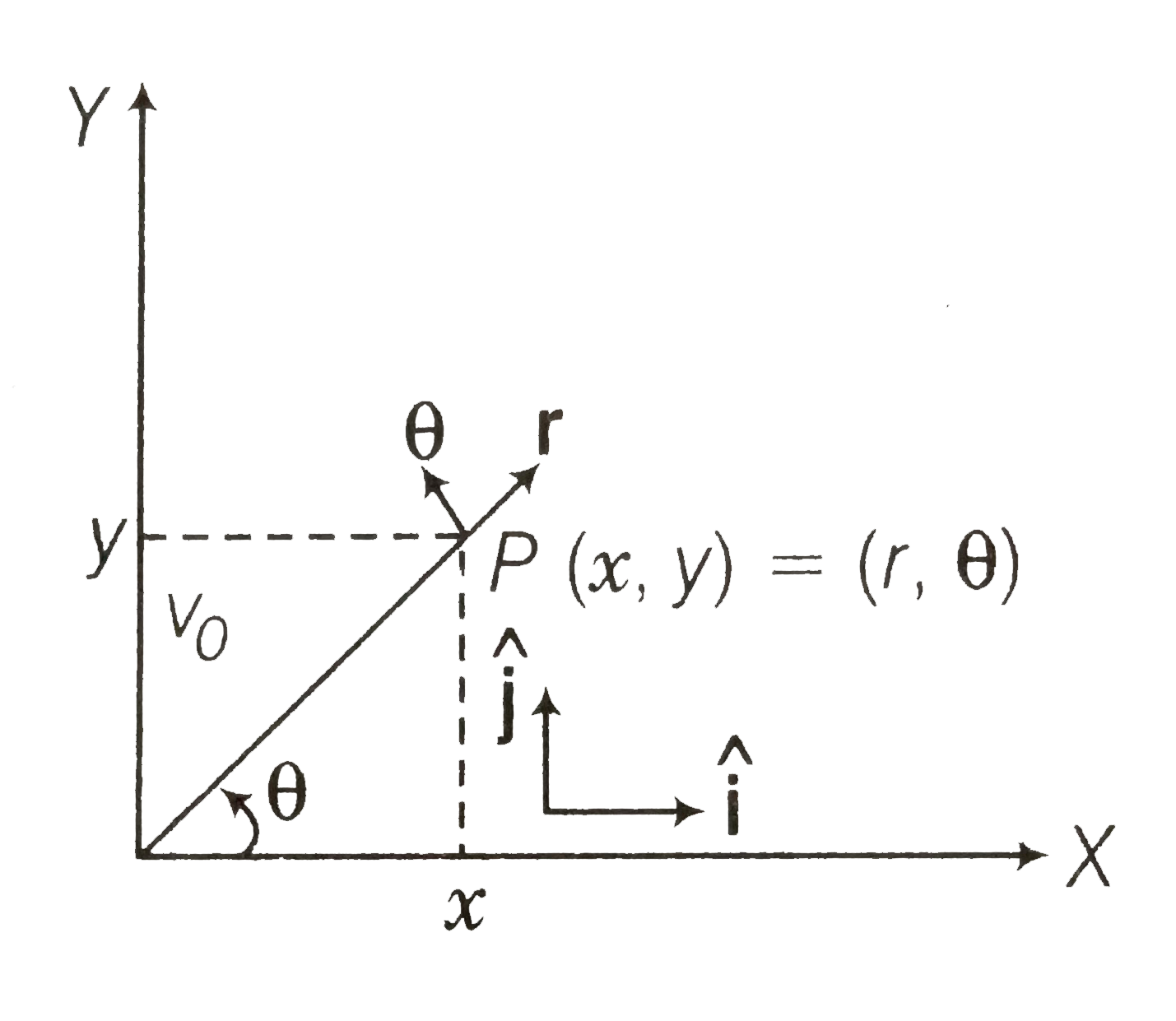
Motion in two dimensions, in a plane can be studied by expressing position, velocity and acceleration as vectors in cartesian coordinates `A=A_(x)hat(i) + A_(y)hat(j)`, where `hat(i)` and `hat(j)` are unit vector along x and y-directions, respectively and `A_(x)` and `A_(y)` are corresponding components of A. Motion can also be studied by expressing vectors in circular polar coordinates as `A= A_(r)hat(r) + A_(theta) hat(theta)`, where `hat(r)=(r)/(r)=cos theta hat(i)+sin theta hat (j)` and `hat(theta)=-sin theta hat(i) + cos theta hat (j)` are unit vectors along direction in which r and `theta` are increasing.
(a) Express `hat(i)` and `hat (j) ` in terms of `hat(r) ` and `hat (theta)`.
(b) Show that both `hat(r)` and `hat(theta)` are unit vectors and are perpendicular to each other.
(c) Show that `(d)/(dt)(hat(r))= omega hat(theta)`, where `omega=(d theta)/(dt)` and `(d)/(dt) (hat(theta))=-thetahat(r)`.
(d) For a particle moving along a spiral given by `r=a theta hat(r)`, where a = 1 (unit), find dimensions of a .
(e) Find velocity and acceleration in polar vector representation for particle moving along spiral described in (d) above.

Text Solution

Verified by Experts

(a) ` hat r = cos theta + sin theta jhat j`
` hat theta =- sin theta hat I + cos atheta hat j` ….(i)
Multipluing (i) by ` sin theta ` and (ii) with ` cos theta ` and adding, we get ….(ii)
` hat e =- sin theta + hat theta cos hteta = (sin^2 theta + cos^@ theta ) hat j = hat j` or hat r sin theta + hat theta cos theta = hat j` ....(iii)
Mjultiplying (i) by cos theta and (ii) b y sin theta and subtracting, we get ` ltbr. ( hat r cos theta - hat theta sin theta ) = hat i` ....(iv)
(b) ` hat i. hat theta = ( hat i + sin theta hat j). (- sin theta hat i + cos theta hat j)`
(1) (1)` cos theta =- cos theta sin theta + sin theat cos theta =0= cos 90^@` or ` theta = 90^@`
(c ) d/( dr) hat r) = d/(dr) cos theta hat i _+ sin theta hat j) =- sin theta (d theta)/(dt) hat i cos tehta (d theta )/(dt) hat i + cos theta (dtheta )/(dt) hat j = omega [- sin hat i + cos theta hat j ] = omega hat i theta` ltBrgt (d) ` vec r = alpha theta hat r ` or ` | vec r | = alpha theta ` or alpha = (|vec r|)/(theta)`
Dimensions of ` alpha L/1 = L = [M^0 L^1 T^0 ]` ltBrgt (E) Given, ` alpha =1 ` unit, from above, we have ` vec r = theta hat r = theta [ cos theta hat i + sin theta hat j]`
velocity , ` vec r = (d vec r)/(dt) = ( d theta )/( dt) vec r + theta [ - sin theta hat i + cos theta hat j] ( d theta)/(dt) vec r + theta hat i theta omega` [ :. (d theta )/(dt) = moega]`
` omega hat r + omega hat theta `
Accelration, ` vec a = d/ (dt) [ omega theta hat theta ] = d/(dt) [ (d theta )/(dt) xx ( theta hat theta) ] = ( d^2 theta )/( dt^2) hat r + (d theta )/(dt) (d hat r)/(dt) + (d^2 theta )/( dt^2) xx (d theta )/(dt) d/(dt) ( theta hat theta)`
` = (d^2 theta )/(st^@) hat r + omega d/(dt) [ cos theta hat i + sin theta hat j ] + (d^2 theta )./( dt^2) theta hat theta + omega d/(dt) ( theta hat theta)`
`= (d^2 thea)/(dt^2) hat r omega [- sin heta hat i + cis theta hat j ] (d theta )/( dt) + (d^2 theta )/( dt^2) theta hat theta + omega [(dtehta )/(dt) hat theta + theta )d hat theta)/(dt)]`
` = (d^2 theta )/( dt^2 ) hat r + omega 2 hat theta + (d^2 theta )/(dt^2) xx theta hat theta + omega ^2 hat theta + omega^2 theta (- hat e)` `[ :. (d hat theta) /(dt) =- omega hat r]`
` =(d^2 theta )/(dt^2) - omega ^2 theta ) hat r + (2 omega^2 + (d^2 theta )/(dt^2) theta )hat theta`.
Promotional Banner

Topper's Solved these Questions

  • KINEMATICS

    PRADEEP|Exercise Advanced Problems|20 Videos
  • KINEMATICS

    PRADEEP|Exercise NCRT Exercises|22 Videos
  • KINEMATICS

    PRADEEP|Exercise 5 Long answer (NCERT)|4 Videos
  • GRAVIATION

    PRADEEP|Exercise Assertion-Reason Type Questions|19 Videos
  • LAWS OF MOTION

    PRADEEP|Exercise Assertion- Reason Type Questions|17 Videos

Similar Questions

Explore conceptually related problems

The angle which the vector vec(A)=2hat(i)+3hat(j) makes with the y-axis, where hat(i) and hat(j) are unit vectors along x- and y-axis, respectively, is

The vector (hat i +hat j) is a unit vector.

The unit vector along hat(i)+hat(j) is

If hat(i), hat(j), hat(k) are the unit vectors and mutually perpendicular, then [[hat(i), hat(j), hat(k)]] =

If hat i and hat j are unit vectors along X - and Y -axis respectively,then what is the magnitude and direction of hat i+hat j and hat i-hat j?

Given, two vectors are hat(i)-hat(j) and hat(i)+2hat(j) , the unit vector coplanar with the two vectors and perpendicular to first is

If hat(i), hat(j) and hat(k) are unit vectors along x,y and z-axis respectively, the angle theta between the vector hat(i) + hat(j) + hat(k)" ""and vector" hat(j) is given by

Vectors which is perpendicular to ( a cos theta hat (i) + b sin theta hat(j)) is

If hat i and hat j are unit vectors along mutually perpendicular directions then the magnitude of hat i- hat j is :
