Home
Class 11
PHYSICS
A hemispherical bowl of radius R is set ...

A hemispherical bowl of radius R is set rotating about its axis of symmetry which is kept vertical. A small block kept in the bowl rotates with the bowl without slipping on its surface. If the surfaces of the bowl is smooth, and the angle made by the radius through the block with the vertical is `theta`, find the angular speed at which the bowl is rotating.

Text Solution

Verified by Experts
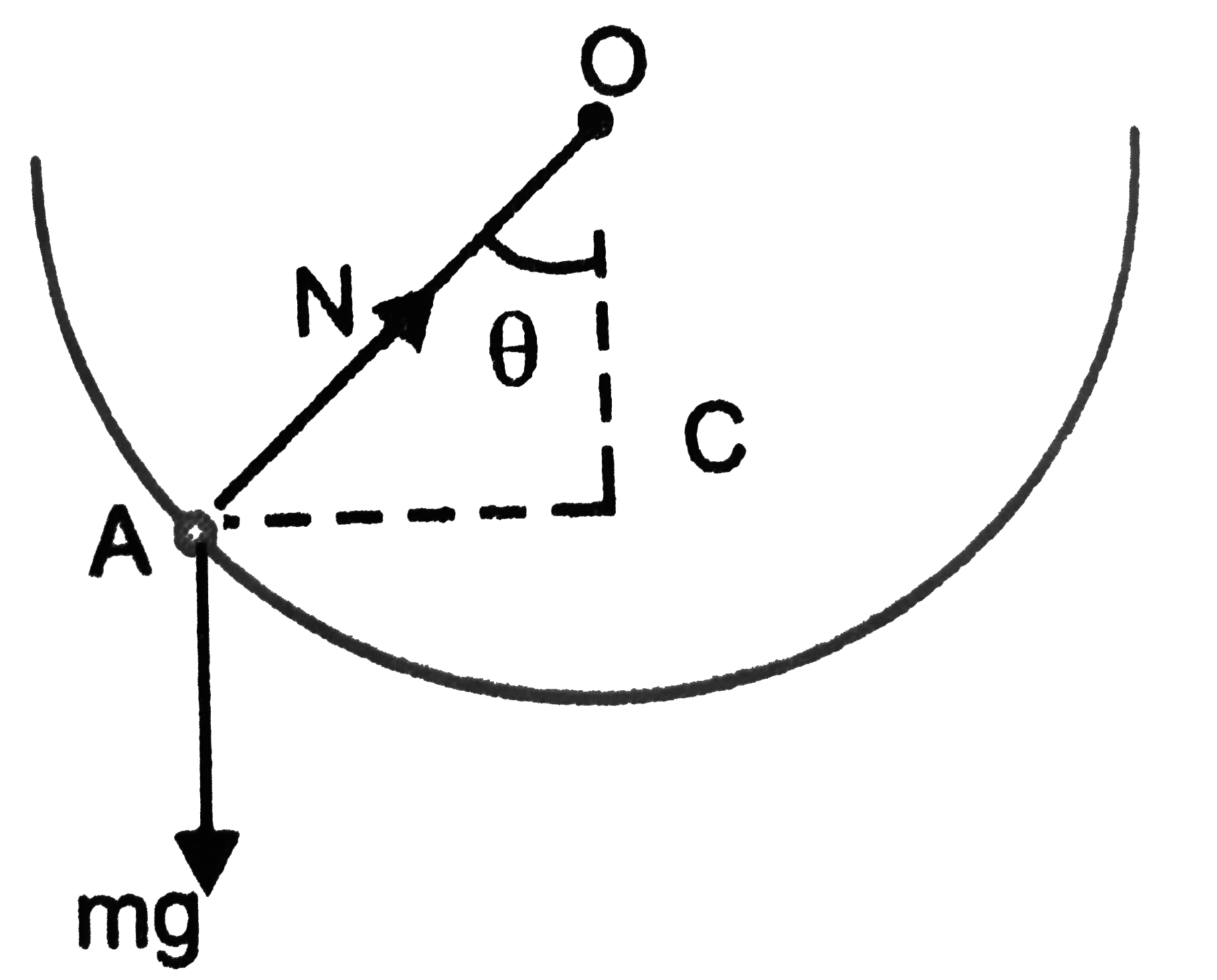
Here ` OA = R, angleAOC = theta`
Block moves in a horizontal circle with centre `C` and
radius ` r = AC = R sin theta`
`:.` In equilibrium `N cos theta = mg`
and `N sin theta = m omega^(2) (R sin theta)`
`N = m omega^(2) R`
From(i) `m omega^(2) R cos theta = mg`
` omega = sqrt((g)/(R cos theta))`
.
Promotional Banner

Topper's Solved these Questions

  • LAWS OF MOTION

    PRADEEP|Exercise Value Based Questions with Answers|5 Videos
  • LAWS OF MOTION

    PRADEEP|Exercise Multiple Choice Questions|42 Videos
  • LAWS OF MOTION

    PRADEEP|Exercise Short Answer Questions|35 Videos
  • KINEMATICS

    PRADEEP|Exercise 1 NCERT Comprehension|4 Videos
  • MATHEMATICAL TOOLS

    PRADEEP|Exercise Fill in the blanks|5 Videos

Similar Questions

Explore conceptually related problems

A hemisphericla bowl of rdius R is rotated about its axis of symetry which is kept vertical.A small block is kept in the bowl at a position where the radius makes an angle theta with the vertical. The block rottes with the bowl without any sliping. The friction coefficient between the block and teh bowl surface is mu . Find the range of the angular speed for which the block will not slip.

A spherical marble of radius r is made to oscillate in a bowl of radius R. What is its period of oscillation ?

A hemispherical bowl of radius R=0.1m is rotating about its own axis (which is verticle) with an angular velocity omega . A particle of mass 10^(-2)kg on the smooth inner surface of the bowl is also rotating with the same omega . The particle is at a height h from the bottom of the bowl (a) obtain the relation betweemn h and omega . what is the minimum value of omega needed, in order to have a non-zero value of h ? (b) it is desired to measure g using this set up, by measuring h accurately. assuming that R and Omega are known precisely and least count in the measurement of h is 10^(-4)m , what is the minimum possible error Deltag in the measured value of g ? (g=10m//s^(2))

A hemispherical bowl of radius R is rotating about its own axis (which is vertical) with an angular velocity omega . A particle on the frictionless inner surface of the bowl is also rotating with the same omega . The particle is a height h from the bottom of the bowl. (i) Obtain the relation between h and omega _________ (ii) Find minimum value of omega needed, in order to have a non-zero value of h _____________ .

A block is kept inside a hemispherical bowl rotating with angular velocity omega . Inner surface of bowl is rough, coefficient of friction is mu . The block is kept at a position where radius makes an angle theta with the vertical. What is the range of the angular speed for which the block will stay at the given position?

If the coefficient of friction between an insect and bowl is mu and the radius of the bowl is r, find the maximum height to which the insect can crawl in the bowl.

A hollow cylinder of radius R rotates about its axis which is vertical. A block remains in contact with the inner wall if the frequency of rotation is f hertz, but falls at lower frequaencies. The coefficient of friction between the block and the cylinder is

A ball of radius r is made to oscillate in a bowl of radius R, find its time period of oscillation.

A disc of radius 4m is rotating about its fixed centre with a constant angular velocity 2(rad)/(s) (in the horizontal plane).A block is also rotating with the disc without slipping. If co-efficient of friction between the block and the disc is 0.4 ,then the maximum distance at which the block can rotate without

