Home
Class 11
PHYSICS
Figure shows a loopthe loop track of rai...

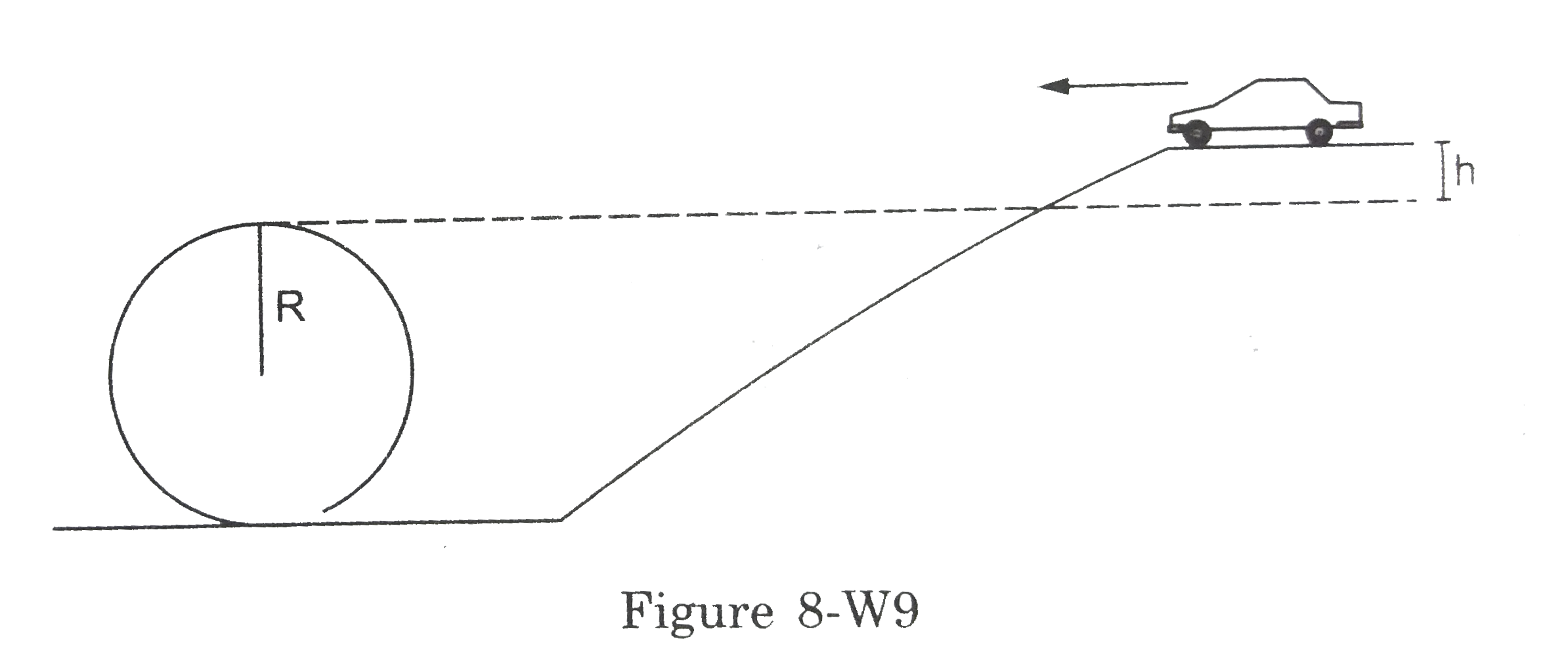
Figure shows a loopthe loop track of raidus R. A car (without engine) starts from a platform at a distance h above the top of the loop and goes around the loop without falling off the track. Find the minimum value of h for a successful looping. Neglect friction.

Text Solution

Verified by Experts

Suppose `upsilon` is speed of the car at the topmost point of the loop.
`:. Mgh=(1)/(2)m upsilon^(2) ` or `m upsilon^(2)=2mgh` …(i)
At the top of the loop, `mg+R=(m upsilon^(2))/(r)=(2mgh)/(r)`
where `R` is the normal reaction.
For `h` to be minum, `R=` minimum `=0,`
`:. (2mgh_(min))/(r)=mg, h_(min)=r//2`
Promotional Banner

Topper's Solved these Questions

  • WORK, ENERGY AND POWER

    PRADEEP|Exercise value Based Question|5 Videos
  • WORK, ENERGY AND POWER

    PRADEEP|Exercise Multiple choice question|29 Videos
  • WORK, ENERGY AND POWER

    PRADEEP|Exercise Additional Exercises|3 Videos
  • THERMODYNAMICS

    PRADEEP|Exercise Assertion- Reason Type Questions|19 Videos

Similar Questions

Explore conceptually related problems

A small solid sphere rolls without slipping along the track shown in figure. The sphere starts from rest from a height h above the bottom of a loop of radius R which is much larger than the radius of the sphere r. The minimum value of h for the sphere to complete the loop is:

The figure shows a circular loop of radius a with two long parallel wires (numbered 1 and 2) all in the plane of the paper . The distance of each wire from the centre of the loop is d . The loop and the wire are carrying the same current I . The current in the loop is in the counterclockwise direction if seen from above. (q) The magnetic fields(B) at P due to the currents in the wires are in opposite directions. (r) There is no magnetic field at P . (s) The wires repel each other. (4) When d~~a but wires are not touching the loop , it is found that the net magnetic field on the axis of the loop . In that case

The figure shows a circular loop of radius a with two long parallel wires (numbered 1 and 2) all in the plane of the paper . The distance of each wire from the centre of the loop is d . The loop and the wire are carrying the same current I . The current in the loop is in the counterclockwise direction if seen from above. (q) The magnetic fields(B) at P due to the currents in the wires are in opposite directions. (r) There is no magnetic field at P . (s) The wires repel each other. (5) Consider dgtgta , and the loop is rotated about its diameter parallel to the wires by 30^(@) from the position shown in the figure. If the currents in the wire are in the opposite directions, the torque on the loop at its new position will be ( assume that the net field due to the wires is constant over the loop).

A small toy car of mass m slides with negligible friction on a ''loop'' the loop track as shown in Fig.3E.32. The toy car starts from rest at a point H above the level of the lowest point of the track (a) If H = 2R , what normal force is exerted by the track on the toy car at point q?. What are the speed and normal force at point r ? (b) At what height will the ball leave the track and to what maxiumum height will it rise afterwards ? (c) If H = 4R , what is the speed and normal reaction reaction at point s ?

Figure shows a loop track whose lower part ends into a circular track of radius R and centre O. A small solid sphere of mass M rolls without slipping along the loop track from the end A at a height 6R from the bottom of the track. What is the horizontal force acting on the sphere, when it rises up to the point P in level with the centre O of the circular part ?

A frictionless tracke ABCDE ends in a circular loop of radius 'r' A body slides down the track from the point 'A' which is at a height h=10 cm . The maximum value of 'r' for the body to successful complete the loop is

A small block of mass m slides along a smooth track, as shown in fig. (i) If it starts from rest at P, what is the resulting force acting on it at Q ? (ii) at what height above the bottom of the loop should the block be released so that the force it exerts against the track at the top of the loop equals its weight?

Figure shows a square loop of edge a made of a uniform wire. A current i enters the loop at the point A and leaves it at the point C. Find the magnetic field at the point P which is on the perpendicular bisector of AB at a distance a/4 from it.

A small block of mass m slides along a smooth frictionless track as shown. (a) If it starts from rest at P , what is the resultant force acting on it at Q ? (b) At what height above the bottom should the block be released so that the force it exerts against the track at the top of the loop equals its weight?
