Home
Class 11
PHYSICS
A ball moving on a horizontal frictionle...

A ball moving on a horizontal frictionless plane hits an identical ball at rest with a velocity of `0.5m//s`. If the collision is elastic, calculate the speed imparted to the target ball, if the speed of projectile after the collision is `30cm//s`. Show that the two balls will move at right angles to eachother, after the collision.

Text Solution

Verified by Experts
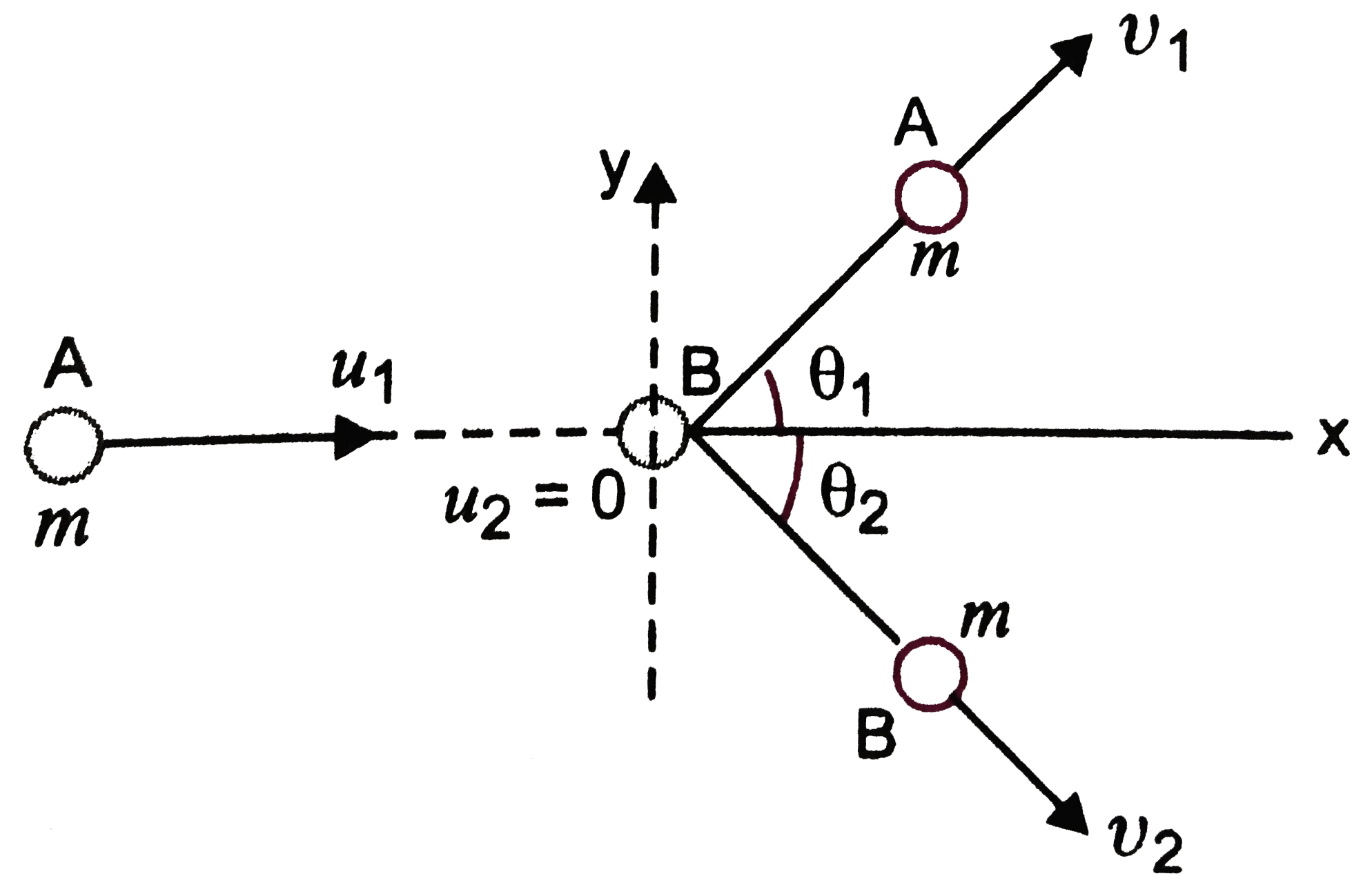
Let `m` be the mass of each ball. The situation is shown in figure,
As the collision is elastic, KE is conserved.
`:. (1)/(2)mu_(1)^(2)+(1)/(2)mu_(2)^(2)=(1)/(2)m upsilon_(1)^(2)+(1)/(2)m upsilon_(2)^(2)`
or `u_(1)^(2)+u_(2)^(2)=upsilon_(1)^(2)+upsilon_(2)^(2)`
`(0.5)^(2)+0=(0.3)^(2)+upsilon_(2)^(2)`
`upsilon_(2)=sqrt((0.5)^(2)-(0.3)^(2))=0.4m//s`
According to law of conservation of linear momentum along X `-` axis,
`0.5m+0=0.3m cos theta_(1)+0.4m cos theta_(2)`
or `5=3cos theta_(1)+4 cos theta_(2)`
or `3 cos theta_(1)=5 -4 cos theta_(2)` ...(i)
Again, applying law of conservation of linear momentum along `Y-` axis,
`0.3m sin theta_(1)=0.4m sin theta_(2)`
or `3 sin theta_(1)=4 sin theta_(2)` ...(ii)
Squaring (i) and (ii) and adding, we get
`9(cos ^(2)theta_(1)+sin^(2)theta_(1))=(5-4 costheta_(2))^(2)+(4 sin theta_(2))^(2)`
`9xx1=25+16 cos^(2)theta_(2)-40 cos theta_(2)+16 sin^(2)theta_(2)`
`=16(cos^(2)theta_(2)+sin^(2)theta_(2))-40cos theta_(2)+25`
`40 cos theta_(2)=16+25-9=32`
`cos theta_(2)=(32)/(49)=(4)/(5)`
From (i), `cos theta_(1)=(5)/(3)-(4)/(3)xx(4)/(5)=(3)/(5)`
`:. sin theta_(1)=sqrt(1-cos^(2)theta_(1))=4//5`
`:. sin theta_(2)=sqrt(1-cos^(2)theta_(1))=3//5`
`sin(theta_(1)+theta_(2))=sin theta_(1)cos theta_(2)+cos theta_(1)sin theta_(2)`
`=(4)/(5)xx(4)/(5)+(3)/(5)xx(3)/(5)=1`
`:. theta_(1)+theta_(2)=90^(@)`
Promotional Banner

Topper's Solved these Questions

  • WORK, ENERGY AND POWER

    PRADEEP|Exercise NCERT( Multiple choide questions-1)|21 Videos
  • WORK, ENERGY AND POWER

    PRADEEP|Exercise JEE (Main and Advanced)|82 Videos
  • WORK, ENERGY AND POWER

    PRADEEP|Exercise Fill in the blanks|10 Videos
  • THERMODYNAMICS

    PRADEEP|Exercise Assertion- Reason Type Questions|19 Videos

Similar Questions

Explore conceptually related problems

A ball of mass m moving with velocity v collides head on elastically with another identical ball moving with velocity - V. After collision

A glass ball collides with an identical ball at rest with v_(0)=2 m/sec. If the coefficient of restitution of collision is e = 0.5, find the velocities of the glass balls just after the collision.

A ball of mass m makes an elastic collision with another identical ball at rest. Show that if the collision is oblique, the bodies go at right angles to each other after collision.

A ball moving with a speed of 9m//s strikes an identical ball at rest, such that after the collision, the direction of each ball makes an angle of 30^(@) with the original line of motion. Find the speeds of the two balls after collision.

A ball moving with speed v hits another identical ball at rest. The two balls stick together after collision. If specific heat of the material of the balls is S , the temperature rise resulting from the collision is

A highly elastic ball moving at a speed of 3 m//s approaches a wall moving towards it with a speed of 3 m//s . After the collision. the speed of the ball will be

A ball moving with a speed of 10" m s"^(-1) strikes an identical ball such that after the collision the direction of each ball makes an angle 45^(@) with the original line of motion. Find the speeds of the two balls after the collision.

A ball moving with a speed of 9ms^(-1) strikes an identical ball such that after the collision the direction of each ball makes and angle 30^@ with the original line of motion. Find the speeds of the two balls after the collision.

PRADEEP-WORK, ENERGY AND POWER-Problems For Practice
  1. A body of mass 2 kg makes an elastic collision with another body at re...

    Text Solution

    |

  2. What percentage of K.E. of a moving particle is transferred to a stati...

    Text Solution

    |

  3. A bomb at rest explodes into two fragments of masses 3.0kg and 1.0kg. ...

    Text Solution

    |

  4. A uranium 238 nucleus, initially at rest emits an alpha particle with ...

    Text Solution

    |

  5. The first ball of mass m moving with the velocity upsilon collides hea...

    Text Solution

    |

  6. What percentage of K.E. of a moving particle is transferred to station...

    Text Solution

    |

  7. What percentage of K.E. of a moving particle is transferred to a stati...

    Text Solution

    |

  8. A simple pendulum of length 1m has a wooden bob of mass 1kg. It is str...

    Text Solution

    |

  9. A moving body of mass m makes a head on elastic collision with another...

    Text Solution

    |

  10. A particle of mass m strikes on ground with angle of incidence 45^(@)...

    Text Solution

    |

  11. A body of mass m falls from a height h and collides with another body ...

    Text Solution

    |

  12. A 10kg ball and a 20kg ball approach each other with velocities 20m//s...

    Text Solution

    |

  13. A sphere of mass m collides against a pendulum of mass m with horizont...

    Text Solution

    |

  14. A ball moving on a horizontal frictionless plane hits an identical bal...

    Text Solution

    |

  15. A ball moving with velocity 2 ms^(-1) collides head on with another st...

    Text Solution

    |

  16. A ball of a mass m hits the floor with as speed v making an angle of i...

    Text Solution

    |

  17. Figure shows a force compression curve of a spring. A body of mass 5kg...

    Text Solution

    |

  18. A body falling on the ground from a height of 10m rebounds to a height...

    Text Solution

    |

  19. The iron Fe^(27) nucleus emits a y-axis of energy 14.4KeV. If mass of...

    Text Solution

    |

  20. A particle moves in a straight line with retardatino proportional it ...

    Text Solution

    |

