Home
Class 11
PHYSICS
A point mass of 1kg collides elastically...

A point mass of 1kg collides elastically with a stationary point mass of 5 kg. After their collision, the 1kg mass reverses its direction and moves with a speed of `2ms^-1`. Which of the following statements (s) is (are) correct for the system of these two masses?

A

Total momentum of the system is `3 kg ms^(-1)`

B

Momentum of `5 kg` mass after collision is `4 kg ms^(-1)`

C

Kinetic energy of the centre of mass is `0.75 J`

D

Total kinetic energy of the system is `4 J`

Text Solution

Verified by Experts

The correct Answer is:
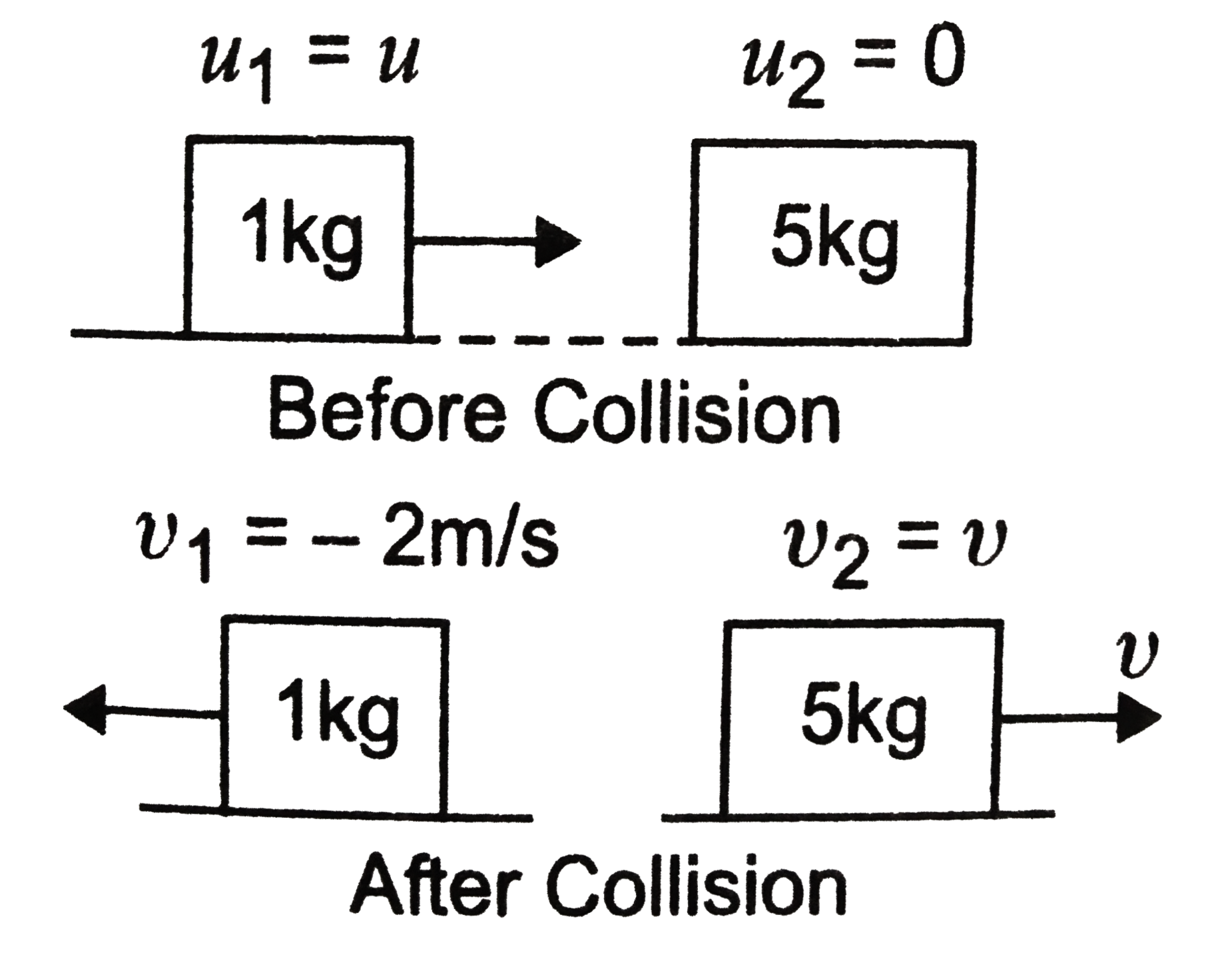
A, C

Total momentum before collision
`=m_(1)u_(1)+m_(2)u_(2)=1xxu+5xx0= u `
Total momentum after collision
`= m _(1) upsilon_(1)+ m_(2)upsilon_(2)=1xx(-2)=5 xxupsilon`
`=5 upsilon-2`
According to law of conservation of linear momentum
`u=5 upsilon-2 ...(i)`
Accroding to law of conservation of `K.E.`
`(1)/(2)m_(1)u_(1)^(2)+(1)/(2) m_(2)u_(2)^(2)=(1)/(2)m_(1)upsilon_(1)^(2)+(1)/(2)m_(2) upsilon_(2)^(2)`
or `(1)/(2) xx1xxu^(2)+(1)/(2)xx5xx0=(1)/(2)xx1xx(-2)^(2)+(1)/(2)xx5 upsilon^(2)`
or `u^(2)=4+5upsilon^(2) ...(ii)`
Solving `(i)` and `(ii)`, we get `upsilon=1 m//s`
and `u=3m//s`
Total momentum of the system before collision
`=3 kg m//s.`
Momentum of `5 kg` mass after collision `= m_(2)upsilon_(2)`
`=5xx1=5kg ms^(-1)`
Now,`upsilon_(cm)=(m_(1)upsilon_(1)+m_(2)upsilon_(2))/(m_(1)+m_(2))`
`=(1(-2)+5(1))/(1+5)=(1)/(2) m//s`
`K.E.` of `c.m=(1)/(2)(m_(1)+m_(2))upsilon_(cm)^(2)`
`=(1)/(2) (1+5)((1)/(2))^(2)=0.75J`
Total `K.E.` of the system `=(1)/(2) m_(1)upsilon_(1)^(2)+(1)/(2) m_(2)upsilon_(2)^(2)`
`=(1)/(2)xx1xx(-2)^(2)+(1)/(2)xx5xx1^(2)=2+2.5=4.5J.`
Promotional Banner

Topper's Solved these Questions

  • WORK, ENERGY AND POWER

    PRADEEP|Exercise Fill in the blanks|10 Videos
  • WORK, ENERGY AND POWER

    PRADEEP|Exercise Problems For Practice|76 Videos
  • WORK, ENERGY AND POWER

    PRADEEP|Exercise value Based Question|5 Videos
  • THERMODYNAMICS

    PRADEEP|Exercise Assertion- Reason Type Questions|19 Videos

Similar Questions

Explore conceptually related problems

A 6 kg mass travelling at 2.5 ms^(-1) collides head on with a stationary 4 kg mass. After the collision the 6kg mass travels in its original direction with a speed of 1 ms^(-1) . The final velocity of 4 kg mass is

A mass of 20 kg moving with a speed of 10 m / s collides with another stationary mass of . 5kg As a result of the collision, the two masses stick together. The kinetic energy of the composite mass will be

A ball of mass 2 kg moving with 4 m/s collides elastically with a stationary ball. If it continues to move in original direction with 1/4th of its original velocity. Find velocity of centre of mass of system

A ball of mass 5 kg moving with speed 8 m/s collides head on with another stationary ball of mass 15 kg. If collision is perfecty inelastic, then loss in kinetic energy is

A ball of mass 5 kg moving with speed 8 m/s collides head on with another stationary ball of mass 15 kg. If collision is perfectly inelastic, then loss in kinetic energ is

A ball of mass 1 kg moving with a velocity of "0.4 ms"^(-1) collides with another stationary ball. After the collision, the first ball moves with a velocity of 0.3ms^(1) in a direction making an angle of 90^(@) with its initial direction. The momentum of the second ball after the collision will be (in kg ms^(-1) )

A 5kg mass collides with a body at rest. After the collision, they travel together with a velocity one third the velocity of 5kg mass. The mass of the second body is

A truck of mass 1000 kg moving with a speed of 72 km/hr collides with a stationary truck of the same mass . After the collision , the trucks get stick together and move . Calculate their common speed after collision . Is it elastic or ineleastic collision ?

PRADEEP-WORK, ENERGY AND POWER-Multiple choice question
  1. For a perfectly elastic collision and a perfectly inelastic collision,...

    Text Solution

    |

  2. The balls, having linear momenta vecp1=vecpi and vecp22=-vecpi, underg...

    Text Solution

    |

  3. When work done on a particle is positive, then its

    Text Solution

    |

  4. A particle is acted upon by a force of constant magnitude which is alw...

    Text Solution

    |

  5. You lift a suitcase from the floor and keep it on a table. The work do...

    Text Solution

    |

  6. If the force is always perpendicular to motion, then KE remains consta...

    Text Solution

    |

  7. A point mass of 1kg collides elastically with a stationary point mass ...

    Text Solution

    |

  8. One end of a light spring of spring constant k is fixed to a wall and ...

    Text Solution

    |

  9. A 3-kg steel ball strikes a wall with a speed of 10.0ms^(-1) at an ang...

    Text Solution

    |

  10. A force F acting on a body depends on its displacement S as FpropS^(-1...

    Text Solution

    |

  11. A heavy stone is thrown from a cliff of height h in a given direction....

    Text Solution

    |

  12. A ball falls vertically onto a floor with momentum p and then bounces ...

    Text Solution

    |

  13. No work is done by a force on an object if

    Text Solution

    |

  14. A particle is acted upon by a force of constant magnitude which is alw...

    Text Solution

    |

  15. A Force F acting on an object varies with distance x as shown in the h...

    Text Solution

    |

  16. The upper half of an inclined plane with inclination phi is perfectly ...

    Text Solution

    |

  17. A ball hits a floor and rebounds after an inelastic collision. In this...

    Text Solution

    |

  18. A smooth block is released at rest on a 45^@ incline and then slides a...

    Text Solution

    |

  19. A body moving towards a finite body at rest collides with it. It is po...

    Text Solution

    |

  20. The block of mass M moving on the frictionless horizontal surface col...

    Text Solution

    |

