Home
Class 11
PHYSICS
A rod of length L is hinged from one end...

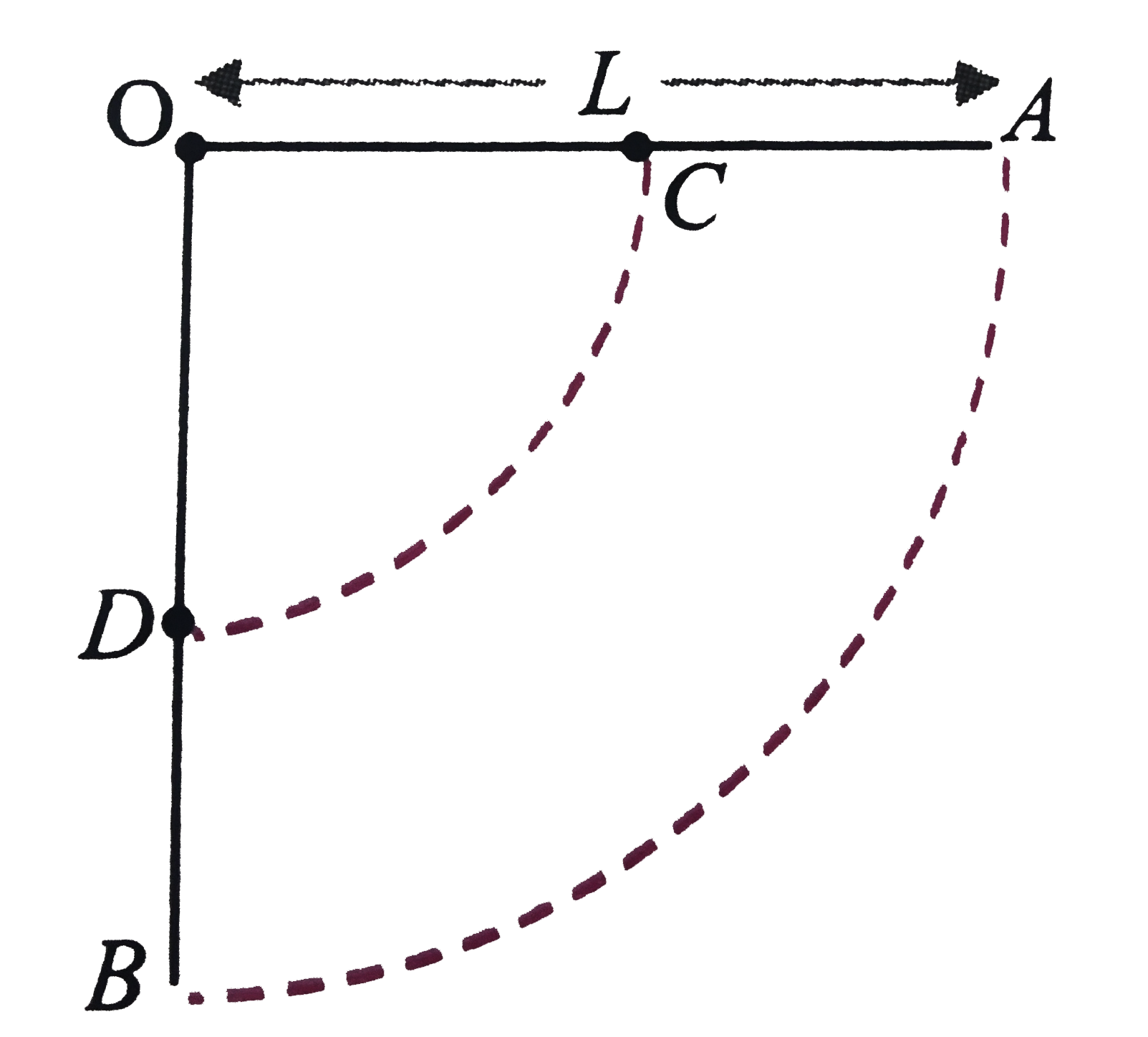
A rod of length `L` is hinged from one end. It is brought to a horizontal position and released. The angular velocity of the rod, When it is in verticle position is

A

`sqrt((2g)/(L))`

B

`sqrt((3g)/(L))`

C

`sqrt((g)/(2L))`

D

`sqrt((g)/(L))`

Text Solution

Verified by Experts

The correct Answer is:
B

Refer to Fig. when the ord goes from position `OA` to `OB`, then loss in `PE` of rod is equal to the gain in `KE` of rotation of rod.
So `mg ((L)/(2)) = (1)/(2)I omega^(2) = (1)/(2) ((mL^(2))/(3))omega^(2)`
or `omega = sqrt((3g)/(L))`
Promotional Banner

Similar Questions

Explore conceptually related problems

A rod of length L is hinged from one end. It is brought to a horizontal position and released. The angular velocity of the rod, when it is in vertical position, is

A rod of length L is hinged from one end. It is brought to horizontal position and released. The angular velocity of the rod when it is in vertical position. Is

A rod of length L is hinged from one end. It is brought to the horizontal position and released. The angular velocity of the rod when it is in the vertical position is sqrt(Kg//L) . Then find the value of K.

A uniform thin rod of length l and mass m is hinged at a distance l//4 from one of the end and released from horizontal position as shown in Fig. The angular velocity of the rod as it passes the vertical position is

Consider a uniform rod of mass M and length L is hinged at one end as shown. Initially the rod is vertical, it is slightly pushed and released. Find the angular velocity of rod and liner velocity of its one end when the rod becomes horizontal. Also calculate angular velocity of rod when it has rotated by an angle theta ( thetalt90^(@) ).

A thin bar of mass M and length L is free to rotate about a fixed horizontal axis through a point at its end. The bar is brought to a horizontal position and then released. The axis is perpendicular to the rod. The angular velocity when it reaches the lowest point is

A rigid rod of mass m & length l is pivoted at one of its ends. If it is released from its horizontal position, find the speed of the centre of mass of the rod when it becomes vertical.

A horizontal rod of mass m and length L is pivoted at one end The rod's other end is supported by a spring of force constant k. The rod is displaced by a small angle theta from its horizontal equilibrium position and released. The angular frequency of the subsequent simple harmonic motion is

