Text Solution
Verified by Experts
The correct Answer is:
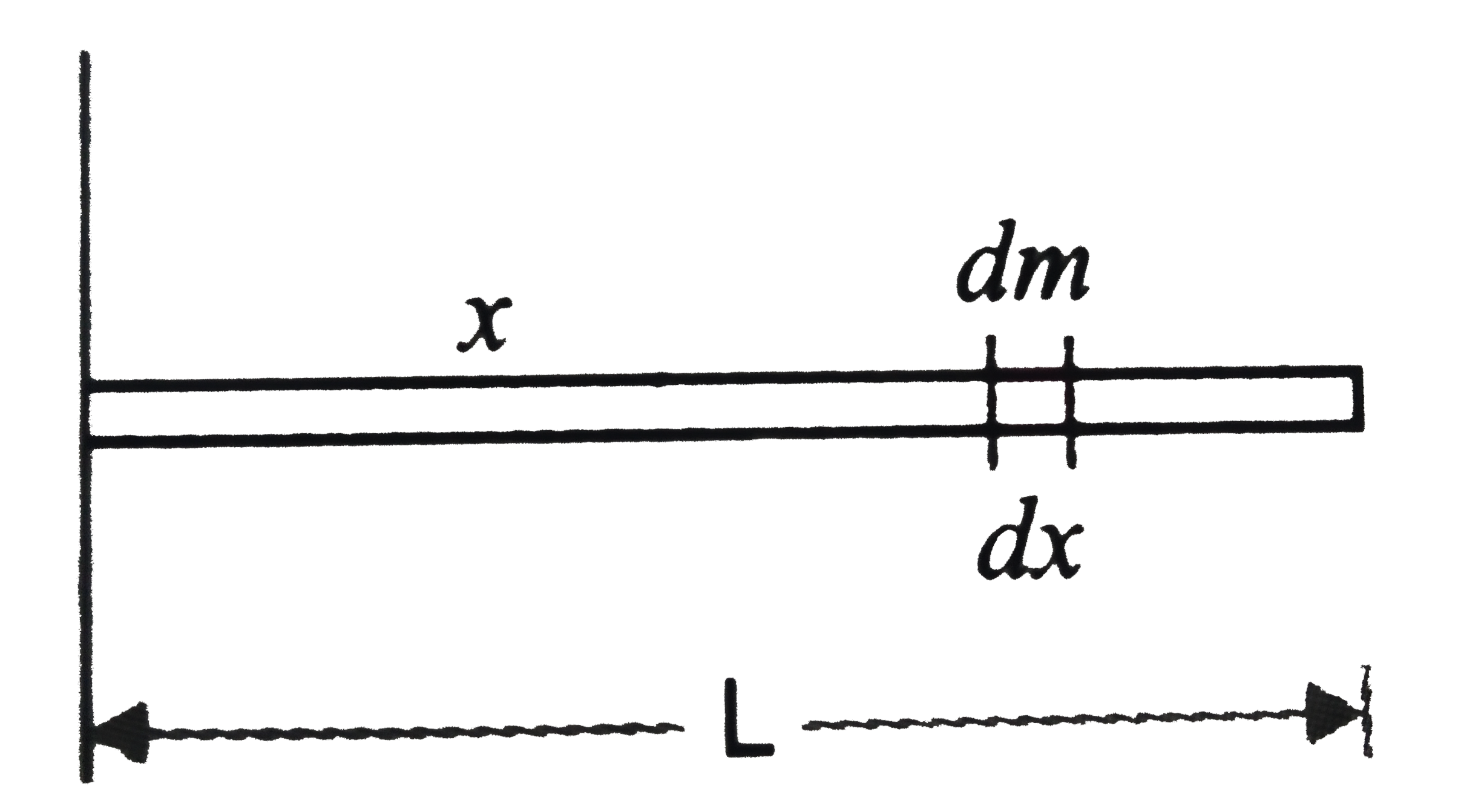



Topper's Solved these Questions
SYSTEMS OF PARTICLES AND ROTATIONAL MOTION
PRADEEP|Exercise Assertion- Reason Type questions|20 VideosSYSTEMS OF PARTICLES AND ROTATIONAL MOTION
PRADEEP|Exercise Multiple Choice Questions Comprehension 2|1 VideosRAY OPTICS
PRADEEP|Exercise Problem For Practice(a)|25 VideosTHERMODYNAMICS
PRADEEP|Exercise Assertion- Reason Type Questions|19 Videos
Similar Questions
Explore conceptually related problems
PRADEEP-SYSTEMS OF PARTICLES AND ROTATIONAL MOTION-Integer Type Questions
- Two homogeneous spheres A and B of masses m and 2 m having radii 2 a a...
Text Solution
|
- A non-uniform thin rod of length L is palced along X-axis so that one ...
Text Solution
|
- A sphere of mass 5kg and diameter 2 m rotates about a tangent. What is...
Text Solution
|
- A uniform rod of length 1m and mass 0.5 kg rotates at angular speed o...
Text Solution
|
- A particle performing uniform circular motion has angular momentum L. ...
Text Solution
|
- A constant torque of 200 Nm turns a wheel of moment of inertia 50 kg m...
Text Solution
|
- If k(1) is radius of gyration of a circular disc about a tangent perpe...
Text Solution
|
- If earth were to shrink to (1)/(8)th of its present volume, what would...
Text Solution
|
- An angular ring wth inner and outer radii R(1) = 1.2 cm and R(2) = 4.8...
Text Solution
|
- A circular disc of radius r is rolling without slipping on a horizonta...
Text Solution
|
- A uniform circular disc of mass 1.5 kg and raius 0.5 m is initially a...
Text Solution
|
- A horizontal circular platform of radius 0.5 m and mass axis. Two mass...
Text Solution
|
- Two identical uniform discs roll without slipping on tow different suf...
Text Solution
|