Two smooth block are placed at a smooth corner as shown in fig. Both the bloks are having mass m. We apply a force F on the block m. Block A presses block B in the normal direction, due to which pressing force on vertical wall will increase, and pressing force on the horizontal wall decreases, as we increases `F(theta = 37^(@)` with horizontal).
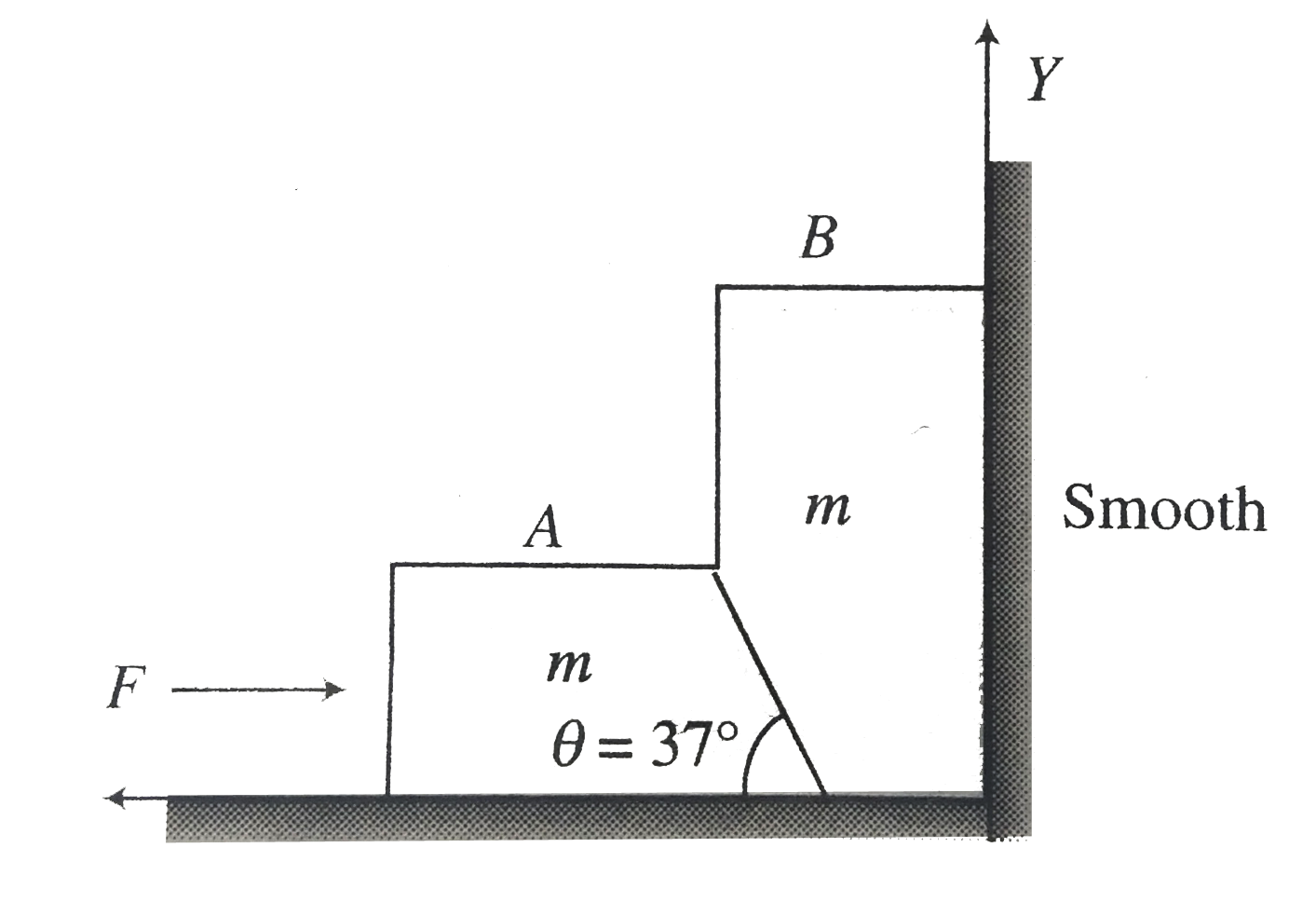
As soon as the pressing force on the horizontal wall by block B become zero, it will lose contact with ground. If the value of F further increases, block B will accelerate in the upward direction and simulaneously block A will towards right.
What is the minimum value of F to lift block B from ground?
Two smooth block are placed at a smooth corner as shown in fig. Both the bloks are having mass m. We apply a force F on the block m. Block A presses block B in the normal direction, due to which pressing force on vertical wall will increase, and pressing force on the horizontal wall decreases, as we increases `F(theta = 37^(@)` with horizontal).
As soon as the pressing force on the horizontal wall by block B become zero, it will lose contact with ground. If the value of F further increases, block B will accelerate in the upward direction and simulaneously block A will towards right.
What is the minimum value of F to lift block B from ground?
As soon as the pressing force on the horizontal wall by block B become zero, it will lose contact with ground. If the value of F further increases, block B will accelerate in the upward direction and simulaneously block A will towards right.
What is the minimum value of F to lift block B from ground?



Similar Questions
Explore conceptually related problems
Two smooth block are placed at a smooth corner as shown in fig. Both the bloks are having mass m. We apply a force F on the block m. Block A presses block B in the normal direction, due to which pressing force on vertical wall will increase, and pressing force on the horizontal wall decreases, as we increases F(theta = 37^(@) with horizontal). As soon as the pressing force on the horizontal wall by block B become zero, it will lose contact with ground. If the value of F further increases, block B will accelerate in the upward direction and simulaneously block A will towards right. If both the blocks are stationary, the force exerted by ground of block A is
Two smooth block are placed at a smooth corner as shown in fig. Both the bloks are having mass m. We apply a force F on the block m. Block A presses block B in the normal direction, due to which pressing force on vertical wall will increase, and pressing force on the horizontal wall decreases, as we increases F(theta = 37^(@) with horizontal). As soon as the pressing force on the horizontal wall by block B become zero, it will lose contact with ground. If the value of F further increases, block B will accelerate in the upward direction and simulaneously block A will towards right. If both the blocks are stationary, the force exerted by ground of block A is
Two smooth block are placed at a smooth corner as shown in fig. Both the bloks are having mass m. We apply a force F on the block m. Block A presses block B in the normal direction, due to which pressing force on vertical wall will increase, and pressing force on the horizontal wall decreases, as we increases F(theta = 37^(@) with horizontal). As soon as the pressing force on the horizontal wall by block B become zero, it will lose contact with ground. If the value of F further increases, block B will accelerate in the upward direction and simulaneously block A will towards right. If both the blocks are stationary, the force exerted by ground of block A is
Two smooth block are placed at a smooth corner as shown in fig. Both the bloks are having mass m. We apply a force F on the block m. Block A presses block B in the normal direction, due to which pressing force on vertical wall will increase, and pressing force on the horizontal wall decreases, as we increases F(theta = 37^(@) with horizontal). As soon as the pressing force on the horizontal wall by block B become zero, it will lose contact with ground. If the value of F further increases, block B will accelerate in the upward direction and simulaneously block A will towards right. If both the blocks are stationary, the force exerted by ground of block A is
Two smooth block are placed at a smooth corner as shown in fig. Both the bloks are having mass m. We apply a force F on the block m. Block A presses block B in the normal direction, due to which pressing force on vertical wall will increase, and pressing force on the horizontal wall decreases, as we increases F(theta = 37^(@) with horizontal). As soon as the pressing force on the horizontal wall by block B become zero, it will lose contact with ground. If the value of F further increases, block B will accelerate in the upward direction and simulaneously block A will towards right. If the acceleration of block A is a rightwards, then the acceleration of block B will be
Two smooth block are placed at a smooth corner as shown in fig. Both the bloks are having mass m. We apply a force F on the block m. Block A presses block B in the normal direction, due to which pressing force on vertical wall will increase, and pressing force on the horizontal wall decreases, as we increases F(theta = 37^(@) with horizontal). As soon as the pressing force on the horizontal wall by block B become zero, it will lose contact with ground. If the value of F further increases, block B will accelerate in the upward direction and simulaneously block A will towards right. If the acceleration of block A is a rightwards, then the acceleration of block B will be
Two smooth block are placed at a smooth corner as shown in fig. Both the bloks are having mass m. We apply a force F on the block m. Block A presses block B in the normal direction, due to which pressing force on vertical wall will increase, and pressing force on the horizontal wall decreases, as we increases F(theta = 37^(@) with horizontal). As soon as the pressing force on the horizontal wall by block B become zero, it will lose contact with ground. If the value of F further increases, block B will accelerate in the upward direction and simulaneously block A will towards right. If the acceleration of block A is a rightwards, then the acceleration of block B will be
Two smooth block are placed at a smooth corner as shown in fig. Both the bloks are having mass m. We apply a force F on the block m. Block A presses block B in the normal direction, due to which pressing force on vertical wall will increase, and pressing force on the horizontal wall decreases, as we increases F(theta = 37^(@) with horizontal). As soon as the pressing force on the horizontal wall by block B become zero, it will lose contact with ground. If the value of F further increases, block B will accelerate in the upward direction and simulaneously block A will towards right. If the acceleration of block A is a rightwards, then the acceleration of block B will be
A block is placed on a smooth inclined plane as shown . For what value of horizontal force F, the block will remain at rest ?
A block is placed on a smooth inclined plane as shown . For what value of horizontal force F, the block will remain at rest ?
Recommended Questions
- Two smooth block are placed at a smooth corner as shown in fig. Both t...
Text Solution
|
- Two smooth block are placed at a smooth corner as shown in fig. Both t...
Text Solution
|
- Two smooth block are placed at a smooth corner as shown in fig. Both t...
Text Solution
|
- Two smooth block are placed at a smooth corner as shown in fig. Both t...
Text Solution
|
- A block of mass m is pressed against a wall which is moving with an ac...
Text Solution
|
- A block weighing w is held against a vertical wall be pressing horizon...
Text Solution
|
- A block of mass 'M' is pressed against a wall with a horizontal force ...
Text Solution
|
- A blocks of mass 'M' is pressed against a wall with a horizontal for...
Text Solution
|
- संलग्न चित्र में दर्शाये गये दो ब्लॉक A व B, बल F द्वारा दीवार पर दबाय...
Text Solution
|