Home
Class 11
PHYSICS
In which of these diagrams, the density ...

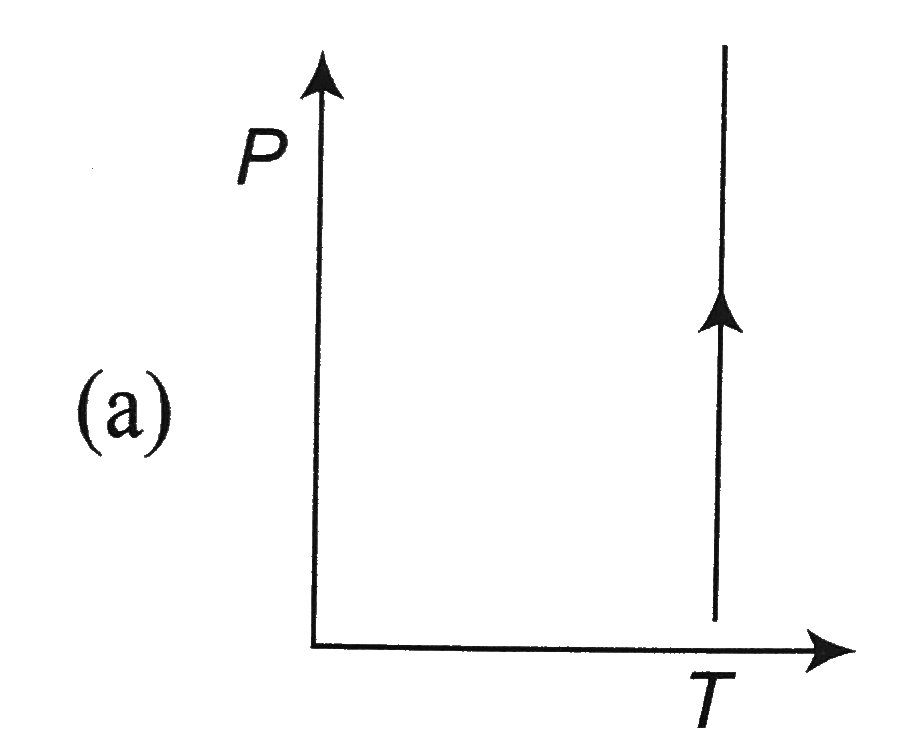
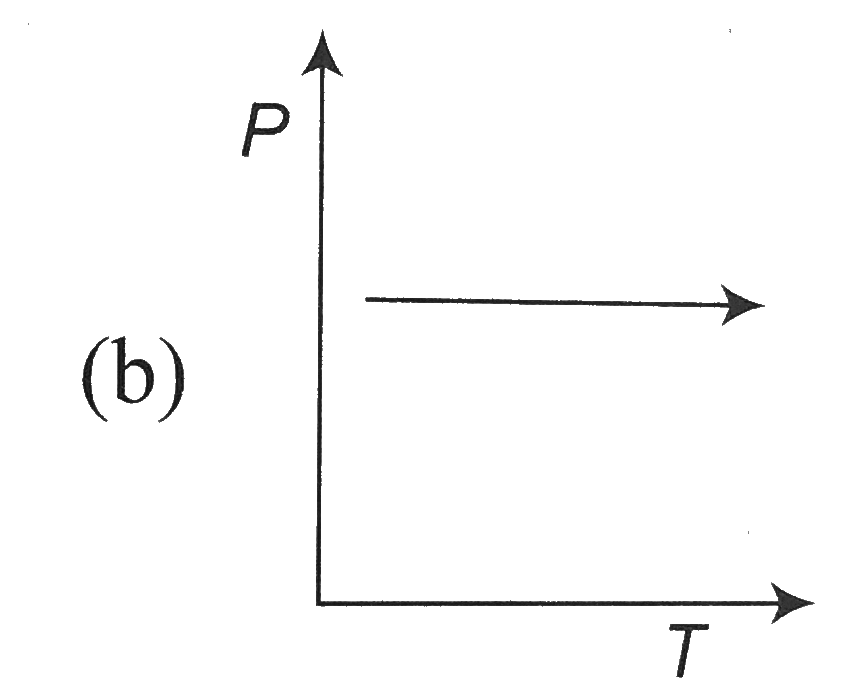
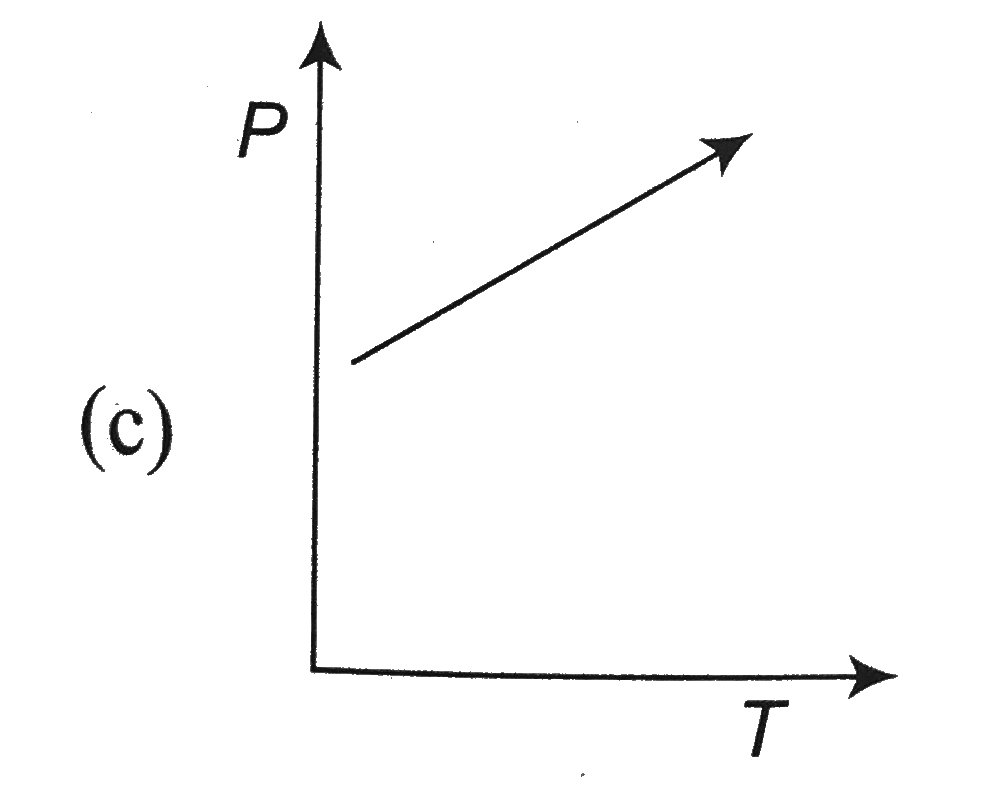
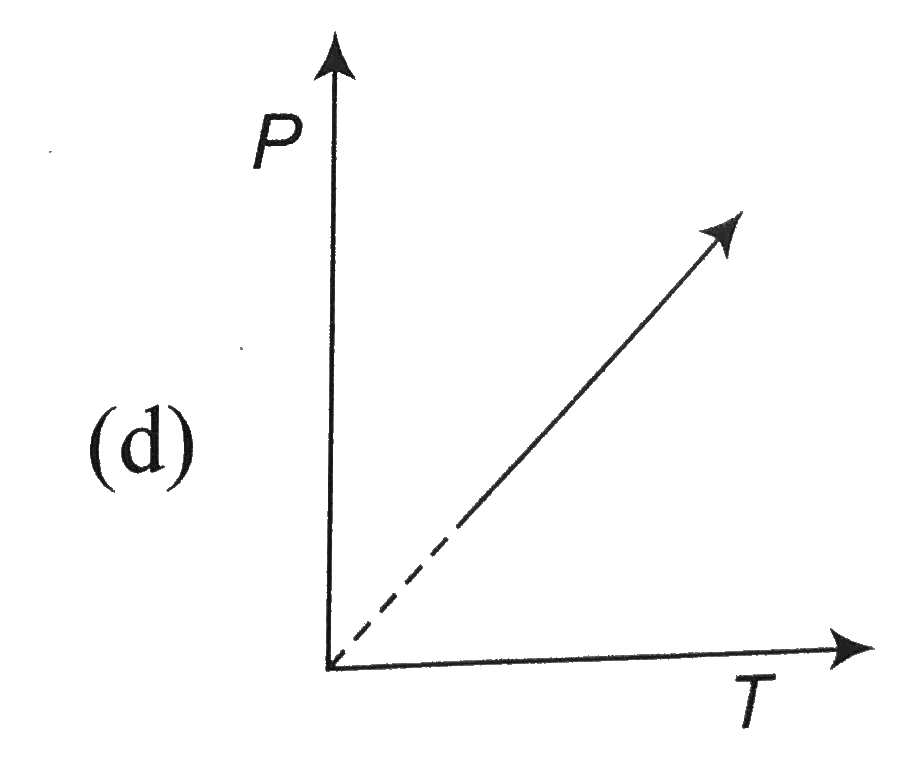
In which of these diagrams, the density of an ideal gas remains constant?

A

B

C

D

Text Solution

AI Generated Solution

The correct Answer is:

To determine in which diagram the density of an ideal gas remains constant, we can analyze the relationships between pressure (P), volume (V), temperature (T), and density (ρ) using the ideal gas law and the derived relationships. ### Step-by-Step Solution: 1. **Understanding the Ideal Gas Law**: The ideal gas law is given by the equation: \[ PV = nRT \] where \(n\) is the number of moles, \(R\) is the universal gas constant, and \(T\) is the temperature in Kelvin. 2. **Expressing Density**: The density (ρ) of the gas can be expressed in terms of mass (m) and volume (V): \[ \rho = \frac{m}{V} \] From the ideal gas law, we can express the number of moles \(n\) as: \[ n = \frac{m}{M} \] where \(M\) is the molar mass. Substituting this into the ideal gas law gives: \[ PV = \frac{m}{M}RT \] Rearranging this, we can express density as: \[ \rho = \frac{PM}{RT} \] 3. **Analyzing Each Diagram**: - **Diagram 1**: Constant temperature (T) with increasing pressure (P). - Since \(T\) is constant, as \(P\) increases, \(\rho\) will also increase. Thus, density is not constant. - **Diagram 2**: Constant pressure (P) with increasing temperature (T). - As \(T\) increases, \(\rho\) will decrease. Thus, density is not constant. - **Diagram 3**: Both pressure (P) and temperature (T) are increasing. - Here, the relationship is more complex. However, if both P and T increase proportionally, the density can vary. Thus, density is not constant. - **Diagram 4**: Pressure (P) is directly proportional to temperature (T) with no intercept. - In this case, if \(P\) increases, \(T\) also increases proportionally, keeping the ratio \(\frac{P}{T}\) constant. Therefore, the density \(\rho\) remains constant. 4. **Conclusion**: The density of the ideal gas remains constant in **Diagram 4**. ### Final Answer: The density of the ideal gas remains constant in **Diagram 4**.

To determine in which diagram the density of an ideal gas remains constant, we can analyze the relationships between pressure (P), volume (V), temperature (T), and density (ρ) using the ideal gas law and the derived relationships. ### Step-by-Step Solution: 1. **Understanding the Ideal Gas Law**: The ideal gas law is given by the equation: \[ PV = nRT ...
Promotional Banner

Topper's Solved these Questions

  • KINETIC THEORY OF GASES AND THERMODYNAMICS

    A2Z|Exercise First Law Of Thermodynamics , Internal Energy And Work Done|55 Videos
  • KINETIC THEORY OF GASES AND THERMODYNAMICS

    A2Z|Exercise Application Of First Law Of Thermodynamics In Different Situations|25 Videos
  • KINETIC THEORY OF GASES AND THERMODYNAMICS

    A2Z|Exercise Chapter Test|29 Videos
  • GRAVITATION

    A2Z|Exercise Chapter Test|29 Videos
  • MOCK TEST

    A2Z|Exercise Motion With Constant Acceleration|15 Videos

Similar Questions

Explore conceptually related problems

At a constant pressure, of the following graphs that one which represents the variation of the density of an ideal gas with the absolute temperature T, is

At a given temperature, the density of an ideal gas is proportional to

For given mass of an ideal gas at constant temperature

In a process the density of a gas remains constant. If the temperature is doubled, then the change in the pressure will be :-

Which of the following diagrams, Fig. depicts ideal gas behaviour ?

At constant pressure what would be the percentage decrease in the density of an ideal gas for a 10% increase in the temperature.

The bulk modulus of an ideal gas at constant temperature

The bulk modulus of an ideal gas at constant temperature

A2Z-KINETIC THEORY OF GASES AND THERMODYNAMICS-Ideal Gas Equation
  1. Figure shows the pressure P versus volume V graphs for a certains mass...

    Text Solution

    |

  2. Figure shows graphs of pressure vs density for an ideal gas at two tem...

    Text Solution

    |

  3. Suppose ideal gas equation follows VP^(3) = constant. Initial temperat...

    Text Solution

    |

  4. Two spherical vessel of equal volume are connected by a n arrow tube. ...

    Text Solution

    |

  5. Pressure versus temperature graphs of an ideal gas are as shown in fig...

    Text Solution

    |

  6. Density vs volume graph is shown in the figure. Find corresponding pre...

    Text Solution

    |

  7. The initial temperature of a gas is 100^(@)C. The gas is contained in ...

    Text Solution

    |

  8. A closed hollow insulated cylinder is filled with gas at 0^(@)C and al...

    Text Solution

    |

  9. The air tight and smooth piston of a cylindrical vessel are connected ...

    Text Solution

    |

  10. An ideal gas has a volume of 3 V at 2 atmosphere pressure. Keeping the...

    Text Solution

    |

  11. The volume of a given mass of a gas at 27^(@)C, 1 atm is 100 cc. What ...

    Text Solution

    |

  12. A vessel of volume 1660 cm^(3) contains 0.1 "mole" of oxygen and 0.2 "...

    Text Solution

    |

  13. One litre of helium gas at a pressure 76 cm. Of Hg and temperature 27^...

    Text Solution

    |

  14. A constant pressure V(1) and V(2) are the volumes of a given mass of a...

    Text Solution

    |

  15. In which of these diagrams, the density of an ideal gas remains consta...

    Text Solution

    |

  16. V = k((P)/(T))^(0.33) where k is constant. It is an,

    Text Solution

    |

  17. The densities at points A and B are rho(0) and (3 rho(0))/(2). Find th...

    Text Solution

    |

  18. The given curve represents the variation of temperatue as a function o...

    Text Solution

    |

  19. One mole of an ideal gas undergoes a process P = P(0) [1 + ((2 V(0))/(...

    Text Solution

    |

  20. Two identical vessels contain the same gas at pressure P(1) and P(2) a...

    Text Solution

    |
