Home
Class 11
PHYSICS
A fixed mass of helium gas is made to un...

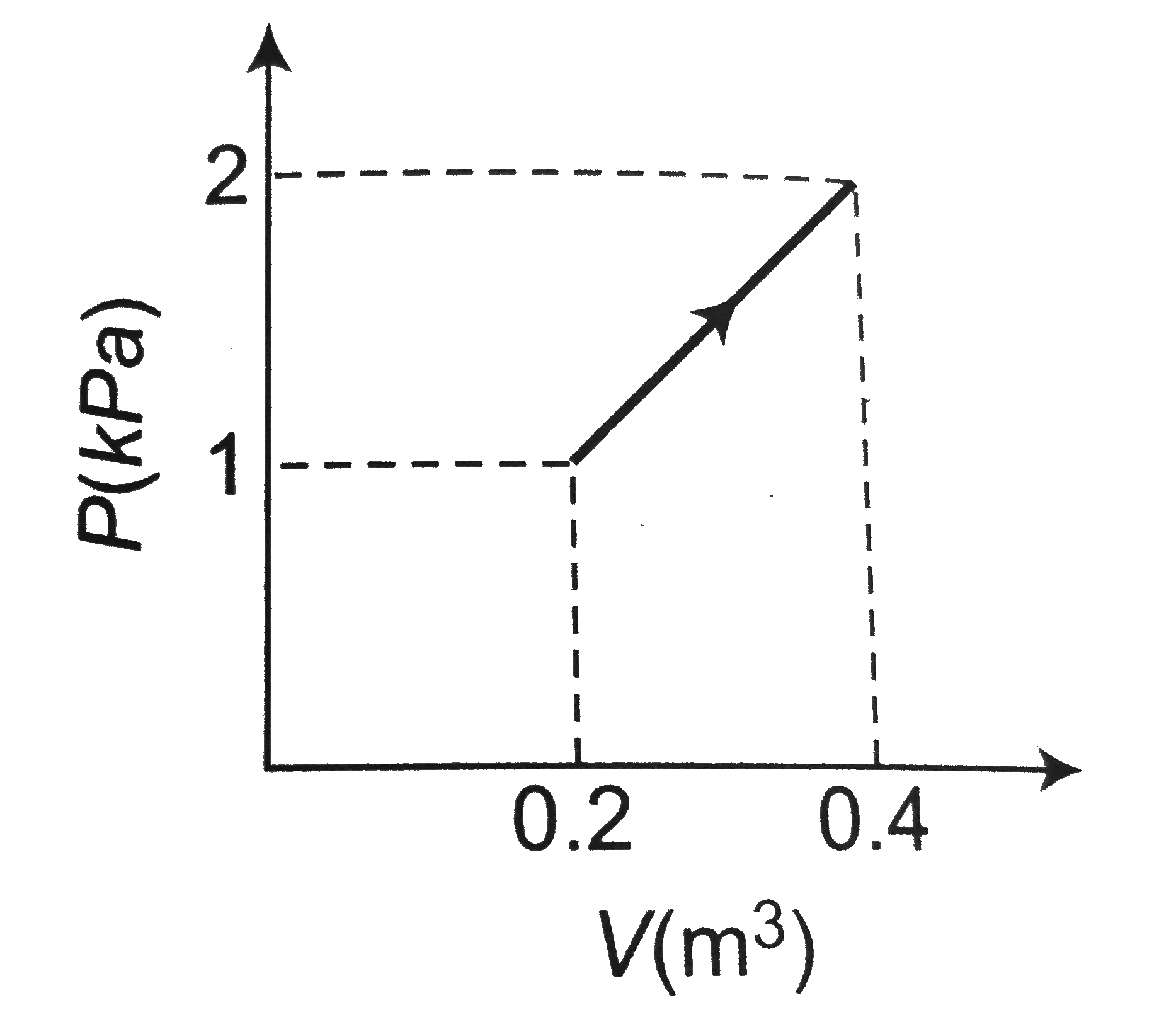
A fixed mass of helium gas is made to undergo a process in which its pressure varies linearly from `1 kPa` to `2 kPa`, in relation to its volume as the latter varies from `0.2 m^(3)` to `0.4 m^(3)`. The heat absorbed by the gas will be

A

`300 J`

B

`900 J`

C

`1200 J`

D

`1500 J`

Text Solution

Verified by Experts

The correct Answer is:
C

`Delta W = 1/2(1+2)xx(10^3N)/(m^2)xx(0.4-0.2)m^(3) = 300J`

`Delta U = nC_(V)DeltaT = ([P_(2)V_(2)-P_(1)V_(1)]/(gamma-1)`
`=(3//2)[0.4xx2-0.2xx1]xx10^(3)J = 900J`
`DeltaQ = Delta W + Delta U = 1200J`.
Promotional Banner

Topper's Solved these Questions

  • KINETIC THEORY OF GASES AND THERMODYNAMICS

    A2Z|Exercise Assertion Reasoning|15 Videos
  • KINETIC THEORY OF GASES AND THERMODYNAMICS

    A2Z|Exercise NEET Questions|55 Videos
  • KINETIC THEORY OF GASES AND THERMODYNAMICS

    A2Z|Exercise Second Law Of Thermodynamics|29 Videos
  • GRAVITATION

    A2Z|Exercise Chapter Test|29 Videos
  • MOCK TEST

    A2Z|Exercise Motion With Constant Acceleration|15 Videos

Similar Questions

Explore conceptually related problems

A gas undergoes a process in which its pressure P and volume V are related as VP^(n) = constant. The bulk modulus of the gas in the process is:

An ideal gas is taken through a process in which pressure and volume vary as P = kV^(2) . Show that the molar heat capacity of the gas for the process is given by C = C_(v) +(R )/(3) .

A pressure of 10 kPa acts on an area of 0.3 m^(2) . The force acting on the area will be :

An ideal diatomic gas with C_(V)=(5R)/(2) occupies a volume V_(1) at a pressure P_(1) . The gas undergoes a process in which the pressure is proportional to the volume. At the end of the process the rms speed of the gas molecules has doubled from its initial value. Heat supplied to the gas in the given process is

An ideal diatomic gas with C_(V)=(5R)/(2) occupies a volume V_(1) at a pressure P_(1) . The gas undergoes a process in which the pressure is proportional to the volume. At the end of the process the rms speed of the gas molecules has doubled from its initial value. The molar heat capacity of the gas in the given process is

An ideal diatomic gas occupies a volume V_1 at a pressure P_1 The gas undergoes a process in which the pressure is proportional to the volume . At the end of process the root mean square speed of the gas molecules has doubled From its initial value then the heat supplied to the gas in the given process is

An ideal gas undergoes a process in which its pressure and volume are related as PV^(n) =constant,where n is a constant.The molar heat capacity for the gas in this process will be zero if

Molar heat capacity of an ideal gas in the process PV^(x) = constant , is given by : C = (R)/(gamma-1) + (R)/(1-x) . An ideal diatomic gas with C_(V) = (5R)/(2) occupies a volume V_(1) at a pressure P_(1) . The gas undergoes a process in which the pressure is proportional to the volume. At the end of the process the rms speed of the gas molecules has doubled from its initial value. Heat supplied to the gas in the given process is :

A2Z-KINETIC THEORY OF GASES AND THERMODYNAMICS-Problems Based On Mixed Concepts
  1. In a certain gas, the ratio of the velocity of sound and root mean squ...

    Text Solution

    |

  2. Argon gas is adiabatically compressed to half its volume. If P, V and ...

    Text Solution

    |

  3. A fixed mass of helium gas is made to undergo a process in which its p...

    Text Solution

    |

  4. Oxygen gas is made to undergo a process in which its molar heat capaci...

    Text Solution

    |

  5. If the ratio of specific heat of a gas of constant pressure to that at...

    Text Solution

    |

  6. A gas is at 1 atm pressure with a volume 800 cm^(3). When 100 J of hea...

    Text Solution

    |

  7. 14 g of N(2) gas is heated in a closed rigid container to increase its...

    Text Solution

    |

  8. A fixed mass of a gas is first heated isobarically to double the volum...

    Text Solution

    |

  9. An ideal heat engine has an efficiency eta. The cofficient of performa...

    Text Solution

    |

  10. Two moles of helium gas are taken along the path ABCD (as shown in Fig...

    Text Solution

    |

  11. Figure shows the adiabatic curve for n moles of an ideal gas, the bulk...

    Text Solution

    |

  12. Two moles of an ideal gas is contained in a cylinder fitted with a fri...

    Text Solution

    |

  13. The equation of state for a gas is given by PV = eta RT + alpha V, whe...

    Text Solution

    |

  14. A sound wave passing through air at NTP produces a pressure of 0.001 d...

    Text Solution

    |

  15. A container of volume 1m^3 is divided into two equal parts by a partit...

    Text Solution

    |

  16. A cannot engine has efficiency (1)/(6). If temperature of sink is decr...

    Text Solution

    |

  17. In a thermodynamic process, pressure of a fixed mass of a gas is chang...

    Text Solution

    |

  18. An ideal heat engine working between temperature T(H) and T(L) has eff...

    Text Solution

    |

  19. Four moles of hydrogen, 2 moles of helium and 1 mole of water form an ...

    Text Solution

    |

  20. In a adiabatic process pressure is increased by 2//3% if C(P)//C(V) = ...

    Text Solution

    |

