Home
Class 11
PHYSICS
An ideal gas expands isothermally from v...

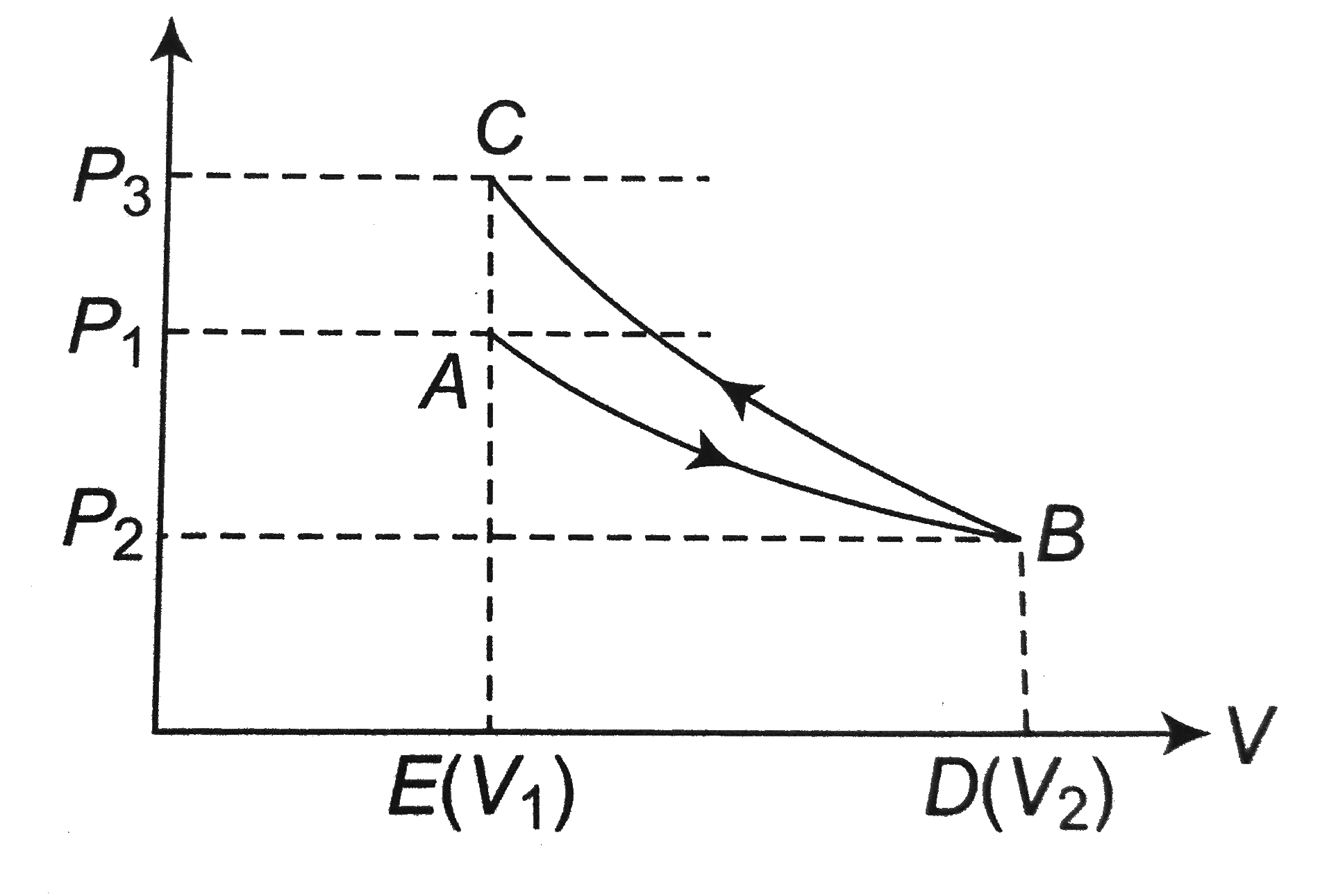
An ideal gas expands isothermally from volume `V_(1)` to `V_(2)` and is then compressed to original volume `V_(1)` adiabatically. Initialy pressure is `P_(1)` and final pressure is `P_(3)`. The total work done is `W`. Then

A

`P_(3)gtP_(1),Wgt0`

B

`P_(3)ltP_(1),Wlt0`

C

`P_(3)ltP_(1),Wlt0`

D

`P_(3)=P_(1),W=0`

Text Solution

Verified by Experts

The correct Answer is:
C

from graph it is clear that `P_(#) ltP_(1)` since area under adiabatic process `(BCED)` is greater that that of isotharmal process `(ABDE)`. Therefore net work done
`W = W_(i+(-W_(A)):'W_(A)lt W_(i)impliesW lt 0`
.
Promotional Banner

Topper's Solved these Questions

  • KINETIC THEORY OF GASES AND THERMODYNAMICS

    A2Z|Exercise AIIMS Questions|27 Videos
  • GRAVITATION

    A2Z|Exercise Chapter Test|29 Videos
  • MOCK TEST

    A2Z|Exercise Motion With Constant Acceleration|15 Videos

Similar Questions

Explore conceptually related problems

An ideal gas of volume V and pressure P expands isothermally to volume 16 V and then compressed adiabatically to volume V . The final pressure of gas is [ gamma = 1.5]

A gas expands under constant pressure P from volume V_(1) to V_(2) The work done by the gas is

A sample of ideal gas undergoes isothermal expansion in a reversible manner from volume V_(1) to volume V_(2) . The initial pressure is P_(1) and the final pressure is P_(2) . The same sample is then allowed to undergoes reversible expansion under adiabatic conditions from volume V_(1) to V_(2) . The initial pressure being same but final pressure is P_(2) . The work of expansion in adiabatic process (w_(adi)) is related to work of expansion in isothermal process (w_(iso)) is

A sample of ideal gas undergoes isothermal expansion in a reversible manner from volume V_(1) to volume V_(2) . The initial pressure is P_(1) and the final pressure is P_(2) . The same sample is then allowed to undergoes reversible expansion under adiabatic conditions from volume V_(1) to V_(2) . The initial pressure being same but final pressure is P_(2) . If P_(3) and P_(2) are equal, then

A sample of ideal gas undergoes isothermal expansion in a reversible manner from volume V_(1) to volume V_(2) . The initial pressure is P_(1) and the final pressure is P_(2) . The same sample is then allowed to undergoes reversible expansion under adiabatic conditions from volume V_(1) to V_(2) . The initial pressure being same but final pressure is P_(2) . Which relation is correct (gamma = (C_(P))/(C_(V))) ?

A sample of ideal gas undergoes isothermal expansion in a reversible manner from volume V_(1) to volume V_(2) . The initial pressure is P_(1) and the final pressure is P_(2) . The same sample is then allowed to undergoes reversible expansion under adiabatic conditions from volume V_(1) to V_(2) . The initial pressure being same but final pressure is P_(2) . Which of the following is correct?

A sample of ideal gas undergoes isothermal expansion in a reversible manner from volume V_(1) to volume V_(2) . The initial pressure is P_(1) and the final pressure is P_(2) . The same sample is then allowed to undergoes reversible expansion under adiabatic conditions from volume V_(1) to V_(2) . The initial pressure being same but final pressure is P_(2) . Which graphic representation is correct a.

A2Z-KINETIC THEORY OF GASES AND THERMODYNAMICS-Chapter Test
  1. Two identical containers A and B with frictionless pistons contain the...

    Text Solution

    |

  2. Two cylinders A and B fitted with pistons contain equal amounts of an ...

    Text Solution

    |

  3. A gas mixture consists of 2 moles of oxygen and 4 moles of argon at te...

    Text Solution

    |

  4. A monoatomic ideal gas, initially at temperature T1, is enclosed in a ...

    Text Solution

    |

  5. In a given process on an ideal gas, dW=0 and dQlt0. Then for the gas

    Text Solution

    |

  6. Which of the following graphs correctly represents the variation of be...

    Text Solution

    |

  7. An ideal gas is taken through the cycle AtoBtoCtoA, as shown in the fi...

    Text Solution

    |

  8. An ideal gas expands isothermally from volume V(1) to V(2) and is then...

    Text Solution

    |

  9. An ideal gas is filled in a closed rigid and thermally insulated conta...

    Text Solution

    |

  10. A Carnot engine operates between 327^(@)C and 27^(@)C How much heat (i...

    Text Solution

    |

  11. One mole of gas having gamma = 7//5 is mixed with 1 mole of a gas havi...

    Text Solution

    |

  12. Two cylinders A and B fitted with pistons contain equal amounts of an ...

    Text Solution

    |

  13. Internal energy of n(1) mol of hydrogen of temperature T is equal to t...

    Text Solution

    |

  14. An ideal gas (gamma = 1.5) is expanded adiabatically. How many times h...

    Text Solution

    |

  15. If 2 mol of an ideal monatomic gas at temperature T(0) are mixed with ...

    Text Solution

    |

  16. Three samples A, B and C of the same gas (gamma = 1.5) have equal volu...

    Text Solution

    |

  17. P - V diagram of an ideal gas is as shown in figure. Work done by the ...

    Text Solution

    |

  18. Statement I: The specific heat of a gas in an adiabatic process is zw...

    Text Solution

    |

  19. Asssertion: It is not possible for a system, unaided by an external ag...

    Text Solution

    |

  20. Assertion : First law of thermodynamics is a restatement of the princi...

    Text Solution

    |

