Home
Class 12
PHYSICS
The lens shown is equiconvex having refr...


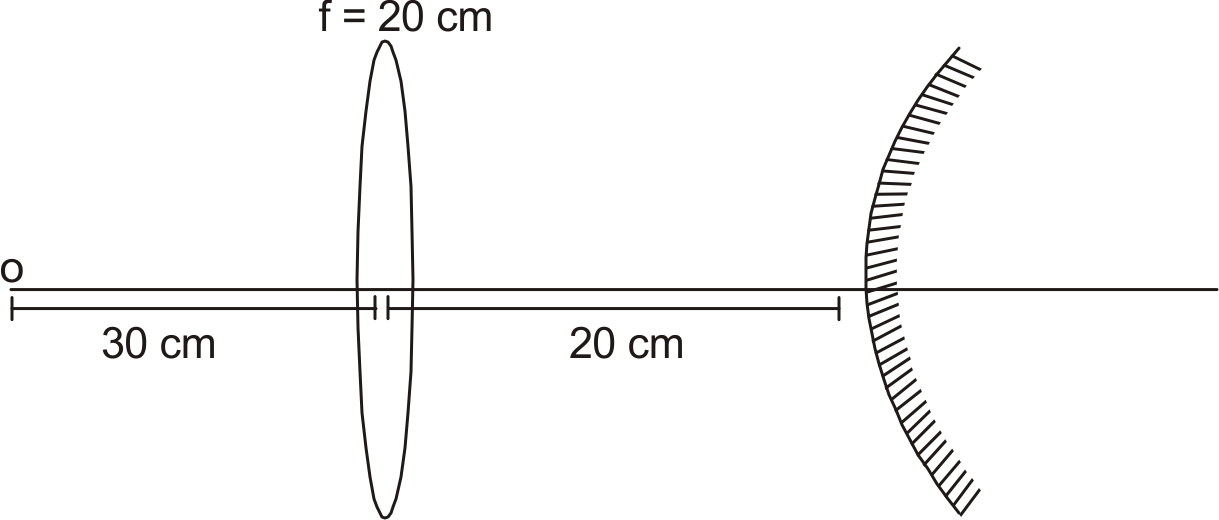
The lens shown is equiconvex having refractive Index. 1.5. In the situation shown the final image of object coincides with the object. The region between lens and mirror is now filled with a liquid of Rrefractive Index 2. Then find the separation between O & image formed by convex mirror.

A

33 cm

B

66 cm

C

16 cm

D

32 cm

Text Solution

Verified by Experts

Case-1:
Radius of curvature of lens is 20 cm
Image of fomred by convex lens should be at centre of curvature of mirror
`(1)/(V)+(1)/(30)=(1)/(20)`
`(1)/(V)=(1)/(20)-(1)/(30)impliesV=60cm`
Radius curvature of mirror should be 40 m.
Case-II
`(2)/(V_(1))+(1)/(30)=(1.5-1)/(20)+(2-1.5)/(-20)`
`impliesV=-60`
So for convex mirror `u=-80`
`(1)/(V)-(1)/(80)=(1)/(20)`
`V=16cm`
Separation between object and this image `O=66cm`
Promotional Banner

Topper's Solved these Questions

  • NUCLEAR PHYSICS

    RESONANCE|Exercise Advanced level solutions|16 Videos
  • SEMICONDUCTORS

    RESONANCE|Exercise Exercise 3|88 Videos

Similar Questions

Explore conceptually related problems

An small object is kept at 18cm from combination of a convex lens and plane mirror to get the image on object itself. Now the space between lens and mirror is filled with liquid of refractive index muL . Now we need to keep the object at 27cm to get the image on object. Find muL .

A thin equiconvex lens of refractive index 3//2 is placed on a horizontal plane mirror as shown in figure. The space between the lens and the mirror is filled with a liquid of refractive index 4//3 . It is found that when a point object is placed 15 cm above the lens on its priincipal axis, the object coincides with its own image. Q. If another liquid is filled instead of water, the object and the image coincide at a distance 25 cm from the lens. Calculate the refractive index of the liquid.

A thin equiconvex lens of refractive index 3//2 is placed on a horizontal plane mirror as shown in figure. The space between the lens and the mirror is filled with a liquid of refractive index 4//3 . It is found that when a point object is placed 15 cm above the lens on its priincipal axis, the object coincides with its own image. Q. The radius of curvature of the convex surface is

A real image of an object is formed by a conex lens at the bottom of an empty beaker. The beaker is now filled with a liquid of refractive index 1.4 to a depth of 7 cm. In order to get the image again at the bottom the beaker shoud be moved

An equi-convex lens, having radius of curvature 33 cm is placed on a horizontal plane mirror and a pin held 20 cm above the lens coincides with its image. Now the space between the and the mirror is filled with a liquid in order to coicide with the image the pin has to be raised by 5 cm. The refractive index of the liquid is

An object is placed at a distance of 12 cm from a convex lens. A convex mirror of focal length 15 cm is placed on other side of lens at 8 cm as shown in the figure. Image of object coincides with the object. When the convex mirror is removed, a real and inverted image is formed at a position. The distance of the image from the object will be (cm) .

An equiconvex lens of refractive index n_(2) is placed such that the refractive index of the surrouding media is as shown. The lens :

The minimum distance between an object and its real image formed by a convex lens is

RESONANCE-REVISION DPP-All Questions
  1. Consider a solid sphere of density rho and radius 4R. Centre of the sp...

    Text Solution

    |

  2. The lens shown is equiconvex having refractive Index. 1.5. In the situ...

    Text Solution

    |

  3. The electric field intensity at the center of a uniformly charged hemi...

    Text Solution

    |

  4. A thin converging lens forms a real image of an object located far awa...

    Text Solution

    |

  5. A point object P is moving towards left with speed 5 mm/sec parallel t...

    Text Solution

    |

  6. Monochromatic light rays parallel to x-axis strike a convex lens AB of...

    Text Solution

    |

  7. Two point charges having charge +Q, –q and mass M, m respectively are ...

    Text Solution

    |

  8. At distance 'r' from a point charge, the ratio (U)/(V^(2)) (where 'U' ...

    Text Solution

    |

  9. A cylindrical portion of radius r is removed from a solid sphere of ra...

    Text Solution

    |

  10. Two satellites revolve around the ‘Sun’ as shown in the figure. First ...

    Text Solution

    |

  11. A small area is removed from a uniform spherical shell of mass M and r...

    Text Solution

    |

  12. A meteorite approaching a planet of mass M (in the straight line passi...

    Text Solution

    |

  13. Two converging lenses have focal length f1 and f2 (f1gtgtf2 ). The o...

    Text Solution

    |

  14. In the figure shown an infinitely long wire of uniform linear charge d...

    Text Solution

    |

  15. Consider a spherical planet rotating about its axis. The velocity of a...

    Text Solution

    |

  16. The figure shows two equal, positive charges, each of magnitude 50 muC...

    Text Solution

    |

  17. Orbital velocity of a satellite in its orbit (around earth) of radius ...

    Text Solution

    |

  18. A solid spherical planet of mass 2m and radius 'R' has a very small tu...

    Text Solution

    |

  19. In the figure shown A & B are two charged particles having charges q a...

    Text Solution

    |

  20. A light ray enters into a medium whose refractive index varies along t...

    Text Solution

    |

