Home
Class 12
PHYSICS
Position (in m) of a particle moving on ...

Position (in m) of a particle moving on a straight line varies with time (in sec) as `x=t^(3)//3-3t^(2)+8t+4 (m)`. Consider the motion of the particle from t=0 to t=5 sec. `S_(1)` is the total distance travelled and `S_(2)` is the distance travelled during retardation. if `s_(1)//s_(2)=((3alpha+2))/11` the find `alpha`.

Text Solution

Verified by Experts
`x=t^(3)//3-3t^(2)+8t+4`
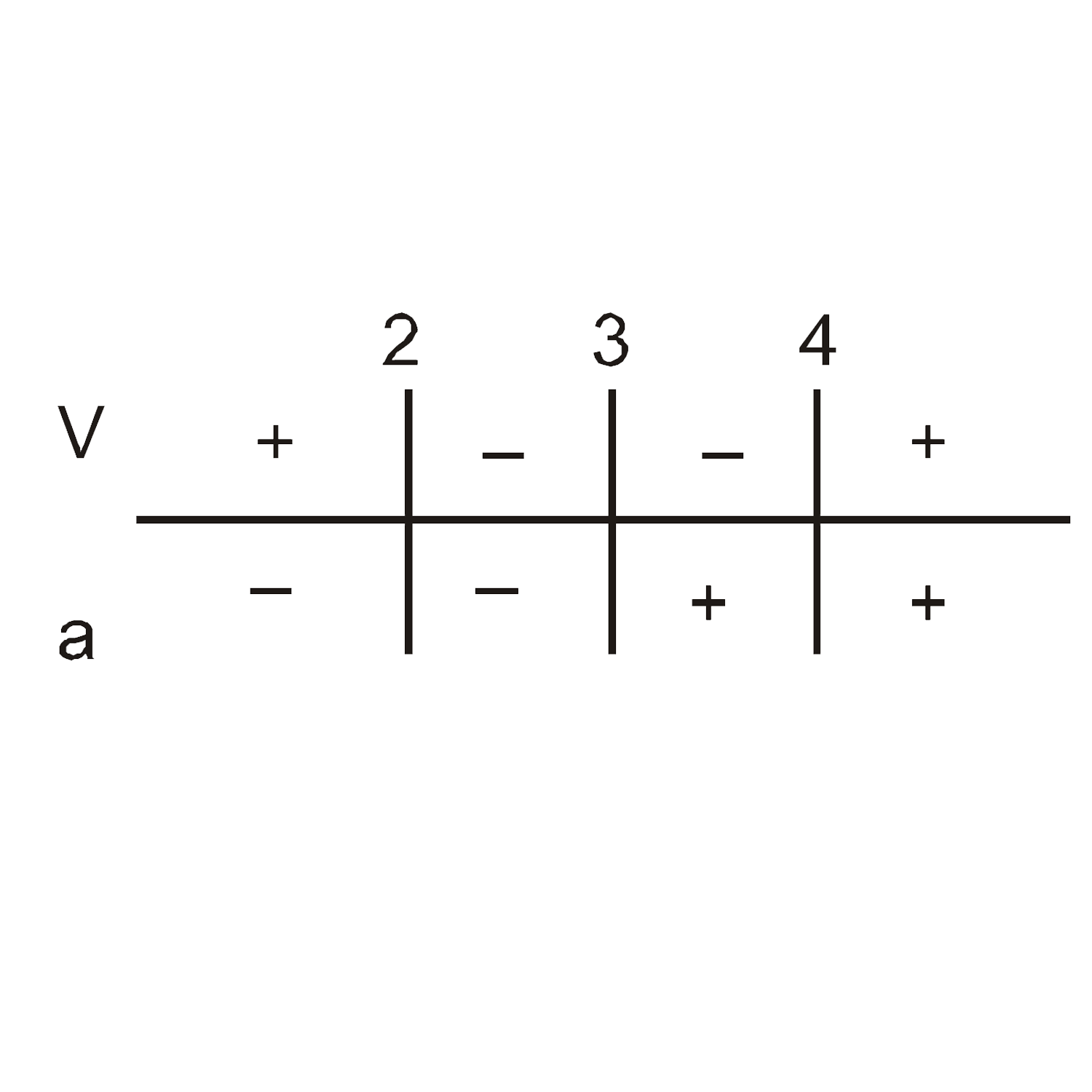
`v=t^(2)-6t+8=(t-2)(t-4)`
`a=2(t-3)`

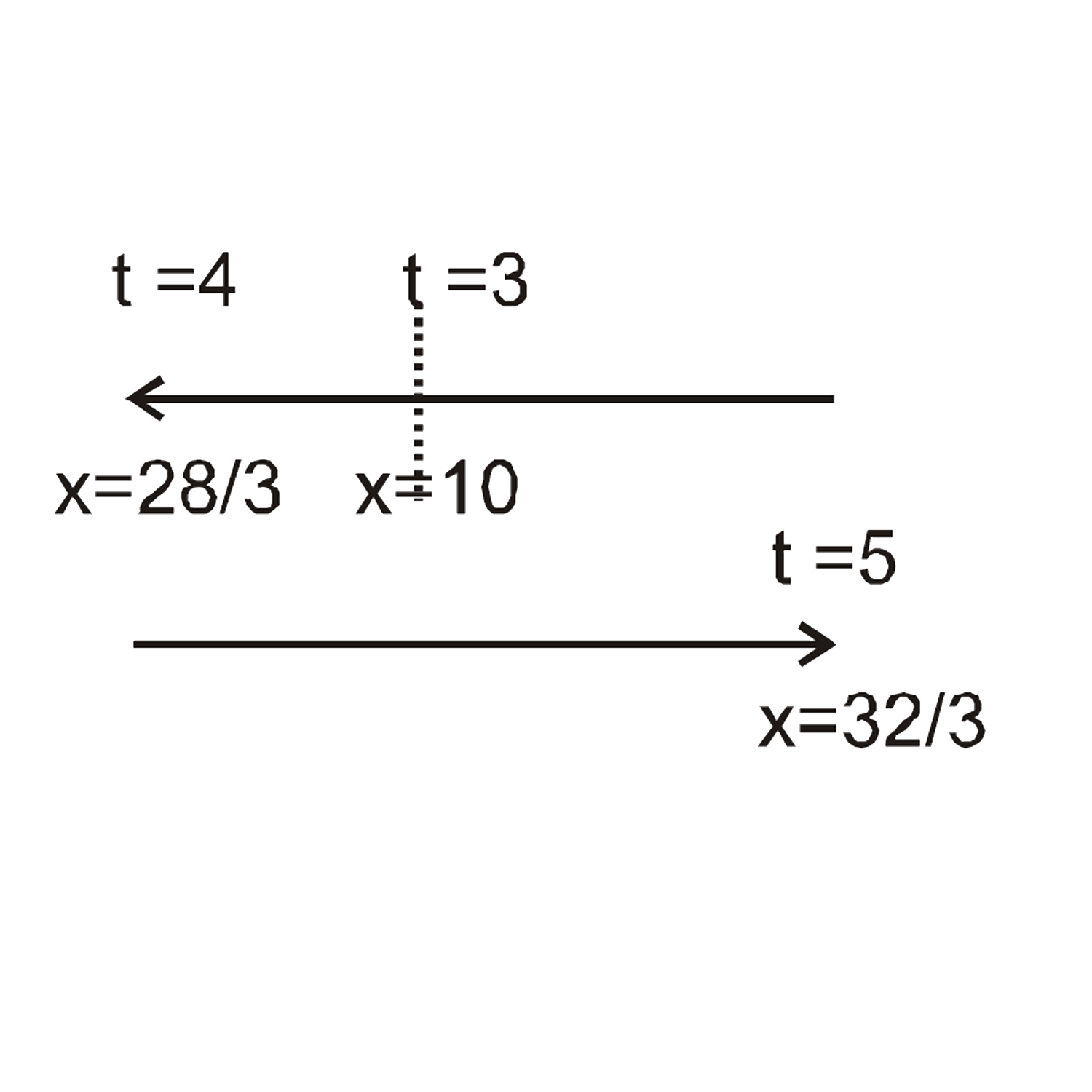
`S_(1)=((32)/(3)xx4)+((32)/(3)-(28)/(3))+((32)/(3)-(28)/(3))=(20)/(3)+(8)/(3)=(28)/(3)m`.

`S_(2)=((32)/(3)-4)+(10-(28)/(3))=(20)/(3)+(2)/(3)=(22)/(3)m`
`(S_(1))/(S_(2))=(28)/(22)=(14)/(11)=(3alpha+2)/(11)rArr alpha=4`
Promotional Banner

Topper's Solved these Questions

  • NUCLEAR PHYSICS

    RESONANCE|Exercise Advanced level solutions|16 Videos
  • SEMICONDUCTORS

    RESONANCE|Exercise Exercise 3|88 Videos

Similar Questions

Explore conceptually related problems

The distance s travelled by a particle moving on a straight line in time t sec is given by s=2t^(3)-9t^(2)+12t+6 then the initial velocity of the particle is

A particle moves along a straight line such that its displacement at any time t is given by s = 3t^(3)+7t^(2)+14t + 5 . The acceleration of the particle at t = 1s is

Displacement of a particle of mass 2 kg varies with time as s=(2t^(2)-2t + 10)m . Find total work done on the particle in a time interval from t=0 to t=2s .

The position of a particle moving along a straight line is defined by the relation, x=t^(3)-6t^(2)-15t+40 where x is in meters and t in seconds.The distance travelled by the particle from t=0 to t=2 s is?

The position of a particle moving along x-axis varies eith time t as x=4t-t^(2)+1 . Find the time interval(s) during which the particle is moving along positive x-direction.

Velocity (in m/s) of a particle moving along x-axis varies with time as, v= (10+ 5t -t^2) At time t=0, x=0. Find (a) acceleration of particle at t = 2 s and (b) x-coordinate of particle at t=3s

The position versus time graph of a particle moving along a straight line is shown. What is the total distance travelled by the particle from t=0s to t=10s?

The velocity 'v' of a particle moving along straight line is given in terms of time t as v=3(t^(2)-t) where t is in seconds and v is in m//s . The distance travelled by particle from t=0 to t=2 seconds is :

If displacement of particle is s=(t^(3))/(3)-(t^(2))/(2)-(t)/(2)+6 , then velocity of the particle at t=4 sec. is

[" If position of particle moving in straight line is "],[" given by "x=(t^(3)-2t+10)m" ,where t is time in "],[" second,then acceleration of particle at "t=1],[" sec is "......]

RESONANCE-REVISION DPP-All Questions
  1. The system shown is in limiting equilibrium. The coefficient of fricti...

    Text Solution

    |

  2. A small body is projected with a velocity of 20.5 ms^(-1) along rough ...

    Text Solution

    |

  3. Position (in m) of a particle moving on a straight line varies with ti...

    Text Solution

    |

  4. A block of 7 kg is placed on a rough horizontal surface and is pulled ...

    Text Solution

    |

  5. The block of mass m(1) is placed on a wedge of an angle theta, as show...

    Text Solution

    |

  6. One has to throw a particle from one side of a fixed sphere, in a diam...

    Text Solution

    |

  7. In the situation shown coefficient of friction between A and B is 0.5 ...

    Text Solution

    |

  8. In the figure acceleration of bodies A,B and C are shown with directio...

    Text Solution

    |

  9. Two blocks A and B of mass m and 2m are intially at rest. Length of bl...

    Text Solution

    |

  10. Two blocks A and B of mass m and 2m are intially at rest. Length of bl...

    Text Solution

    |

  11. A smooth wedge of mass M is pulled towards left with an acceleration a...

    Text Solution

    |

  12. A smooth wedge of mass M is pulled towards left with an acceleration a...

    Text Solution

    |

  13. A smooth wedge of mass M is pulled towards left with an acceleration a...

    Text Solution

    |

  14. Three indentical uniform blocks of mass m each and length L are placed...

    Text Solution

    |

  15. Three indentical uniform blocks of mass m each and length L are placed...

    Text Solution

    |

  16. Three indentical uniform blocks of mass m each and length L are placed...

    Text Solution

    |

  17. Initially both blocks are at rest on a horizontal surface and string i...

    Text Solution

    |

  18. Three blocks of masses m(1), m(2) and M are arranged as shown in figur...

    Text Solution

    |

  19. Consider two infinite large parallel current carrying sheet. Current u...

    Text Solution

    |

  20. Consider two uniformaly charged concentric and coaxial rings of radii ...

    Text Solution

    |