Home
Class 12
PHYSICS
A particle is moving along an elliptical...

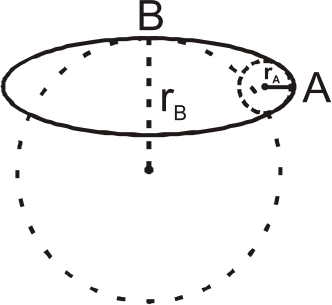
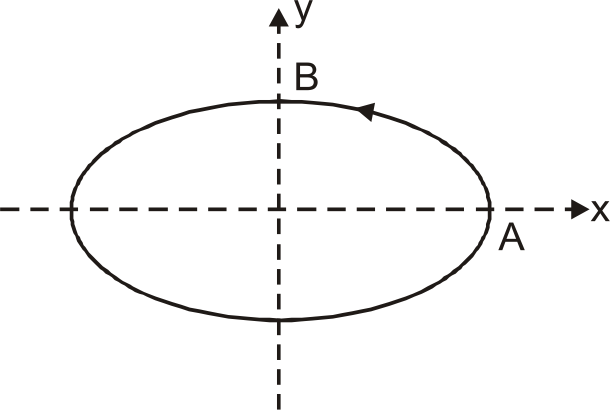
A particle is moving along an elliptical path with constant speed. As it moves from A to B, magnitude of its acceleration :

A

Continuously increases

B

continuously decreases

C

Remains constant

D

first increases and then decreases

Text Solution

Verified by Experts

`a_(t)=(dv)/(dt)=0`
`a_(c)=(v^(2))/R`
From A to B radius of curvature increases
So, acceleration decreases
Promotional Banner

Topper's Solved these Questions

  • NUCLEAR PHYSICS

    RESONANCE|Exercise Advanced level solutions|16 Videos
  • SEMICONDUCTORS

    RESONANCE|Exercise Exercise 3|88 Videos

Similar Questions

Explore conceptually related problems

A particle is moving along an elliptical path with a constant speed. As it moves from A to B, magnitude of its acceleration:

If a particle is moving along a circular path with constant speed, then Its motion is

A particle is moving in a circle with a constant speed. Its moving is

A particle moves in a circular path with constant speed . Its motion is

A particle is moving on a circular path with constant speed, then its acceleration will be

A particle is moving along a circular path with a constant speed 10 ms^-1 .What is the magnitude of the change in velocity of the particle ,when it moves through an angle of 60^@ around the center of the circle ?

A particle is moving on a circular path with a constant speed 'v'. Its change of velocity as it moves from A to B is:

If a particle is moving on a circular path with constant speed, then the angle between the direction of acceleration and its position vector w.r.t. centre of circle will be

A particle moves on circular path of radius 5 m with constant speed 5 m/s. Find the magnitude of its average acceleration when it completes half revolution.

A particle is moving horizontally with constant acceleration.

RESONANCE-REVISION DPP-All Questions
  1. Power of the only force acting on a particle of mass m=1 kg moving in ...

    Text Solution

    |

  2. Sand is falling on a flat car being pulled with constant speed. The ra...

    Text Solution

    |

  3. A particle is moving along an elliptical path with constant speed. As ...

    Text Solution

    |

  4. A small bead of mass m = 1 kg is free to move on a circular hoop. The ...

    Text Solution

    |

  5. Two blocks of mass m(1) and m(2) (m(1) lt m(2)) are connected with an ...

    Text Solution

    |

  6. Three point masses are attached by light inextensible strings of vario...

    Text Solution

    |

  7. One end of a light rod of length 1m is attached with a string of lengt...

    Text Solution

    |

  8. Particle sticks to wooden loop, If particle reach at the lowest positi...

    Text Solution

    |

  9. Two identical blocks A and B of mass m each are connected to each othe...

    Text Solution

    |

  10. Three identical particles A, B and C of mass m lie on a smooth horizo...

    Text Solution

    |

  11. A particle is attached to an end of a rigid rod. The other end of the ...

    Text Solution

    |

  12. A particle is moving in a uniform circular motion on a horizontal surf...

    Text Solution

    |

  13. The linear momentum of a particle is given by vec(P)=(a sin t hati- ac...

    Text Solution

    |

  14. A circular road of radius r is banked for a speed v=40 km/hr. A car of...

    Text Solution

    |

  15. A cylinder of radius R is rotating about its horizontal axis with cons...

    Text Solution

    |

  16. A gun which fires small balls of mass 20 g is firing 20 balls per seco...

    Text Solution

    |

  17. A rocket of total mass 1000kg initially is launched from ground. The g...

    Text Solution

    |

  18. AB is a long frictionless horizontal surface. One end of an ideal spri...

    Text Solution

    |

  19. In a region, potential energy varies with X as U(x)=30-(x-5)^(2) Joule...

    Text Solution

    |

  20. Two particles A and B are revolving with constant angular velocity on ...

    Text Solution

    |