Home
Class 12
PHYSICS
The figure shows a block of mass M=2m ha...

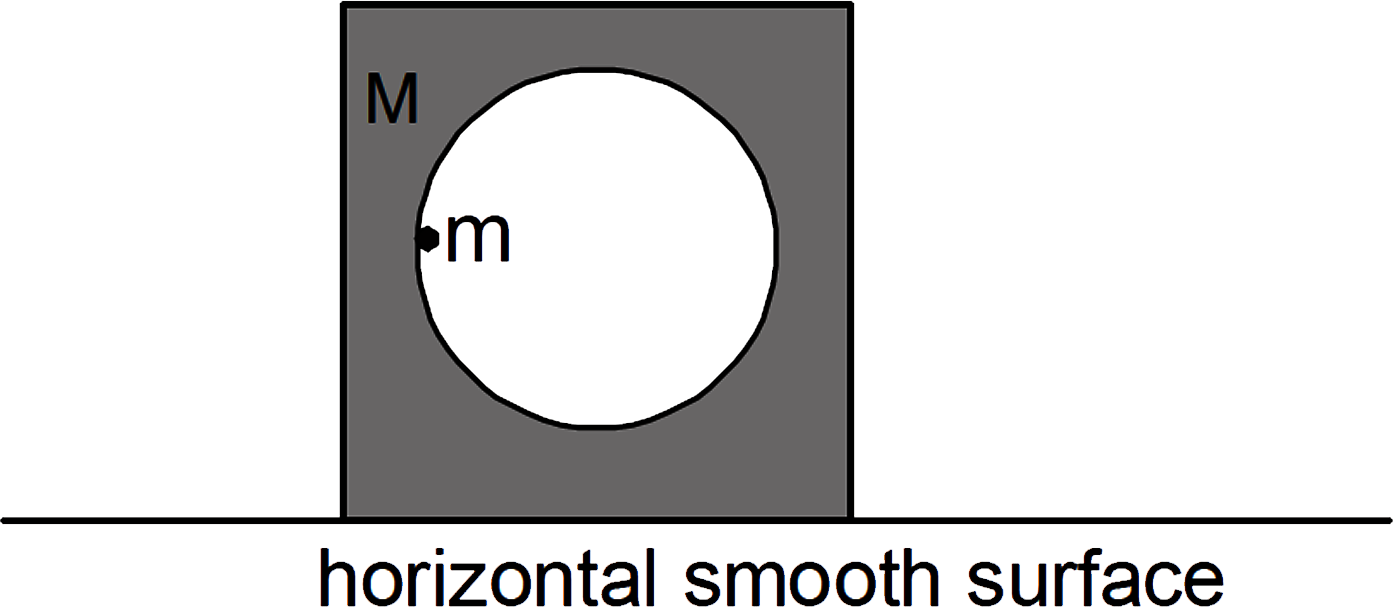
The figure shows a block of mass M=2m having a spherical smooth cavity of radius R placed on a smooth horizontal surface .There is a small ball of mass m moving at an instant vertically downward with a velocity v with respect to the block .At this instant :

A

The normal reaction on the ball by the block is `(mv^(2))/R`

B

The normal reaction on the ball by the block is `2/3 (mv^(2))/R`

C

The acceleration of the block with respect to the ground is `(v^(2))/(3R)`

D

The acceleration of the block with respect to the ground is `(v^(2))/(2R)`

Text Solution

Verified by Experts

Let the normal force between the block and the ball be N
For the block, from Newton's `II^(nd)` law, we have N=Ma=2ma
For ball (with respect to the block), from Newton's `II^(nd)` law, we have `N+ma=(mv^(2))/R`
Solve the two equations.
Promotional Banner

Topper's Solved these Questions

  • NUCLEAR PHYSICS

    RESONANCE|Exercise Advanced level solutions|16 Videos
  • SEMICONDUCTORS

    RESONANCE|Exercise Exercise 3|88 Videos

Similar Questions

Explore conceptually related problems

A block of mass m is placed at rest on a smooth wedge of mass M placed at rest on a smooth horizontal surface. As the system is released

Figure shows a block A of mass 6 m having a smooth semicircular groove of radius a placed on a smooth horizontal surface. A block B of mass m is released from a position in groove where its radius is horizontal. Find the speed of the bigger block when the smaller block reaches its bottom most position.

A smooth wedge of mass M rests on a smooth horizontal surface. A block of mass m is projected from its lowermost point with velocity v_(0) . What is the maximum height reached by the block?

A block of mass m moving with velocity v_(0) on a smooth horizontal surface hits the spring of constant k as shown. Two maximum compression in spring is

Figure shows a wedge A of mass 6 m smooth semicircular groove of radius a= 8.4 m placed on a smooth horizontal surface. A small block B of mass m is released from a position in groove where its radius is horizontal. Find the speed (in ms^(-1) ) of bigger block when smaller block reaches its bottommost position.

Figure shown a block of mass m placed on a smooth wedge of mass M. Calculate the minimum value of M' and tension in the string, so that the block of mass m will move vertically downwards with acceleration 10ms^(-2)

Figure shows a block of mass 2m sliding on a block of mass m. Find the acceleration of each block . ( All surface are smooth )

A man of mass m_1 is standing on a platform of mass m_2 kept on a smooth horizontal surface. The man starts moving on the platform with a velocity v_r relative to the platform. Find the recoil velocity of platform.

A long block A of mass M is at rest on a smooth horizontal surface.A small block B of mass M//2 is placed on A at one end and projected along A with some veklocity v.The coefficient of friction between the block is mu then , the accelerations of blocks A and B before reaching a common velocity will be respectively

Two identical cubes of mass 1.5 M each are kept almost touching the faces on a smooth horizontal surface On top of them we neatly placed a smooth ball of mass M, which begins to move vertically downwards, pushing the cubes sideways. Find the velocity of the ball (in m//s) just before impact on the horizontal surface The initial velocity of the ball is negligible Radius of the ball is 5m side of cube 2.5 m

RESONANCE-REVISION DPP-All Questions
  1. The figure shows a block of mass M=2m having a spherical smooth cavity...

    Text Solution

    |

  2. Consider a solid sphere of density rho and radius 4R. Centre of the sp...

    Text Solution

    |

  3. The lens shown is equiconvex having refractive Index. 1.5. In the situ...

    Text Solution

    |

  4. The electric field intensity at the center of a uniformly charged hemi...

    Text Solution

    |

  5. A thin converging lens forms a real image of an object located far awa...

    Text Solution

    |

  6. A point object P is moving towards left with speed 5 mm/sec parallel t...

    Text Solution

    |

  7. Monochromatic light rays parallel to x-axis strike a convex lens AB of...

    Text Solution

    |

  8. Two point charges having charge +Q, –q and mass M, m respectively are ...

    Text Solution

    |

  9. At distance 'r' from a point charge, the ratio (U)/(V^(2)) (where 'U' ...

    Text Solution

    |

  10. A cylindrical portion of radius r is removed from a solid sphere of ra...

    Text Solution

    |

  11. Two satellites revolve around the ‘Sun’ as shown in the figure. First ...

    Text Solution

    |

  12. A small area is removed from a uniform spherical shell of mass M and r...

    Text Solution

    |

  13. A meteorite approaching a planet of mass M (in the straight line passi...

    Text Solution

    |

  14. Two converging lenses have focal length f1 and f2 (f1gtgtf2 ). The o...

    Text Solution

    |

  15. In the figure shown an infinitely long wire of uniform linear charge d...

    Text Solution

    |

  16. Consider a spherical planet rotating about its axis. The velocity of a...

    Text Solution

    |

  17. The figure shows two equal, positive charges, each of magnitude 50 muC...

    Text Solution

    |

  18. Orbital velocity of a satellite in its orbit (around earth) of radius ...

    Text Solution

    |

  19. A solid spherical planet of mass 2m and radius 'R' has a very small tu...

    Text Solution

    |

  20. In the figure shown A & B are two charged particles having charges q a...

    Text Solution

    |

  21. A light ray enters into a medium whose refractive index varies along t...

    Text Solution

    |