Home
Class 12
PHYSICS
A nonconducting ring of uniform mass m, ...

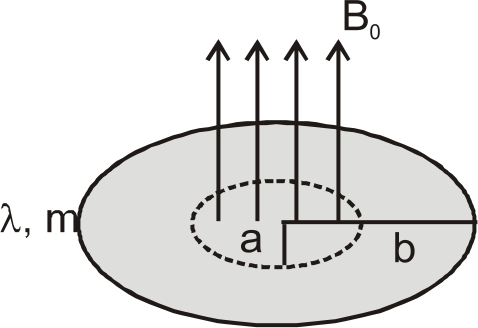
A nonconducting ring of uniform mass m, radius b and uniform linear charge density `lambda` is suspended as shown in figure in a gravity free space. There is uniform coaxial magnetic field `B_0`, pointing up in a circular region of radius 'a' `(lt b)`. Now if this field is switched off, then:-

A

There will be induced electric field on periphery of ring, in anticlockwise sense when seen from above

B

Induced electric field imparts angular momentum of magnitude `lambda pia^(2)b B_(o)`

C

Final angular velocity of ring will be more if time taken to switch of the field `B_(o)` is small

D

Final angular velocity will always be independent of time taken to switch off the field `B_(o)`

Text Solution

Verified by Experts

Changing magnetic field (at switching off `B_(0)` to zero) induced electric field in such a way to restore the upwards flux, hence anticlockwise (E) as seen from above
` intvec(E).vec(dl)=-(dphi)/(dt)=-pia^(2)(dB)/(dt)=intEdl`
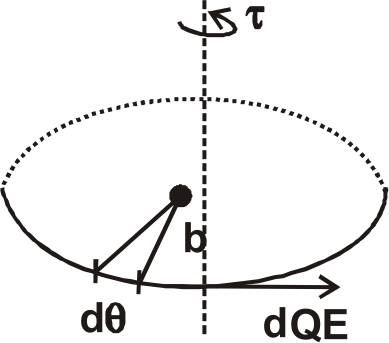
There is force on small element dQ of ring, tangentially Now this force produces torque about axis of ring to rotate in anticlockwise sense, so
`tau=int dQExxb=intlambdadlEb=lambdabintEdl=lambdabpia^(2)(dB)/(dt)`
So impulse or torque
`int taudt=lambdab pia^(2)int_(B_(0))^(2)dB=int taudt=lambdabpi a^(2)B_(0)`
`L_(f)-L_(i)=DeltaL=inttau dt =lambda b pia^(2)B_(0) =Iomega` (in magnitude)
It is indpendent of time taken `I omega_(f)-Iomega_(i)=lambdab pia^(2)B_(0)`
where I is moment of inertia
So, `omega_(f)=(lambdab pi a^(2)B_(0))/(mR^(2))`
Promotional Banner

Topper's Solved these Questions

  • NUCLEAR PHYSICS

    RESONANCE|Exercise Advanced level solutions|16 Videos
  • SEMICONDUCTORS

    RESONANCE|Exercise Exercise 3|88 Videos

Similar Questions

Explore conceptually related problems

Figure shows a long wire having uniform charge density lambda as shown in figure. Calculate electric field intensity at point P.

A quarter ring of radius R is having uniform charge density lambda . Find the electric field and potential at the centre of the ring.

A line charge with linear charge density lambda is wound around an insulating disc of mass M and radius R , which is then suspended horizontally as shown in Fig. 3.90, so that it is free to rotate. In the central region, of radius a , there is a uniform magnetic field B_(0) , pointing up. Now the magnetic field is switched off, which causes the disc to rotate. Find the angular speed with which the disc starts rotating.

An insulating rod of uniform linear charge density A and uniform linear mass density mu lies on a smooth table whose surface is xy -plane. A uniform electric field E is switched on in the space:

A circular ring of radius R and uniform linear charge density +lamdaC//m are kept in x - y plane with its centre at the origin. The electric field at a point (0,0,R/sqrt(2)) is

Metal ring of radius R is placed perpendicular to uniform magnetic field B. Magnetic field starts changing at a rate alpha

There is a ring of radius r having linear charge density lambda and rotating with a uniform angular velocity omega. the magnetic field produced by this ring at its own centre would be

A thin non-conducting ring or radius a has a linear charge density lambda = lambda_(0) sin phi . A uniform electric field E_(0) hat(i) + E_(0) hat(j) exist in the region . .Net torque acting on ring is given as :

A thin non conducting ring of mass m , radius a carrying a charge q can rotate freely about its own axis which is vertical. At the initial moment, the ring was at rest in horizontal position and no magnetic field was present. At instant t=0 , a uniform magnetic field is switched on which is vertically downward and increases with time according to the law B=B_0t . Neglecting magnetism induced due to rotational motion of ring. The magnitude of an electric field on the circumference of the ring is

A particle carrying a charge moves perpendicular to a uniform magnetic field of induction B with a momentum p then the radius of the circular path is

RESONANCE-REVISION DPP-All Questions
  1. A nonconducting ring of uniform mass m, radius b and uniform linear ch...

    Text Solution

    |

  2. Consider a solid sphere of density rho and radius 4R. Centre of the sp...

    Text Solution

    |

  3. The lens shown is equiconvex having refractive Index. 1.5. In the situ...

    Text Solution

    |

  4. The electric field intensity at the center of a uniformly charged hemi...

    Text Solution

    |

  5. A thin converging lens forms a real image of an object located far awa...

    Text Solution

    |

  6. A point object P is moving towards left with speed 5 mm/sec parallel t...

    Text Solution

    |

  7. Monochromatic light rays parallel to x-axis strike a convex lens AB of...

    Text Solution

    |

  8. Two point charges having charge +Q, –q and mass M, m respectively are ...

    Text Solution

    |

  9. At distance 'r' from a point charge, the ratio (U)/(V^(2)) (where 'U' ...

    Text Solution

    |

  10. A cylindrical portion of radius r is removed from a solid sphere of ra...

    Text Solution

    |

  11. Two satellites revolve around the ‘Sun’ as shown in the figure. First ...

    Text Solution

    |

  12. A small area is removed from a uniform spherical shell of mass M and r...

    Text Solution

    |

  13. A meteorite approaching a planet of mass M (in the straight line passi...

    Text Solution

    |

  14. Two converging lenses have focal length f1 and f2 (f1gtgtf2 ). The o...

    Text Solution

    |

  15. In the figure shown an infinitely long wire of uniform linear charge d...

    Text Solution

    |

  16. Consider a spherical planet rotating about its axis. The velocity of a...

    Text Solution

    |

  17. The figure shows two equal, positive charges, each of magnitude 50 muC...

    Text Solution

    |

  18. Orbital velocity of a satellite in its orbit (around earth) of radius ...

    Text Solution

    |

  19. A solid spherical planet of mass 2m and radius 'R' has a very small tu...

    Text Solution

    |

  20. In the figure shown A & B are two charged particles having charges q a...

    Text Solution

    |

  21. A light ray enters into a medium whose refractive index varies along t...

    Text Solution

    |