

Home
Class 12
PHYSICS
A block of mass m=2kg of shown dimension...

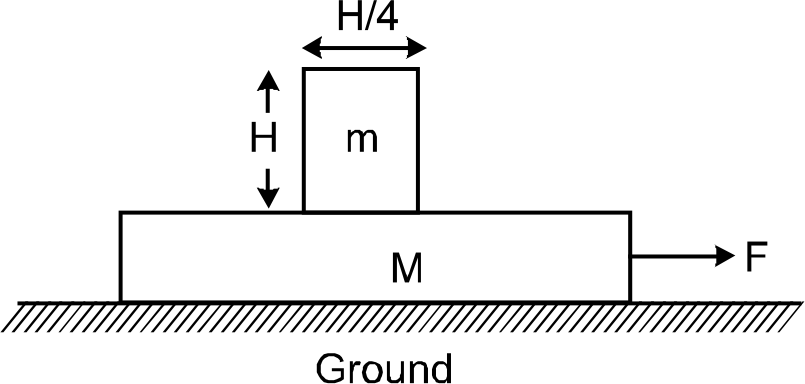
A block of mass m=2kg of shown dimensions is placed on a plank of mass M = 6Kg which is placed on smooth horizontal plane. The coefficient of friction between the block and the plank is `mu=1/3`. If a horizontal froce F is applied on the plank, then find the maximum value of F (in N) for which the block and the plank move together

Text Solution

Verified by Experts

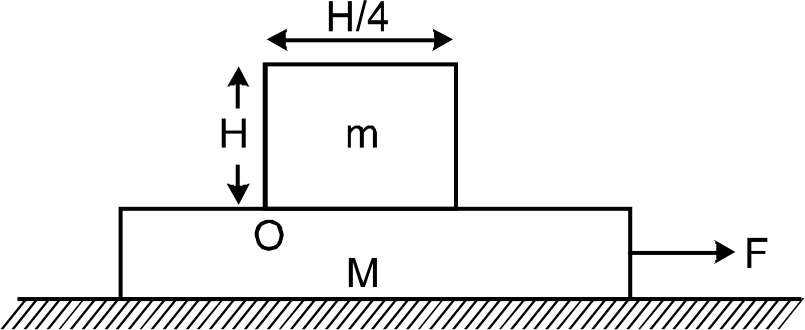
The block has two tendencies

(i) to slide w.r.t. plank
(ii) to topple over the point O maximum acceleration for sliding

`f_(s)=ma le f_(L)`
`ma le mu mg`
`ale g/3 , a_(max)=g/3`
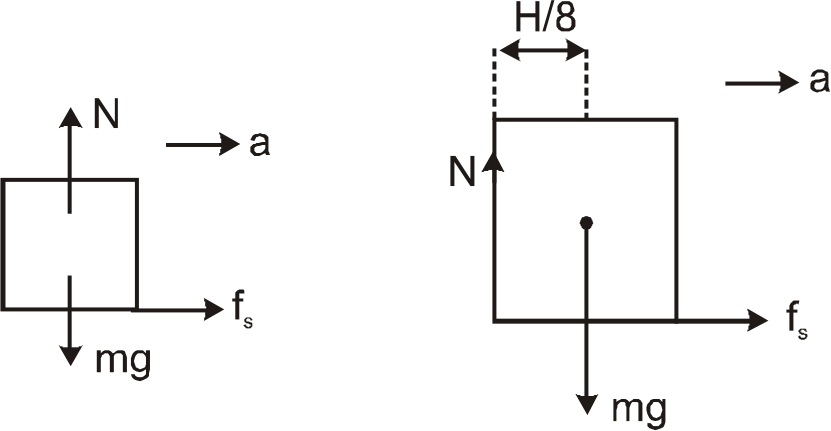
maximum acceleration for toppling,
N=mg, `f_(s)=ma`
`N.(H/8)=H/2 f_(s) , a_(max)=g/4`
So, the block will topple before sliding. hence `f_(max) =(M+m) g/4`
Promotional Banner

Topper's Solved these Questions

  • NUCLEAR PHYSICS

    RESONANCE|Exercise Advanced level solutions|16 Videos
  • SEMICONDUCTORS

    RESONANCE|Exercise Exercise 3|88 Videos

Similar Questions

Explore conceptually related problems

A bolck of mass m =2 kg is placed on a plank of mass M = 10 kg, which is placed on a smooth horizontal plane as shown in the figure. The coefficient of friction between the block and the plank is mu=(1)/(3) . If a horizontal force F is applied on the plank, then the maximum value of F for which the block and the plank move together is (g=10m//s^(2))

A block of mass m=4kg is placed oner a rough inclined plane as shown in figure. The coefficient of friction between the block and the plane is mu=0.5 . A force F=10N is applied on the block at an angle of 30^(@) .

Block of mass m rests on the plank B of mass 3m which is free to slide on a frictionless horizontal surface. The coefficient of friction between the block and plank is 0.2. If a horizontal force of magnitude 2 mg is applied to the plank B, the acceleration of A relative to the plank and relative to the ground respectively, are

A block is kept on a rough horizontal plank. The coefficient of friction between the block and the plank is 1/2 . The plank is undergoing SHM of angular frequency 10 rad/s. The maximum amplitude of plank in which the block does not slip over the plank is (g= 10 m/ s^(2) )

A block is kept on a rough horizontal plank. The coefficient of friction between block and plank is 1//2 . Plank is undergoing SHM is angular frequency 10 rad//s . Find the maximum amplitude of plank in which the block does slip over plank (g = 10 m//s^(2)) .

A bar of mass m_(1) is placed on a plank of mass m_(2) which rests on a smooth horizontal plane . The coefficient of friction between the surfaces of bar and plank is k . The plank is subjected to a horizontal force F depending on time t as F = at , where a is a constant . The moment of time t_(0) at which the plank starts sliding is :

A small block of mass 1kg is placed over a plank of mass 2kg. The length of the plank is 2 m. coefficient of friction between the block and the plnak is 0.5 and the ground over which plank in placed is smooth. A constant force F=30N is applied on the plank in horizontal direction. the time after which the block will separte from the plank is (g=10m//s^(2))

A block A of mass m is over a plank B of mass 2m . Plank B si placed over a smooth horizontal surface. The coefficient of friction between A and B is (1)/(2) . Blocks A is given a velocity V_(0) towards right. Then

A block of mass m is placed gently onto a long plank of mass M moving with a velocity v_(0) on a smooth horizontal floor. If friction is present between M and m :

The coefficient of static friction between the two blocks shown in figure is mu and the table is smooth. What maximum horizontal forced F can be applied to he block of mass M so that the block move together?

RESONANCE-REVISION DPP-All Questions
  1. A ring of radius r made of wire of density rho is rotated about a stat...

    Text Solution

    |

  2. The length of an elastic string is 5 metre when the longitudinal tensi...

    Text Solution

    |

  3. A block of mass m=2kg of shown dimensions is placed on a plank of mass...

    Text Solution

    |

  4. There are two ideal springs of force constants K1 and K2 respectively....

    Text Solution

    |

  5. There are two ideal springs of force constants K1 and K2 respectively....

    Text Solution

    |

  6. There are two ideal springs of force constants K1 and K2 respectively....

    Text Solution

    |

  7. A rod of mass 'm and length L is attached to a L shaped plank at 'A'. ...

    Text Solution

    |

  8. A rod of mass 'm and length L is attached to a L shaped plank at 'A'. ...

    Text Solution

    |

  9. A rod of mass 'm and length L is attached to a L shaped plank at 'A'. ...

    Text Solution

    |

  10. A uniform rod of mass M and length L, area of cross section A is place...

    Text Solution

    |

  11. A uniform rod of mass M and length L, area of cross section A is place...

    Text Solution

    |

  12. A uniform rod of mass M and length L, area of cross section A is place...

    Text Solution

    |

  13. In column-I some conditions are mentioned and magnitude of required re...

    Text Solution

    |

  14. A particle of mass m = 1 kg excutes SHM about mean position O with ang...

    Text Solution

    |

  15. In a spring block system on a horizontal smooth surface. K = spring co...

    Text Solution

    |

  16. A container open from top, filled with water (density rhow) upto the t...

    Text Solution

    |

  17. A uniform solid sphere of radius R is in equilibrium inside a liquid w...

    Text Solution

    |

  18. A large open tank is filled with water upto a height H. A small hole i...

    Text Solution

    |

  19. A capillary tube with inner cross-section in the form of a square of s...

    Text Solution

    |

  20. A sphere of mass m and radius r is projected in a gravity free space w...

    Text Solution

    |