Home
Class 12
PHYSICS
There are two ideal springs of force con...

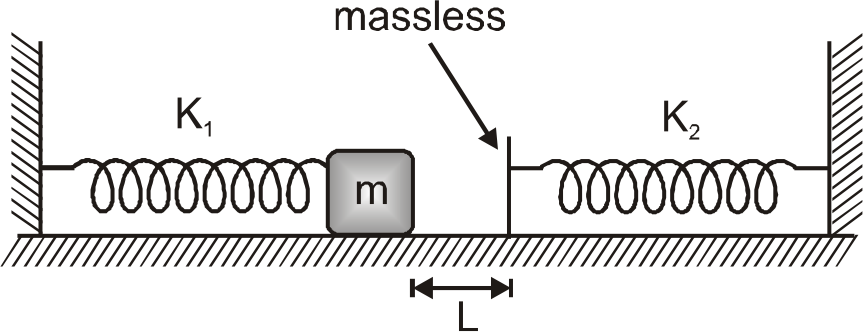
There are two ideal springs of force constants `K_1` and `K_2` respectively. When both springs are relaxed the separation between free ends is L. Now the particle of mass m attached to free end of left spring is displaced by distance 2L towards left and then released. assuming the surface to be frictionless. `((K_(1))/(K_(2))=4/3)`. (Neglect size of the block)

The time interval after which mass 'm' hits the right spring will be

A

`(7pi)/6sqrt(m/(K_(1)))`

B

`(4pi)/3sqrt(m/(K_(1)))`

C

`(3pi)/4sqrt(m/(K_(1)))`

D

`(7pi)/4sqrt(m/(K_(1)))`

Text Solution

Verified by Experts

Time taken by particle to go from
x=0 to x=A/2 is T/12
`:. ` time interval `=T/2+T/12=(7T)/12`
`=7/12 . 2pisqrt(m/(K_(1)))=(7pi)/6sqrt(m/(K_(1)))`
Assume, maximum compression in right spring is x. hence
`1/2 K_(1)(2L)^(2)=1/2 K_(1)(L+x)^(2)+1/2K_(2)x^(2)`
Put `K_(2)=3/4 K_(1)`, we get `x=(6L)/7`
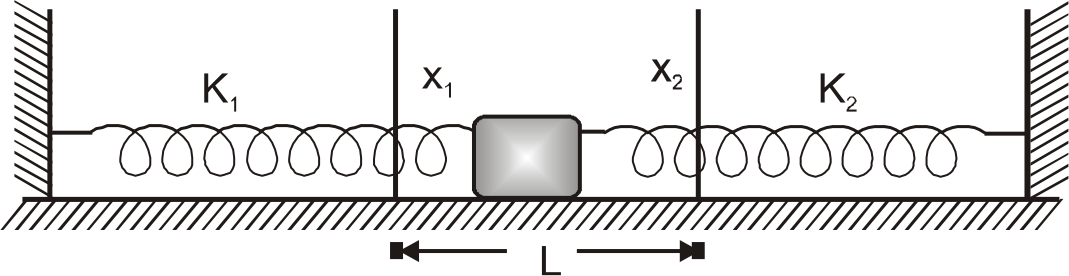
When mass m in equilibrium both spring will be in extended state.

`K_(1)x_(1)=K_(2)x_(2)` and `x_(1)+x_(2) =L`
`x_(1)=(3L)/7`.
Promotional Banner

Topper's Solved these Questions

  • NUCLEAR PHYSICS

    RESONANCE|Exercise Advanced level solutions|16 Videos
  • SEMICONDUCTORS

    RESONANCE|Exercise Exercise 3|88 Videos

Similar Questions

Explore conceptually related problems

There are two ideal springs of force constants K_1 and K_2 respectively. When both springs are relaxed the separation between free ends is L. Now the particle of mass m attached to free end of left spring is displaced by distance 2L towards left and then released. assuming the surface to be frictionless. ((K_(1))/(K_(2))=4/3) . (Neglect size of the block) The maximum compression produced in right spring will be

There are two ideal springs of force constants K_1 and K_2 respectively. When both springs are relaxed the separation between free ends is L. Now the particle of mass m attached to free end of left spring is displaced by distance 2L towards left and then released. assuming the surface to be frictionless. ((K_(1))/(K_(2))=4/3) . (Neglect size of the block) Suppose mass m hits the right spring and sticks to it. The extension in left spring when mass ‘m’ is in equilibrium position during its motion is :

A mass M is suspended by two springs of force constants K_(1) and K_(2) respectively as shown in the diagram. The total elongation (stretch) of the two springs is

As shown in the figure, two light springs of force constant k_(1) and k_(2) oscillate a block of mass m. Its effective force constant will be

Two spring have force constants k_(1) and k_(2) respectively. They are attached to a mass m and two fixed supports as shwon in figure. If the surface is frictionless, fing the time period of oscillations. What is the spring factore of this combination.

A flat spiral spring of force constant K is loaded with mass M and oscillates vertically with a time period T. Then the mass suspended to the free end is

A spring of force constant K rests on a smooth floor, with one end fixed to a wall. A block of mass m hits the free end of the spring with velocity v. The maximum force exerted by the spring on the wall is

Four massless springs whose force constants are 2k, 2k, k and 2k respectively are attached to a mass M kept on a frictionless plane (as shown in figure). If the mass M is displaced in the horizontal direction.

A flat spiral spring of force constant k is loaded with mass M and oscillate about vertical with a time period T. Then the mass suspended to the free end is

Two identical springs of spring constant k are attached to a block of mass m and to fixed supports as shown in figure. When the mass is displaced from equilibrium position by a distance x towards right, find the restoring force.

RESONANCE-REVISION DPP-All Questions
  1. The length of an elastic string is 5 metre when the longitudinal tensi...

    Text Solution

    |

  2. A block of mass m=2kg of shown dimensions is placed on a plank of mass...

    Text Solution

    |

  3. There are two ideal springs of force constants K1 and K2 respectively....

    Text Solution

    |

  4. There are two ideal springs of force constants K1 and K2 respectively....

    Text Solution

    |

  5. There are two ideal springs of force constants K1 and K2 respectively....

    Text Solution

    |

  6. A rod of mass 'm and length L is attached to a L shaped plank at 'A'. ...

    Text Solution

    |

  7. A rod of mass 'm and length L is attached to a L shaped plank at 'A'. ...

    Text Solution

    |

  8. A rod of mass 'm and length L is attached to a L shaped plank at 'A'. ...

    Text Solution

    |

  9. A uniform rod of mass M and length L, area of cross section A is place...

    Text Solution

    |

  10. A uniform rod of mass M and length L, area of cross section A is place...

    Text Solution

    |

  11. A uniform rod of mass M and length L, area of cross section A is place...

    Text Solution

    |

  12. In column-I some conditions are mentioned and magnitude of required re...

    Text Solution

    |

  13. A particle of mass m = 1 kg excutes SHM about mean position O with ang...

    Text Solution

    |

  14. In a spring block system on a horizontal smooth surface. K = spring co...

    Text Solution

    |

  15. A container open from top, filled with water (density rhow) upto the t...

    Text Solution

    |

  16. A uniform solid sphere of radius R is in equilibrium inside a liquid w...

    Text Solution

    |

  17. A large open tank is filled with water upto a height H. A small hole i...

    Text Solution

    |

  18. A capillary tube with inner cross-section in the form of a square of s...

    Text Solution

    |

  19. A sphere of mass m and radius r is projected in a gravity free space w...

    Text Solution

    |

  20. A spherical ball of mass 4m, density sigma and radius r is attached to...

    Text Solution

    |