

Home
Class 12
PHYSICS
The velocity distribution for the flow o...

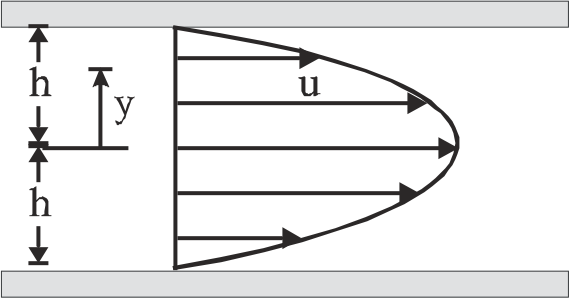
The velocity distribution for the flow of a Newtonian fluid between two wide, parallel plates is given by the equation

`u=(3V)/2[1-(y/h)^(2)]`
where V is the mean velocity. The fluid has coefficient of viscosity `eta` Answer the following 3 questions for this situation.

A

`tau=eta(3V)/h`

B

`tau=eta(3V)/(2h)`

C

`tau=eta(6V)/h`

D

`tau=etaV/h`

Text Solution

Verified by Experts

For this type of parallel flow the shearing stress is given as `ta=eta(du)/(dy)....(i)`
For the given distribution
`(du)/(dy)=-(3Vy)/(h^(2))....(ii)`
(a) Along the bottom wall so that (from eq. (ii))
`(du)/(dy)=(3V)/h` and therefore the shearing stress is `tau_("bottom wall")=eta((3V)/h)`
(b) Along the plane where `y=h//2` it follows from equation (ii) that
`(du)/(dy)=(-3Vy)/(h^(2))` and thus the shearing stress is `|tau|=eta(3V)/(2h)`.
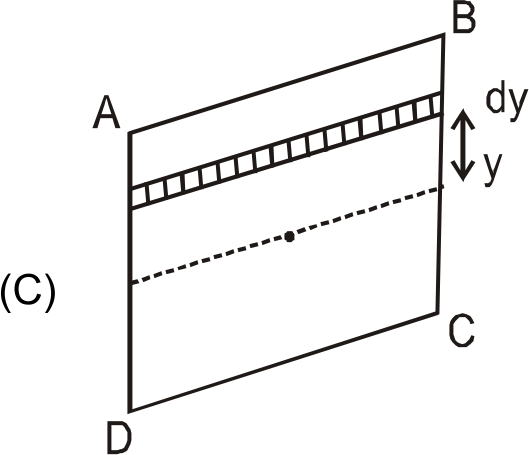
(C)
Rate of volume flow
`2int_(0)^(h) (3V)/2(1-(y^(2))/(h^(2)))dy.l=2Vlh`
Promotional Banner

Topper's Solved these Questions

  • NUCLEAR PHYSICS

    RESONANCE|Exercise Advanced level solutions|16 Videos
  • SEMICONDUCTORS

    RESONANCE|Exercise Exercise 3|88 Videos

Similar Questions

Explore conceptually related problems

The critical velocity of the flow of a liquid through a pipe of radius 3 is given by v_c= (K eta/rp) , where p is the density and eta , is the coefficient of viscosity of liquid. Check if this relation is dimentionally correct.

The coefficient of viscosity n of a fluid moving steadily between two surfaces is given by the formula, f = nA(dV)/(dx) where f is the frictional force on the fluid, A is an area in the fluid and dV//dx is the velocity gradient inside the fluid at that area. The SI unit of viscosity coefficient n is given as.

Find the dimensions of the quantity v in the equation, v=(pip(a^(2)-x^(2)))/(2etal) where a is the radius and l is he length of the tube in which the fluid of coefficient of viscosity eta is flowing , x is the distacne from the axis of the tube and p is the pressure differnece.

The velocity fo a spherical ball through a visocous liquid is given by v = v_(0) (1- e^(kt)) , where v_(0) is the initial velocity and t represents time. If K depends on radius of ball (r) , coefficient of viscosity (eta) and mass fo the ball (m) , tehn

If the velocity of a particle "v" as a function of time "t" is given by the equation,v=a(1-e^(-bt) ,where a and b are constants,then the dimension of the quantity a^2*b^3 will be

The velocity of a moving particle is given by the equation v = (5 - t^(2)) The average acceleration of the particle between the 2nd and 3rd seconds is

The coefficient of viscosity (eta) of a fluid moving steadily between two surface is given by the formula (f) = etaA dV//dx where f is the frictional force on the flluid, A is the area in the fluid, and dN//dx is velocity gradient inside the fluid at that area. The SI unit of viscosity is given as :

When a liquid flows in a tube, there is relative motion between adjacent layers of the liquid. This force is called the viscous force which tends to oppose the relative motion between the layers of the liquid. Newton was the first person to study the factors that govern the viscous force in a liquid. According to Newton’s law of viscous flow, the magnitude of the viscous force on a certain layer of a liquid is given by F = - eta A (dv)/(dx) where A is the area of the layer (dv)/(dx) is the velocity gradient at the layer and eta is the coefficient of viscosity of the liquid. A river is 5 m deep. The velocity of water on its surface is 2 ms^(-1) If the coefficient of viscosity of water is 10 ^(-3 ) Nsm ^(-2) , the viscous force per unit area is :

When an object moves through a fluid, as when a ball falls through air or a glass sphere falls through water te fluid exerts a viscous foce F on the object this force tends to slow the object for a small sphere of radius r moving is given by stoke's law, F_(w)=6pietarv . in this formula eta in the coefficient of viscosity of the fluid which is the proportionality constant that determines how much tangential force is required to move a fluid layer at a constant speed v, when the layer has an area A and is located a perpendicular distance z from and immobile surface. the magnitude of the force is given by F=etaAv//z . For a viscous fluid to move from location 2 to location 1 along 2 must exceed that at location 1, poiseuilles's law given the volumes flow rate Q that results from such a pressure difference P_(2)-P_(1) . The flow rate of expressed by the formula Q=(piR^(4)(P_(2)-P_(1)))/(8etaL) poiseuille's law remains valid as long as the fluid flow is laminar. For a sfficiently high speed however the flow becomes turbulent flow is laminar as long as the reynolds number is less than approximately 2000. This number is given by the formula R_(e)=(2overline(v)rhoR)/(eta) In which overline(v) is the average speed rho is the density eta is the coefficient of viscosity of the fluid and R is the radius of the pipe. Take the density of water to be rho=1000kg//m^(3) Q. Blood vessel is 0.10 m in length and has a radius of 1.5xx10^(-2) m blood flows at rate of 10^(-7)m^(3)//s through this vessel. The pressure difference that must be maintained in this flow between the two ends of the vessel is 20 Pa what is the viscosity sufficient of blood?

When an object moves through a fluid, as when a ball falls through air or a glass sphere falls through water te fluid exerts a viscous foce F on the object this force tends to slow the object for a small sphere of radius r moving is given by stoke's law, F_(w)=6pietarv . in this formula eta in the coefficient of viscosity of the fluid which is the proportionality constant that determines how much tangential force is required to move a fluid layer at a constant speed v, when the layer has an area A and is located a perpendicular distance z from and immobile surface. the magnitude of the force is given by F=etaAv//z . For a viscous fluid to move from location 2 to location 1 along 2 must exceed that at location 1, poiseuilles's law given the volumes flow rate Q that results from such a pressure difference P_(2)-P_(1) . The flow rate of expressed by the formula Q=(piR^(4)(P_(2)-P_(1)))/(8etaL) poiseuille's law remains valid as long as the fluid flow is laminar. For a sfficiently high speed however the flow becomes turbulent flow is laminar as long as the reynolds number is less than approximately 2000. This number is given by the formula R_(e)=(2overline(v)rhoR)/(eta) In which overline(v) is the average speed rho is the density eta is the coefficient of viscosity of the fluid and R is the radius of the pipe. Take the density of water to be rho=1000kg//m^(3) Q. If the sphere in previous question has mass of 1xx10^(-5)kg what is its terminal velocity when falling through water? (eta=1xx10^(-3)Pa-s)

RESONANCE-REVISION DPP-All Questions
  1. The velocity distribution for the flow of a Newtonian fluid between tw...

    Text Solution

    |

  2. The velocity distribution for the flow of a Newtonian fluid between tw...

    Text Solution

    |

  3. The velocity distribution for the flow of a Newtonian fluid between tw...

    Text Solution

    |

  4. A rod is formed by joining two cylinders each having a length l and cr...

    Text Solution

    |

  5. A cubical block of mass m and surface area 6A is placed on a thick lay...

    Text Solution

    |

  6. A very large metal plate carries a charge of Q=-1C. The work function ...

    Text Solution

    |

  7. Consider the following statements: (i) Nuclear fission is normally fol...

    Text Solution

    |

  8. A particle of mass 'm' is projected from ground with velocity u making...

    Text Solution

    |

  9. Light of wavelength 400nm is incident continuously on a Cesium ball. (...

    Text Solution

    |

  10. In a photoelectric experiment, with light of wavelength lambda, the fa...

    Text Solution

    |

  11. The radionuclide .^(238)U decays by emitting an alpha particle. .^(238...

    Text Solution

    |

  12. The energy that should be added to an electron, to reduce its de-Brogl...

    Text Solution

    |

  13. X-rays of high penetrating power are called hard X-ray. Hard X-rays ha...

    Text Solution

    |

  14. The voltage applied to an X-ray tube is 18 kV. The maximum mass of pht...

    Text Solution

    |

  15. In a photoelectric experiment, the frequency and intensity of a light ...

    Text Solution

    |

  16. n a sample of radioactive nuclide

    Text Solution

    |

  17. In a radioactive reactor, radionuclide X are being injected at a rate ...

    Text Solution

    |

  18. Radius of a nucleus is given by the relation R = R(0)A^(1//3) where R...

    Text Solution

    |

  19. Three samples of a radioactive substance have activity in a ratio 2 : ...

    Text Solution

    |

  20. The only source of energy in a particular star is the fusion reaction ...

    Text Solution

    |