Home
Class 12
PHYSICS
A cubical block of mass m and surface ar...

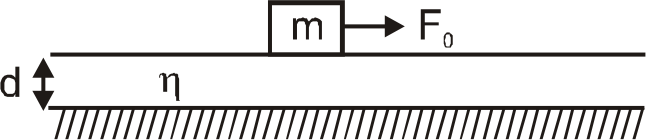
A cubical block of mass m and surface area 6A is placed on a thick layer of viscous liquid, of thickness d as shown

Initially the block is at rest. A constant horizontal force F0 starts acting on the block at t = 0. In column - 1 a physical quantity regarding the motion of the block is given and in column-2 corresponding variation with time is given. Match the proper entries from column-2 to column-1 using the codes given below the columns.
`{:("Column-I",,"Column-II"),("(P) X (distance travel by the block as function of time.) ",,(1) alphae^(-betat)(alpha,betane0)),("(Q) V (velocity of block as as function of time.)",,(2) alpha+beta t+gammae^(-deltat)(alpha,beta,gamma,delta ne0)),("(R) A (acceleration of block as as function of time.)",,(3) alphae^(-betat)-gammae^(-deltat)(alpha,beta,gamma,deltane0)),("(S) dK/ dt (rate of change in kinetic energy of block as as function of time.)",,(4) alpha+betae^(gammat)(alpha,beta,gammane0)):}`
(here `alpha,beta,gamma,delta` may have different values in each of options)

A

`{:(,P,Q,R,S),((A),2,1,3,4):}`

B

`{:(,P,Q,R,S),((B),2,4,1,3):}`

C

`{:(,P,Q,R,S),((C),2,4,3,1):}`

D

`{:(,P,Q,R,S),((D),1,2,4,3):}`

Text Solution

Verified by Experts

`F=mA=F_(0)-F_(v)=F_(0)-(etaAv)/d`
`A=(F_(0))/m-(etaA)/(md)v=a-bv`
`(dv)/(dt)=a-bv rArr int_(0)^(v) (dv)/(a-bv)=int_(0)^(t) dt`
`rArr (-1/b)ln((a-bv)/a)=trArr V=a/b (1-e^(-bt))`
`(dx)/(dt)=a/b(1-e^(-bt))rArr int_(0)^(x)dx=a/bint_(0)^(t)(1-e^(-bt))dt`
`x=a/b t -a/(b^(2))+a/(b^(2))e^(-bt)`
`A=ae^(-bt)`
`k=1/2 mv^(2)`
`(dk)/(dt)=mv (dv)/(dt)=(ma)/b(1-e^(-bt))(ae^(-bt))=(ma^(2))/b(e^(-bt)-e^(-2bt))`
Promotional Banner

Topper's Solved these Questions

  • NUCLEAR PHYSICS

    RESONANCE|Exercise Advanced level solutions|16 Videos
  • SEMICONDUCTORS

    RESONANCE|Exercise Exercise 3|88 Videos

Similar Questions

Explore conceptually related problems

A force of 50N acts in the direction as shown in figure. The block of mass 5kg, resting on a smooth horizontal surface. Find out the acceleration of the block.

In the figure shown, all surfaces are smooth and the pulley is massless. A constant force of magnitude F = (mg)/(2) is acting on the block of mass M. The acceleration of the block M is :

A block is kept on a rough horizontal surface as shown. Its mass is 2 kg and coefficient of friction between block and surface (mu)=0.5. A horizontal force F is acting on the block. When

Two blocks of masses 1 kg and 2 kg are placed in contact on a smooth horizontal surface as shown in fig. A horizontal force of 6N is applied d(a) on a 1-kg block. Find the force of interaction of the blocks. .

A block is placed on a rough horizontal plane. A time-dependent horizontal force F=kt^(2) acts on the block. Here k is a positive constant. Acceleration -time graph of the block is

A horizontal force F acts on the block of mass m and the block remains stationary, thr value of friction force is.

A block of mass m is connected to another block of mass M by a spring (massless) of spring constant k. The block are kept on a smooth horizontal plane. Initially the blocks are at rest and the spring is unstretched. Then a constant force F starts acting on the block of mass M to pull it. Find the force of the block of mass M.

Two blocks A and B, each of mass m, are connected by a spring of force constant K. Initially, the spring is in its natural length. A horizontal constant force F starts acting on block A at time t=0 and at time t , the extension in the spring is seen to be l . What is the displacement of the block A in time t ?

A block is placed on a smooth inclined plane as shown . For what value of horizontal force F, the block will remain at rest ?

RESONANCE-REVISION DPP-All Questions
  1. The velocity distribution for the flow of a Newtonian fluid between tw...

    Text Solution

    |

  2. A rod is formed by joining two cylinders each having a length l and cr...

    Text Solution

    |

  3. A cubical block of mass m and surface area 6A is placed on a thick lay...

    Text Solution

    |

  4. A very large metal plate carries a charge of Q=-1C. The work function ...

    Text Solution

    |

  5. Consider the following statements: (i) Nuclear fission is normally fol...

    Text Solution

    |

  6. A particle of mass 'm' is projected from ground with velocity u making...

    Text Solution

    |

  7. Light of wavelength 400nm is incident continuously on a Cesium ball. (...

    Text Solution

    |

  8. In a photoelectric experiment, with light of wavelength lambda, the fa...

    Text Solution

    |

  9. The radionuclide .^(238)U decays by emitting an alpha particle. .^(238...

    Text Solution

    |

  10. The energy that should be added to an electron, to reduce its de-Brogl...

    Text Solution

    |

  11. X-rays of high penetrating power are called hard X-ray. Hard X-rays ha...

    Text Solution

    |

  12. The voltage applied to an X-ray tube is 18 kV. The maximum mass of pht...

    Text Solution

    |

  13. In a photoelectric experiment, the frequency and intensity of a light ...

    Text Solution

    |

  14. n a sample of radioactive nuclide

    Text Solution

    |

  15. In a radioactive reactor, radionuclide X are being injected at a rate ...

    Text Solution

    |

  16. Radius of a nucleus is given by the relation R = R(0)A^(1//3) where R...

    Text Solution

    |

  17. Three samples of a radioactive substance have activity in a ratio 2 : ...

    Text Solution

    |

  18. The only source of energy in a particular star is the fusion reaction ...

    Text Solution

    |

  19. The decay constant of a radioactive substance is 0.173 ("years")^(-1)....

    Text Solution

    |

  20. A fusion reaction consists of combining four protons into an alpha–par...

    Text Solution

    |

