Home
Class 12
PHYSICS
AB is a light rigid rod. Which is rotati...

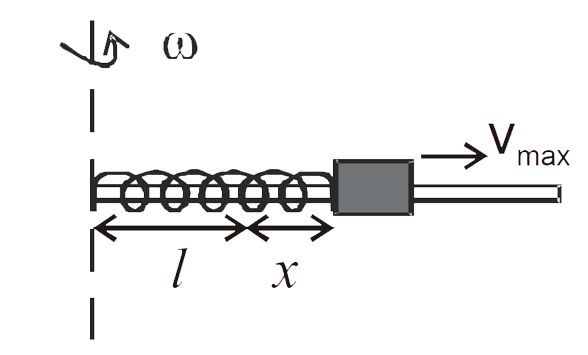
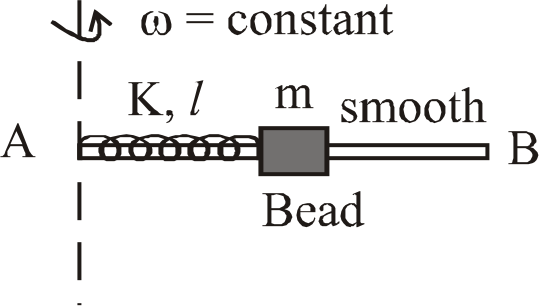
`AB` is a light rigid rod. Which is rotating about a vertical axis passing through `A,A` spring of force constant `K` and natural length `l` is attached at `A` and its other end is attached to a small bead of mass `m`. The bead can slide without friction on the rod. At the initial moment the bead is at rest (w.rt. the rod) and the spring is unstreached Select correct option

A

The maximum velocity attained by the bead w.r.t. the rod is given by `V_("max")=sqrt((momega^(4)l^(2))/(k-momega^(2)))`

B

The maximum velocity attained by the bead w.r.t the rod is given by `V_("max")=sqrt(((momega^(4)+K)/(momega^(2)-K))omega^(2)l^(2))`

C

The maximum extension in the spring in given by `X_("max")=(2momega^(2)l)/(K-momega^(2))`

D

The maximum value of contact force between the bead and the rod is greater than `mg`

Text Solution

Verified by Experts

Velocity will be maximum at equilibrium position

`rArr momega^(2)(l+x)=kx`
`rArr x=(momega^(2)l)/(K-momega^(2))`
`(1)/(2)mV_("max")^(2)=underset(0)overset(x)intmomega^(2)(l+x)dx-(1)/(2)kx^(2)`
`rArrV_("max")=(2momega^(2)lx+momega^(2)x^(2)-kx^(2))/(m)`
`V_("max")^(2)=((momega^(2)l+momega^(2)(l+x)-kx)x)/(m)`
`rArrV_("max")^(2)=omega^(2)l=(momega^(4)l^(2))/(momega^(2)-K)`
`V_("max")=sqrt((momega^(4)l^(2))/(k-momega^(2)))`
For maximum extension
`underset(0)overset(x)intmomega^(2)(l+x)dx-(1)/(2)kx_("max")^(2)=0 rArr x_("max")=(2momega^(2)l)/(k-momega^(2))`
Promotional Banner

Topper's Solved these Questions

  • NUCLEAR PHYSICS

    RESONANCE|Exercise Advanced level solutions|16 Videos
  • SEMICONDUCTORS

    RESONANCE|Exercise Exercise 3|88 Videos

Similar Questions

Explore conceptually related problems

A vertical rod is rotating about its axis with a uniform angular speed omega . A simple pendulum of length l is attached to its upper end what is its inclination with the rod ?

A ring of mass m is attached to a horizontal spring of spring constant k and natural length l_0 . The other end of the spring is fixed and the ring can slide on a horizontal rod as shown. Now the ring is shifted to position B and released Find the speed of the ring when the spring attains its natural length.

A bead of mass m can slide without friction along a vertical ring of radius R. One end of a spring of force constant k=(3mg)/(R ) is connected to the bead and the other end is fixed at the centre of the ring. Initially, the bead is at the point A and due to a small push it starts sliding down the ring. If the bead momentarily loses contact with the ring at the instant when the spring makes an angle 60^(@) with the vertical, then the natural length of the spring is

One end of a light spring of natural length d and spring constant k is fixed on a rigid wall and the other is attached to a smooth ring of mass m which can slide without friction on a vertical rod fixed at a distance d from the wall. Initially the spring makes an angle of 37^(@) with the horizontal as shown in fig. When the system is released from rest, find the speed of the ring when the spring becomes horizontal. [ sin 37^(@) = 3/5]

One end a light spring of natural length d and spring constant k ( = mg //d) is fixed on a rigid support and the other end is fixed to a smoth ring of mass m which can slide without friction on a vertical rod fixed at a distance d from the support. Initially , the spring makes an angle of 37^(@) with the horizontal as shown in the figure. The system is released from rest. The speed of the ring at the same angle subtended downward will be

Moment of inertia of a thin rod of mass m and length l about an axis passing through a point l/4 from one end and perpendicular to the rod is

A smooth light horizontal rod AB can rotate about a vertical axis passing through its end A. The rod is fitted with a small slieeve of mass m attached to the end A by a weightless spring of length l_0 and stiffness x . What work must be performed to slowly get this system going and reaching the angular velocity omega ?

RESONANCE-REVISION DPP-All Questions
  1. Suppose the earth was covered by an oceam of uniform depth h,(hltltR) ...

    Text Solution

    |

  2. One mole of an ideal monatomic gas has initial temperature T(0), is ma...

    Text Solution

    |

  3. AB is a light rigid rod. Which is rotating about a vertical axis passi...

    Text Solution

    |

  4. Three projecties are thrown all with same speed u but at different ang...

    Text Solution

    |

  5. The figure shown the velocity as a function of the time for an object ...

    Text Solution

    |

  6. In an isobaric process (lambda is adiabatic exponent of the gas)

    Text Solution

    |

  7. Ina moving coil galvanometer, a coil of area pi cm^(2) and 10 windings...

    Text Solution

    |

  8. A gas consisting of rigid diatomic molecules (degrees of freedom r = 5...

    Text Solution

    |

  9. The degree of freedom per molecule for a gas is 6. At constant pressur...

    Text Solution

    |

  10. 5 moles of nitrogen gas are enclosed in an adiabatic cylindrical vesse...

    Text Solution

    |

  11. At the middle of the mercury barometer tube there is a little column o...

    Text Solution

    |

  12. One mole of an ideal gas (y=1.4) at 500K, is filled in an adiabatic cy...

    Text Solution

    |

  13. The current density bar(J) inside a long, solid cylindrical wire of ra...

    Text Solution

    |

  14. The basic idea of Quantum Mechanics is that motion in any system is qu...

    Text Solution

    |

  15. The basic idea of Quantum Mechanics is that motion in any system is qu...

    Text Solution

    |

  16. The basic idea of Quantum Mechanics is that motion in any system is qu...

    Text Solution

    |

  17. The fixed non-conducting cylinder shown in figure has a noconducting h...

    Text Solution

    |

  18. The fixed non-conducting cylinder shown in figure has a noconducting h...

    Text Solution

    |

  19. The fixed non-conducting cylinder shown in figure has a noconducting h...

    Text Solution

    |

  20. Sand is droped vetically downward at the constant rate mu kg//s on a c...

    Text Solution

    |