Home
Class 12
PHYSICS
A straight nicrome wire is initially at ...


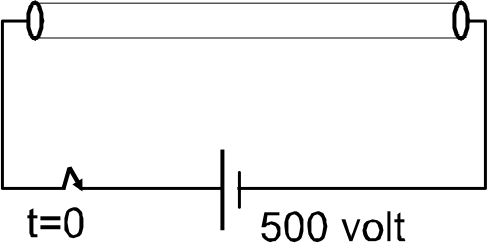
A straight nicrome wire is initially at room temperature `20^(@)C` it is connected to an ideal battery of 500 volt. Just after switching on, the current detected is 5 amp. Due to heaing effect its temperature increases. and it also loosing heat to the environment according to newton's cooling law as `(dQ_(max))/(dt)=45(T-20^(@))J//sec`. at steady state the current detected is 4.5 amp.

A

Steady state temperature of the wire is `70^(@)C`

B

steady state temperature of the wire is `75.5^(@)C`

C

temperature co-efficient of resistance of the wire is nearly `2.2xx10^(-3)//.^(@)C`

D

temperature co-efficient of resistance of the wire is nearly `1.57.10^(-3)//.^(@)C`

Text Solution

Verified by Experts

For steady state
`((dQ)/(dt))_("in")=((dQ)/(dt))_(out)`
`(V)(i_(55))=45(T-20)`
`(500)(4.5)=45(T-20)`
`T_(55)=70^(@)C`
Resistance at `20^(@)C` is `R=(v)/(i)=(500)/(50)`
`R_(20)=100Omega`
Resistance at `70^(@)C` is `R=(v)/(i)=(500)/(4.5)~=111Omega`
`R_(f)=R_(0)(1+alphatriangleT)`
`111=1000(1+alpha(50))`
`alpha=(0.11)/(50)=2.2xx10^(-3)//.^(@)C`.
Promotional Banner

Topper's Solved these Questions

  • NUCLEAR PHYSICS

    RESONANCE|Exercise Advanced level solutions|16 Videos
  • SEMICONDUCTORS

    RESONANCE|Exercise Exercise 3|88 Videos

Similar Questions

Explore conceptually related problems

A metal block is placed in a room which is at 10^(@)C . It is heated by an electric heater of power 500 W till its temperature becomes 50^(@)C . Its initial rate of rise of temperature is 2.5^(@)C//sec . The heater is switched off and now a heater of 100 W is required to maintain the temperature of the block at 50^(@)C . (Assume Newtons Law of cooling to be valid) (i) What is the heat capacity of the block ? ( ii ) What is the rate of cooling of block at 50^(@)C if the 100W heater is also switched off ? (iii) What is the heat radiated per second when the block was 30^(@)C ?

Four moles of an ideal gas is initially in a state A having pressure 2xx10^(5)N//m^(2) and temperature 200 K . Keeping pressure constant the gas is taken to state B at temperature of 400K. The gas is then taken to a state C in such a way that its temperature increases and volume decreases. Also from B to C, the magnitude of (dT)/(dV) increases. The volume of gas at state C is eaual to its volume at state A. Now gas is taken is initial state A keeping volume constant. A total of 1000 J heat is rejected from the sample in the cyclic process. Take R=8.3J//K//mol . Which graph between temperture T and volume V for the cyclic process is correct.

Four moles of an ideal gas is initially in a state A having pressure 2xx10^(5)N//m^(2) and temperature 200 K . Keeping pressure constant the gas is taken to state B at temperature of 400K. The gas is then taken to a state C in such a way that its temperature increases and volume decreases. Also from B to C, the magnitude of (dT)/(dV) increases. The volume of gas at state C is eaual to its volume at state A. Now gas is taken is initial state A keeping volume constant. A total of 1000 J heat is rejected from the sample in the cyclic process. Take R=8.3J//K//mol . The work done by the gas along path B to C is

Four moles of an ideal gas is initially in state A having pressure 2 xx 10^(5) N//m^(2) and temperature 200 K . Keeping the pressure constant the gas is taken to state B at temperature of 400K . The gas is then taken to a state C in such a way that its temperature increases and volume decreases. Also from B to C , the magnitude of dT//dV increases. The volume of gas at state C is eqaul to its volume at statem A . Now gas is taken to initial state A keeping volume constant. A total 1000 J of heat is withdrawn from the sample of the cyclic process . Take R=8.3 J// K// mol . The volume of gas at state C is

Four moles of an ideal gas is initially in state A having pressure 2 xx 10^(5) N//m^(2) and temperature 200 K . Keeping the pressure constant the gas is taken to state B at temperature of 400K . The gas is then taken to a state C in such a way that its temperature increases and volume decreases. Also from B to C , the magnitude of dT//dV increases. The volume of gas at state C is eqaul to its volume at statem A . Now gas is taken to initial state A keeping volume constant. A total 1000 J of heat is withdrawn from the sample of the cyclic process . Take R=8.3 J// K// mol . The work done in path B to C is

Four moles of an ideal gas is initially in state A having pressure 2 xx 10^(5) N//m^(2) and temperature 200 K . Keeping the pressure constant the gas is taken to state B at temperature of 400K . The gas is then taken to a state C in such a way that its temperature increases and volume decreases. Also from B to C , the magnitude of dT//dV increases. The volume of gas at state C is eqaul to its volume at statem A . Now gas is taken to initial state A keeping volume constant. A total 1000 J of heat is withdrawn from the sample of the cyclic process . Take R=8.3 J// K// mol . Which graph between temperature T and volume V for the cyclic process is correct.

A metal block is placed in a room which is at 10^(@)C for long time. Now it is heated by an electric heater of power 500 W till its temperature becomes 50^(@)C . Its initial rate of rise of temperature is 2.5^(@)C//sec . The heater is switched off and now a heater of 100W is required to maintain the temperature of the block at 50^(@)C . (Assume Newtons Law of cooling to be valid) What is the rate of cooling of block at 50^(@)C if the 100W heater is also switched off?

Two moles of an idea gas is initially in state A having pressure 1.01xx10^(5)N//m^(2) and temperature 3O0k keeping pressure constant the gas is taken to state B temperature at B is 500K the gas is then taken to state C in such a way that its temperature increases and volume decreases also from B To c the magnitude of (dT)/(dV) increases the volume of gas at C is equal to volume of gas at A now the gas is taken to initial state A keeping volume constant A total of 1200 J of heat is with drawn from the sample in the cyclic process the T-V graph for the cyclic process and work done in path B to C are respectively (take R=8.3J//k//mol)

RESONANCE-REVISION DPP-All Questions
  1. A vessel is partly filled with a liquid. Coefficients of cubical expan...

    Text Solution

    |

  2. The ends of a rod of uniform thermal conductivity are maintained at di...

    Text Solution

    |

  3. A straight nicrome wire is initially at room temperature 20^(@)C it is...

    Text Solution

    |

  4. When the temperature of a copper coin is raised by 80^@C, its diameter...

    Text Solution

    |

  5. The emissive power of a black body at T=300K is 100Watt//m^(2) conside...

    Text Solution

    |

  6. A solid cube of side a density d and specific heat s is at temperature...

    Text Solution

    |

  7. A sphere P (emissivity=1) of radius 2R and and another sphere Q(emissi...

    Text Solution

    |

  8. Inner surfaec of a cylindrical shell of length l and of material of th...

    Text Solution

    |

  9. Three rods of copper, brass and steel are joined together to form T sh...

    Text Solution

    |

  10. A steel wire is rigidly fixed at both ends its length mass and cross s...

    Text Solution

    |

  11. A body cools in 7 min from 60^@C to 40^@C What will be its temperature...

    Text Solution

    |

  12. As shown in Fig. AB is rod of length 30 cm and area of cross section 1...

    Text Solution

    |

  13. A scale (alpha=10^(-3)//.^(@)C) gives correct reading at 0^(@)C it is ...

    Text Solution

    |

  14. Figure shows in cross section a wall consisting of four layers with th...

    Text Solution

    |

  15. Figure shows in cros section a wall consisting of four layers with the...

    Text Solution

    |

  16. If layer thickness L(2) is 1.4 cm, then its thermal conductivity K(2) ...

    Text Solution

    |

  17. Temperature shows in cross section a wall consisting of four layers wi...

    Text Solution

    |

  18. Temperature shows in cross section a wall consisting of four layers wi...

    Text Solution

    |

  19. Temperature shows in cross section a wall consisting of four layers wi...

    Text Solution

    |

  20. Four identical uniform rods of mass M=6kg each are welded at their end...

    Text Solution

    |

