Home
Class 12
PHYSICS
Containerrs of different materials are f...


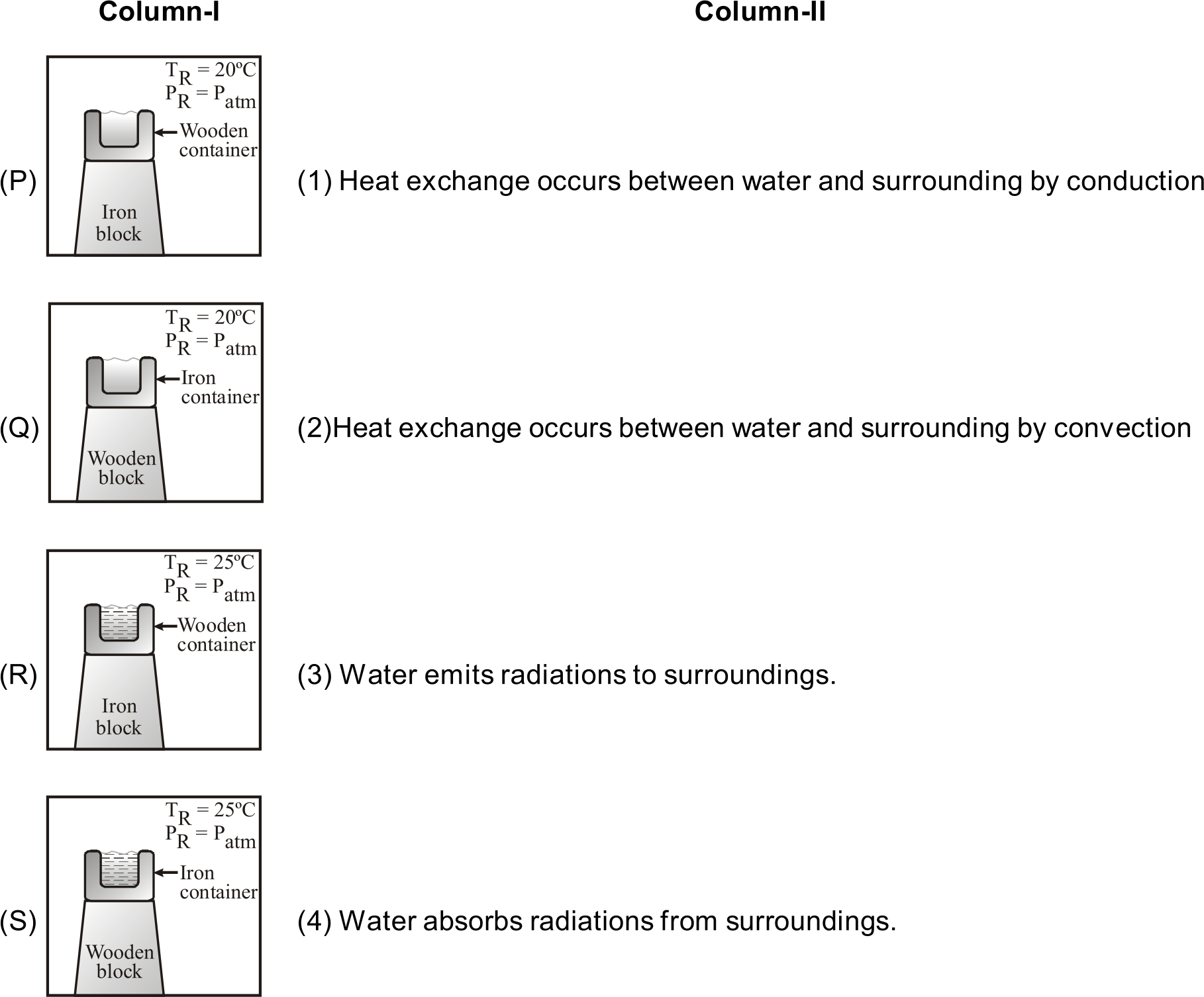
Containerrs of different materials are filled with water at room temperature `25^(@)C` and kept in a closed room (at temperature `T_(R)` and pressure `P_(R))` in different conditions shown in column-I, match each situation given in column I with the phenomenon given in column-II assume air and wood are bad conductors of heat.

A

`{:(P,Q,R,S),(4,1,2,3):}`

B

`{:(P,Q,R,S),(1,3,2,4):}`

C

`{:(P,Q,R,S),(2,1,3,4):}`

D

`{:(P,Q,R,S),(1,2,3,4):}`

Text Solution

Verified by Experts

Promotional Banner

Topper's Solved these Questions

  • NUCLEAR PHYSICS

    RESONANCE|Exercise Advanced level solutions|16 Videos
  • SEMICONDUCTORS

    RESONANCE|Exercise Exercise 3|88 Videos

Similar Questions

Explore conceptually related problems

Match the statement (A,B,C,D) in column I with the statement (p,q,r,s) in column II. The answers are to be properly bobbled.

In a container of negligible mass, ‘m’ grams of steam at 100°C is added to 100 g of water that has temperature 20°C. If no heat is lost to the surroundings at equilibrium, match the items given in Column I with that in Column II.

A magnet was brought from different directions towards a toy boat that has been floating in water in a tub. Affect observed in each case is stated in Column I. Possible reasons for the observed affects are mentioned in Column II. Match the statements given in Column I with those in Column II

Match the statement (A, B, C, D) in column I with statement (p, q, r, s) in column II. The answers to the question are to be properly bubbled.

Match the statements in Column I labeled as (a), (b), (c), and (d) with those in Column II labeled as (p), (q). (c), and (s). Any given statement in Column I can have correct matching with one or more statements in Column II. Match the observation given in Column I with the experiments given in Column II.

RESONANCE-REVISION DPP-All Questions
  1. A steel wire is rigidly fixed at both ends its length mass and cross s...

    Text Solution

    |

  2. A body cools in 7 min from 60^@C to 40^@C What will be its temperature...

    Text Solution

    |

  3. As shown in Fig. AB is rod of length 30 cm and area of cross section 1...

    Text Solution

    |

  4. A scale (alpha=10^(-3)//.^(@)C) gives correct reading at 0^(@)C it is ...

    Text Solution

    |

  5. Figure shows in cross section a wall consisting of four layers with th...

    Text Solution

    |

  6. Figure shows in cros section a wall consisting of four layers with the...

    Text Solution

    |

  7. If layer thickness L(2) is 1.4 cm, then its thermal conductivity K(2) ...

    Text Solution

    |

  8. Temperature shows in cross section a wall consisting of four layers wi...

    Text Solution

    |

  9. Temperature shows in cross section a wall consisting of four layers wi...

    Text Solution

    |

  10. Temperature shows in cross section a wall consisting of four layers wi...

    Text Solution

    |

  11. Four identical uniform rods of mass M=6kg each are welded at their end...

    Text Solution

    |

  12. Four identical uniform rods of mass M=6kg each are welded at their end...

    Text Solution

    |

  13. Four identical uniform rods of mass M=6kg each are welded at their end...

    Text Solution

    |

  14. A body cools in a surrounding of constant temperature 30^@C Its heat c...

    Text Solution

    |

  15. A body cools in a surrounding of constant temperature 30^@C Its heat c...

    Text Solution

    |

  16. A body cools in a surrounding of constant temperature 30^@C Its heat c...

    Text Solution

    |

  17. (P). In a negative beta^(-) decay reaction z^(X^(A))toz+1^(Y^(A))+beta...

    Text Solution

    |

  18. Column-I has some statements about the system shown in column-II, matc...

    Text Solution

    |

  19. In columns-II some situations are gien and in column-I some results ar...

    Text Solution

    |

  20. Containerrs of different materials are filled with water at room tempe...

    Text Solution

    |

