Home
Class 11
CHEMISTRY
Compound (A)(C(8)H(12)) on oxidation giv...

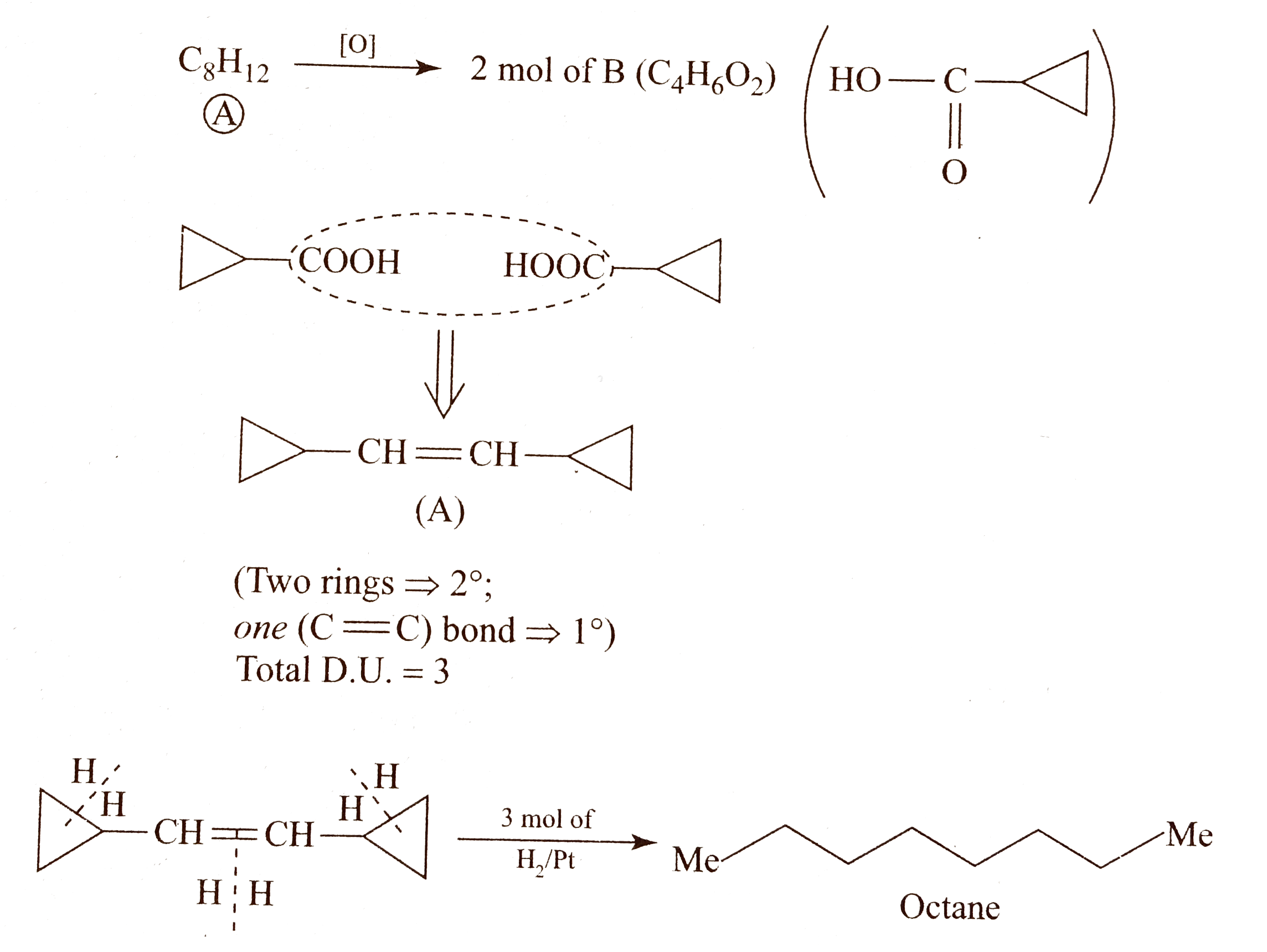
Compound `(A)(C_(8)H_(12))` on oxidation gives an acid `B(C_(4)H_(6)O_(2))`. One mole of compound `(A)` reacts with `3 mol` of `H_(2)` in the presence of `Pt` catalyst to give octane. Identify compound `(A)`.

Text Solution

Verified by Experts

`C_(8)H_(12)` `(A)` `(C_(4)H_(6)O_(2))` `(Acid)`
Degree of unsaturation is compound `(A)`
`D.U.` in `(A)=((2n_(C)+2)-n_(H))/(2)=((2xx8+2)-12)/(2)=3^(@)`
Degree of unsaturation in compound `(B)(` discard `O` and calculate `D.U.)`
`D.U.` in `(B)=((2n_(C)+2)-n_(H))/(2)=((2xx4+2)-6)/(2)=2^(@)`
Acid has `1^(@)` of unsaturation, so `1^(@)` of unsaturation shoulb in `(C_(3)H_(5)-)` group. It can be one `(C=C)` or a ring. One `(C=C)` bond is not possible because after the oxidation of compound `(A)`, the double bond cannot be left behind in `(B)`, So, it is a three membered ring.
Moreover, number of `C` atome in `(A)` is twice the number of `C` atoms in acid `(B)`. So, `2 mol` of acid join with each other to give the compound `(A)`.
Since the cyclopropane ring is a highly strained ring, so on hydrogenation under normal conditions it gives propane. Hence, on hydrogenation, `3 mol` are required, `1 mol` each for the cyclopropane ring and `1 mol`for the reducing the `(C=C)` bond.
Promotional Banner

Topper's Solved these Questions

  • ALKENES AND ALKADIENES

    CENGAGE CHEMISTRY|Exercise SOLVED Example|62 Videos
  • ALKENES AND ALKADIENES

    CENGAGE CHEMISTRY|Exercise EXERCISES|29 Videos
  • ALKANES AND CYCLOALKANES

    CENGAGE CHEMISTRY|Exercise Archives|13 Videos
  • ALKYNES

    CENGAGE CHEMISTRY|Exercise Exercises (Archives - Analytical and Desriptive Type)|4 Videos

Similar Questions

Explore conceptually related problems

Compound (A)(C_(12)H_(16)) on oxidation with acideic KMnO_(4) solution gives acetone and . Identify compound (A) .

The compound F(C_(6)H_(12)O) on oxidative ozonolysis yirlds acetic acid and a compound (G) (C_(4)H_(8)O_(3)) . The new compound (G) on heating gives:

An organic compound 'A' (C_(4)H_(10)O) is optically active. On mild oxidation, it gives a compound 'B' (C_(4)H_(8)O) but upon vigorous oxidation, it gives another compound 'C' (C_(3)H_(6)O_(2)) . The compound 'C' along with 'D' are also formed from 'B' by reacting with iodine in the presence of alkali. Deduce the structures of 'A', 'B', 'C' and 'D' .

Benzene reacts with CH_(3)I in the presence of AlCl_(3) to give compound (A) (C_(7) H_(8)) which undergas oxidation with alkaline KMnO_(4) to give an acidic compound (B).(B) reacts with SOCl_(2) to give (C) which gives (D) with ammonia. The compound (D) on reaction with bromine and alkali froms (E) which reacts with bromnine water to give (F) (C_(6) H_(4) NBr_(3)). (F) reacts with NaNO_(2) adn HCl and forms (G) (C_(6) H_(2) N_(2) Br_(3) Cl) . Additiaon of Kl froms (H) Indenitify the compounds (A) to (H) .

An organic compound A (C_(7)H_(6)Cl_(2)) on treatment with NaOH solution gives another compound B (C_(7)H_(6)O) . B on oxidation gives and acid C (C_(7)H_(6)O_(2)) which on treatment with a mixture of conc. HNO_(3)" and "H_(2)SO_(4) gives a compound D (C_(7)H_(5)NO_(4)) . B on treatment with conc. NaOH gives a compound E (C_(7)H_(8)O)" and "C_(6)H_(5)COONa . Deduce the structures of [A], [B], [C], [D] and [E].

An organic compound A(C_(4)H_(8)N_(2)) on hydrolysis in acidic medium gives another compound B(C_(4)H_(9)O_(2)N) . B forms zwitter ion and gives off CO_(2) with NaHCO_(3) . B on heating gives compound C(CH_(4)H_(7)ON).LiAlH_(4) in ether reduces C to pyrolidine. Identify compounds A,B,C.