Home
Class 11
CHEMISTRY
Based on the arrangement of branching of...

Based on the arrangement of branching of `[(R)-(Ph),` in case of styron of `(CH_(3))`, in case of polypropene `]` groups relative to long`-` chain backbone of the polymer, how many types of stereoisomers are possible for styron or polypropene ?

Text Solution

Verified by Experts
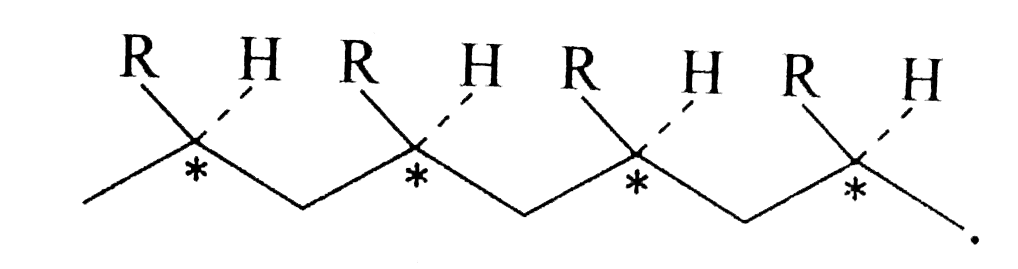
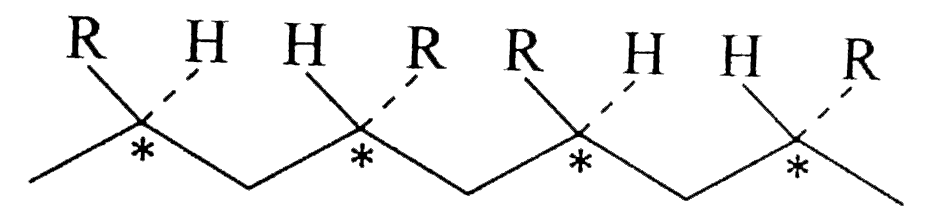
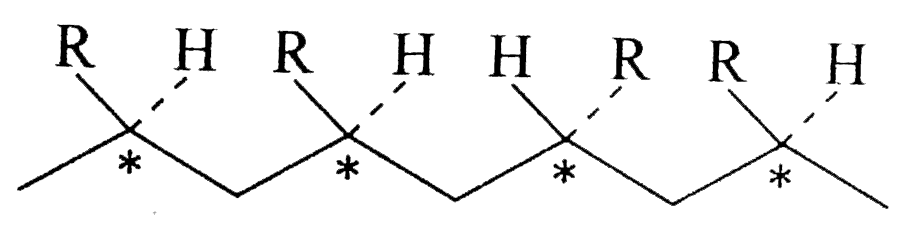
Three classes of stereoisomers are possible.
`i.` Isotactic, when `(CH_(3)-)` and `(R-)` groups are on the same side. It is highly crystalline, has high melting point, and forms strong fibres.

`ii.` Syndiotactic, when `(CH_(3)-)` and `(R-)` groups are on alternate sides. Its properties are intermediate of isotactic and atactic.

`iii.` Atactic, when `(CH_(3)-)` and `(R-)` groups are randomly arranged `:`

It is a soft, elastic , and rubbery material.
Promotional Banner

Topper's Solved these Questions

  • ALKENES AND ALKADIENES

    CENGAGE CHEMISTRY|Exercise EXERCISES|29 Videos
  • ALKENES AND ALKADIENES

    CENGAGE CHEMISTRY|Exercise linked Comprehension Type|38 Videos
  • ALKENES AND ALKADIENES

    CENGAGE CHEMISTRY|Exercise Single correct Answer|14 Videos
  • ALKANES AND CYCLOALKANES

    CENGAGE CHEMISTRY|Exercise Archives|13 Videos
  • ALKYNES

    CENGAGE CHEMISTRY|Exercise Exercises (Archives - Analytical and Desriptive Type)|4 Videos

Similar Questions

Explore conceptually related problems

Isomers in coordination chemistry include many types. In structural isomers hydrate or solvent isomers, ionisation isomers and coordination isomers have same overall formula but have different ligands attached to the central atom or ion. The term linkage isomerism or ambidentate isomerism are used for cases of bonding through different through different atoms of the same ligand. Stereoisomers have the same ligands, but differ in the geometric arrangement of the ligands. Ma_(3).b_(3) complex has two geometrical forms(I) Facial (II) Meridonial then which of the following statement is incorrect ?

Give the IUPAC names for each of the following : (i) (CH_(3)CH_(2))_(2)CHCH(CH_(3))CH_(2)CH_(3) (ii) (CH_(3))_(4)C (iii) [(CH_(3))_(3)C]_(4)C (iv) (CH_(3))_(3)C CH_(2)C (CH_(3))_(3) Strategy: Select as the parent structure the longest possible continous chain and then consider the compound to have been derived from this structure by the replacement of H atoms by ends of the longest chain, begin numbering at the end nearest to the branch that is first in alphabetical order. 3. Assign the name and position number to each substituent. Arrange the substituents in alphabetical order. Hyphenated prefixes such as tert- sec- are not used in the alphabetization of substituents. 4. Use on appropriate prefix to group like substituents: di=2, tri=3, tetra=4 penta= 5, and so on. Do not consider these prefix when alphabetizing attached groups. 5. Write the name as single word. Use hyphens to separate numbers and letters (plus some hyphenated prefix) and commas to spearate numbers. Do not leave any spaces. Some examples showing the application of the rules of nomenclature are given below: various alkyl groups as substituents. To avoid any mistake. it is always better to write the complete structural formula.

Greater is the stability of the substituted ammonium cation, stronger should be the corresponding amine as a base. Thus, the order of basicity of aliphatic amines should be: primary > secondary > tertiary, which is opposite to the inductive effect based order. Secondly, when the alkyl group is small, like- CH_3 group, there is no steric hindrance to H-bonding. In case the alkyl group is bigger than CH_3 group, there will be steric hinderance to H-bonding. Therefore, the change of nature of the alkyl group, e.g.,from- CH_3 to- C_2 H_5 results in change of the order of basic strength. In the following questions a statement of assertion followed by a statement of reason is given. Choose the correct answer out of the following choices. Assertion (A): Greater is the stability of the substituted ammonium cation, stronger is the corresponding amine as a base. Reason (R): The order of basicity of aliphatic amines is: primary > secondary > tertiary.

CENGAGE CHEMISTRY-ALKENES AND ALKADIENES-SOLVED Example
  1. Write the monomer of the following polymer : a. P.M.M.A. ,b. H.D.P....

    Text Solution

    |

  2. Which of the polymer (s) in Example is // are optically active or chir...

    Text Solution

    |

  3. Based on the arrangement of branching of [(R)-(Ph), in case of styron ...

    Text Solution

    |

  4. Convert the following :

    Text Solution

    |

  5. Identify compound (A).

    Text Solution

    |

  6. Identify compound (A) and (B).

    Text Solution

    |

  7. Identify compounds (A) and (B) Acetic acid + Propanoic acid + ...

    Text Solution

    |

  8. a. Write the products of the reductive and oxidative ozonolyses of mes...

    Text Solution

    |

  9. a. Identify compound (A) in the following reactions. Compound (A)ove...

    Text Solution

    |

  10. Give the product of the following with : a. O(3)//Zn-CH(3)COOH ,b. ...

    Text Solution

    |

  11. Write the structural lformulae for the compounds that yields the follo...

    Text Solution

    |

  12. Give the product obtained from the oxidation of the following compound...

    Text Solution

    |

  13. Complete the following reaction

    Text Solution

    |

  14. Comlete the following reaction : Also write the mechanism of th...

    Text Solution

    |

  15. Give all the structural isomers ( excloding stereoisomers and allenes ...

    Text Solution

    |

  16. Complete the following reaction : Also write the mechanism of the...

    Text Solution

    |

  17. Write all the resonating structures of : Which of these carbons ...

    Text Solution

    |

  18. Conver : Which product is kinetically favoured and which product...

    Text Solution

    |

  19. Give the name and structure of the lowest molecular mass cumulative po...

    Text Solution

    |

  20. Complete the following reaction

    Text Solution

    |