Home
Class 11
CHEMISTRY
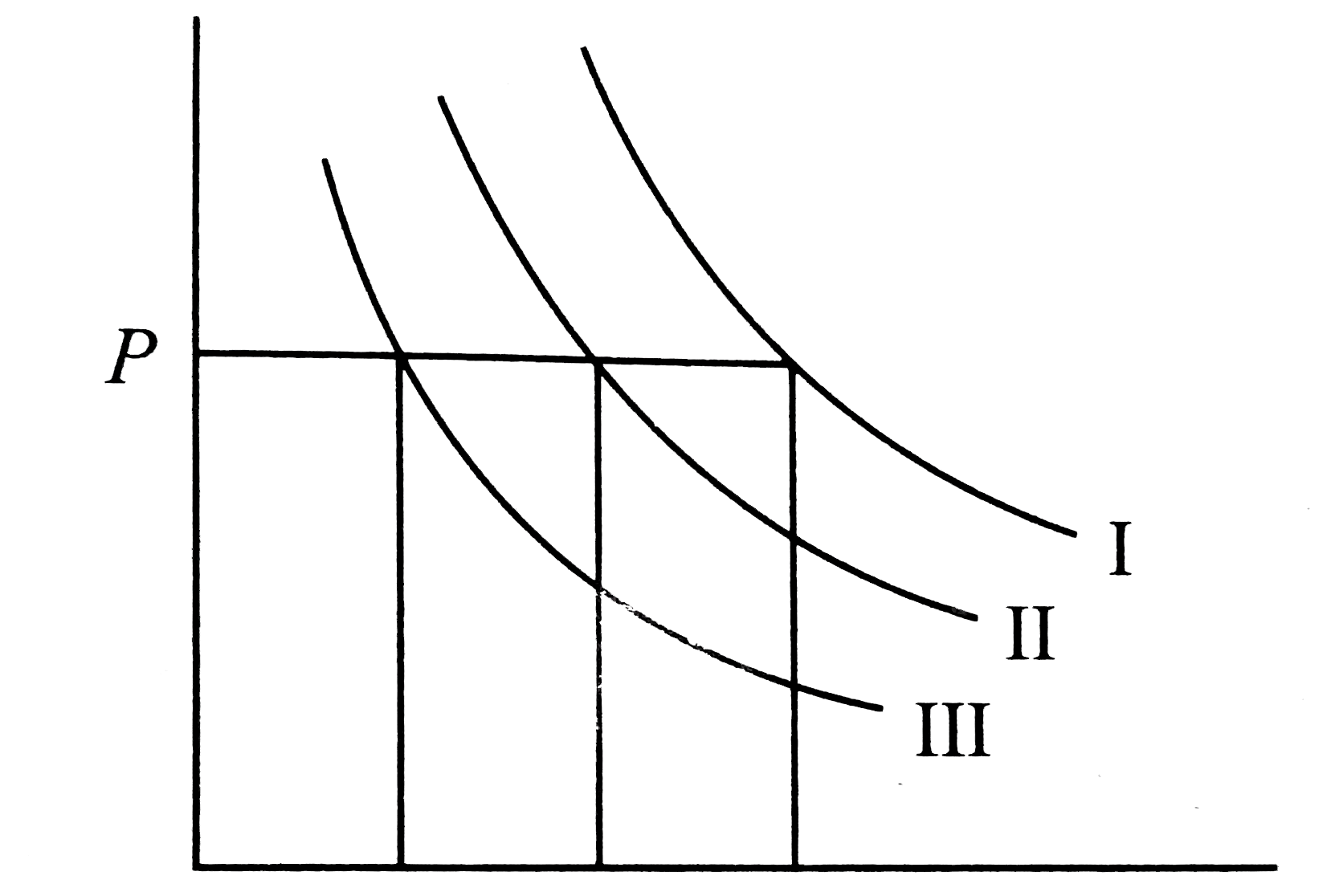
I, II, and III are three istherms, respe...

`I`, `II`, and `III` are three istherms, respectively, at `T_(1)`, `T_(2)`, and `T_(3)`. Temperature will be in order

A

`T_(1) =T_(2) =T_(3)`

B

`T_(1) lt T_(2) gt T_(3)`

C

`T_(1) gt T_(2) gt T_(3)`

D

`T_(1) gtT_(2) =T_(3)`

Text Solution

Verified by Experts

As the temperature increases at constant `P` volume of gas increases .
Promotional Banner

Topper's Solved these Questions

  • GASEOUS STATE

    P BAHADUR|Exercise Exercise B|1 Videos
  • GASEOUS STATE

    P BAHADUR|Exercise Exercise 4|1 Videos
  • GASEOUS STATE

    P BAHADUR|Exercise Exercise 3|1 Videos
  • CHEMICAL EQUILIBRIUM

    P BAHADUR|Exercise Exercise|134 Videos
  • IONIC EQUILIBRIUM

    P BAHADUR|Exercise Exercise|85 Videos

Similar Questions

Explore conceptually related problems

Freundlich adsorption isotherm is represnted at temparetures T_(1),T_(2) and T_(3) . Arrange the temperatures in the increasing order as shown in the graph.

The correct order for T_(i), T_(B) and T_(C) is

Three isothermal plots (P versus V) A, B and C are plotted at three temperature T_(1), T_(2) and T_(3) respectively The correct order of the temperature will be

Equal masses of three liquids are thoroughly mixed. The specific heat capacities of the liquids ar s_(1), s_(2) and s_(3) and their temperatures t_(1), t_(2) and t_(3) respectively. Find the temperature of the mixture.

The plots of intensity versus wavelength for three black bodies at temperatures T_(1),T_(2) and T_(3) respectively are shown in Their temperatures are shown in How their temperatures are related ? .

Path of three projectiles are shown. If T_(1),T_(2) and T_(3) are time of flights and ignoring air resistances-

P BAHADUR-GASEOUS STATE-Exercise
  1. Average velocity of the molecules of a gas in a container moving in on...

    Text Solution

    |

  2. An open vessel containing air is heated form 300 K to 400 K. The fract...

    Text Solution

    |

  3. I, II, and III are three istherms, respectively, at T(1), T(2), and T(...

    Text Solution

    |

  4. NH(3) gas is liquefied more easily than N(2). Hence

    Text Solution

    |

  5. Under critical conditions, the compressibility factor foa a gas is .

    Text Solution

    |

  6. The behaviour of a real gas is usually depicted by plotting compressib...

    Text Solution

    |

  7. When an ideal gas undergoes unrestrained expansion, no cooling occurs ...

    Text Solution

    |

  8. For two gases A and B with molecular weights M(A) and M(B), respective...

    Text Solution

    |

  9. The temperature at which the second virial coefficient of a real gas i...

    Text Solution

    |

  10. The Joule -Thomson coefficient for a gas is zero at .

    Text Solution

    |

  11. The team that accounts for intermolecular force in van der Waals' equa...

    Text Solution

    |

  12. Total number of electrons in 1.4g dinitrogen gas is .

    Text Solution

    |

  13. Consider 1 cm^(3) sample of air at absolute temperature T(0) at sea le...

    Text Solution

    |

  14. Boyle's law may be experssed as .

    Text Solution

    |

  15. According to Charles's law

    Text Solution

    |

  16. For an ideal gas, the correct relation is .

    Text Solution

    |

  17. if the pressure at the triple point of a substance is greater tha n1 a...

    Text Solution

    |

  18. The mean free path (lambda) of a gas sample is given by .

    Text Solution

    |

  19. If the intermolecular forces vanish away the volume occupied by the mo...

    Text Solution

    |

  20. Four par ticles have speed 2, 3, 4 and 5 cm/s respectively Their RMS s...

    Text Solution

    |

