Home
Class 10
MATHS
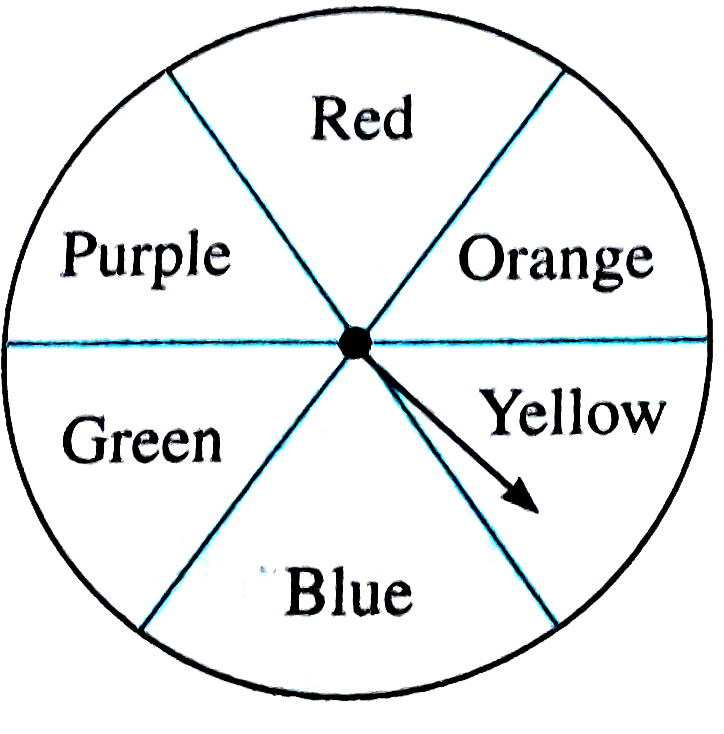
The arrow is rotated and it stops random...

The arrow is rotated and it stops randomly on the disc. Find out on which colour it may stop.

Text Solution

Verified by Experts

The correct Answer is:

`:.` Arrow may stop on any one of the six colours.
Promotional Banner

Topper's Solved these Questions

  • PROBABILITY

    TARGET PUBLICATION|Exercise Practice set 5.3|1 Videos
  • PROBABILITY

    TARGET PUBLICATION|Exercise Practice Set 5.4|5 Videos
  • PROBABILITY

    TARGET PUBLICATION|Exercise Practice Set 5.1|1 Videos
  • MODEL QUESTION PAPER (PART - II)

    TARGET PUBLICATION|Exercise Questions|28 Videos
  • PYTHAGORAS THEOREM

    TARGET PUBLICATION|Exercise Chapter Assessment|16 Videos

Similar Questions

Explore conceptually related problems

If earth stops rotating

In Fig., shown a disc on which a player spins an arrow twice. The function (a)/(b) is formed, where 'a' is the number of sector on which arrow stops on the first spin and 'b' is the number of the sector in which the arrow stops on second spin. On each spin, each sector has equal chance of selection by the arrow. Find the probability that the fraction (a)/(b) gt 1 .

A bus travels 1300 km with an average speed of 65 km/h. If it stops at 8 junctions it takes exactly 1 day to travel the whole distance. Find out the time duration it stops for at each stop.

A man of mass m_(1) stands on the edge of a horizontal uniform disc of mass m_(2) and radius R which is capable of rotating freely about a stationary vertical axis passing through its centre . The man walks along the edge of the disc through angle theta relative to the disc and then stops . find the angle through which the disc turned the time the man stopped . [(2m_(1)theta)/(2m_(1) + m_(2))]

A man of mass m_1 stands on the edge of a horizontal uniform disc of mass m_2 and radius R which is capable of rotating freely about a stationary vertical axis passing through its centre. At a certain moment the man starts moving along the edge of the disc, he shifts over an angle varphi^' relative to the disc and then stops. In the process of motion the velocity of the man varies with time as v^'(t) . Assuming the dimensions of the man to be negligible, find: (a) the angle through which the disc had turned by the moment the man stopped, (b) the force moment (relative to the rotation axis) with which the man acted on the disc in the process of motion.

A disc of radius R and mass m is mounted on a vertical axis through its centre and perendicular to its plane. A rat of same mass m runs around the rim of the disc with speed v anticlockwise relative to stationary observer. The disc rotates clockwise with angular speed omega. The rat finds a piece of bread on the rim and stops. Find the angular velocity of the disc after the rat stops.

A cockroach is moving with velocity v in anticlockwise direction on the rim of a disc of radius R of mass m . The moment of inertia of the disc about the axis is I and it is rotating in clockwise direction with an angular velocity omega . If the cockroach stops, the angular velocity of the disc will be

Name the force which helps things to move and stop.

Three identical discs A, B, and C (figure) rest on a smooth horizontal plane. The disc A is set in motion with vector v after which it experiences an elastic collision simultaneously with the discs B and C. The distance between the centres of the latter discs prior of the collision is eta times greater than the diameter of each disc. Find the velocity of the disc A after the collision. At what value of eta will the disc A recoil after the collision, stop, move on?

A ring and a disc of different masses are rotating with the same kinetic energy. If a retarding torque (tau) is applied to the ring, the ring stops after completing n rotations. If the same retarding torque is applied to the disc, how many rotations would it complete before coming to rest?
