Home
Class 12
PHYSICS
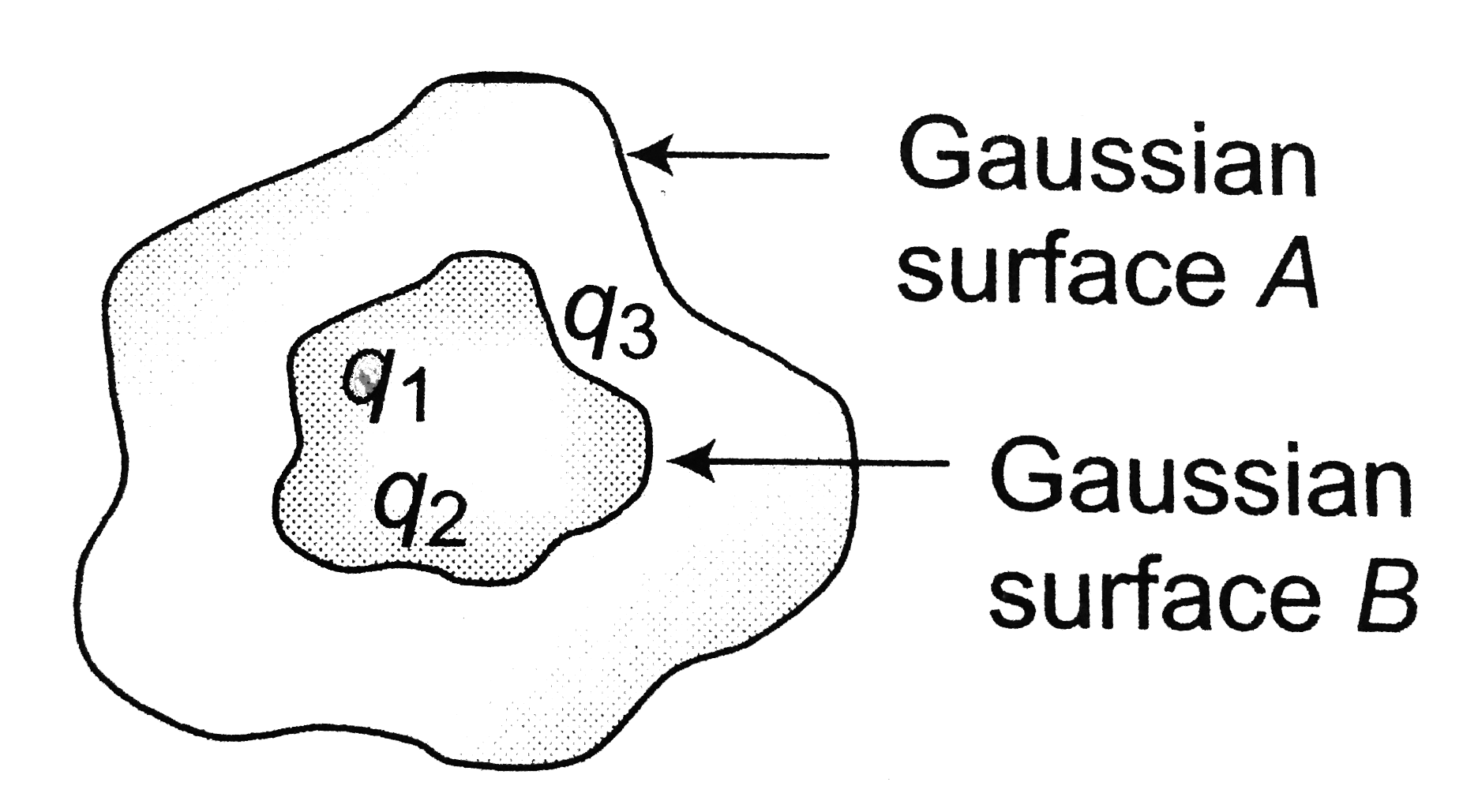
The electric flux for Gaussian surface A...

The electric flux for Gaussian surface `A` that enclose the charge particles in free space is (given `q_(1)= -14nC,q_(2)= 78.85nC,q_(3)= -56nC)`

A

`10^(3)Nm^(2)C^(-1)`

B

`10^(3)CN^(-1)C^(-2)`

C

`6.32xx10^(3)Nm^(2)C^(-1)`

D

`6.32xx10^(3)CN^(-1)m^(-2)`

Text Solution

Verified by Experts

The correct Answer is:

A

Flux is due to charges enclosed per `epsilon_(0)`
`:.` Total flux `=(-14+78.85-56)nC//epsilon_(0)`
`=8.85xx10^(-9)Cxx(4pi)/(4piepsilon_(0))= 8.85xx10^(-9)xx9xx10^(9)xx4pi`
`1000.4Nm^(2)//Ci.e., 1000 Nm^(2)C^(-1)`
Promotional Banner

Topper's Solved these Questions

  • ELECTRIC CHARGE, FIELD & FLUX

    A2Z|Exercise Electric Dipole|29 Videos
  • ELECTRIC CHARGE, FIELD & FLUX

    A2Z|Exercise Problems Based On Mixed Concepts|40 Videos
  • ELECTRIC CHARGE, FIELD & FLUX

    A2Z|Exercise Electric Field And Motion|37 Videos
  • DUAL NATURE OF RADIATION AND MATTER

    A2Z|Exercise Section D - Chapter End Test|30 Videos
  • ELECTRIC POTENTIAL & CAPACITANCE

    A2Z|Exercise Section D - Chapter End Test|29 Videos

Similar Questions

Explore conceptually related problems

Electric flux through a closed surface in free space enclosing a charge q is

The electric flux through a chlosed surface area S enclosing charge Q is phi . If the surface area is doubled, then the flux is

In the given figure, there are four point charges placed at the vertices of a square of side, a=1.4 m . If q_(1)=+18 nC,q_(2)=-24 nC,q_(3)+35nC and q_(4)=+16 nC m then find the electric at the centre P of the square Assume the potential to be zero at infinity.

In Fig., the four particles form a square of edge length a = 5.00 cm and have charges q_(1) = +3 nC, q_(2) = -15 nC, q_(3) = +15 nC , and q_(4) = -30 nC . In unit-vector notation, what net electric field do the particles produce at the square's center ?

What is the electric potential at point P, located at the center of the square of charged particles shown in Fig. 24-16a? The distanced is 1.3 m, and the charges are q_(1) = + 12 nC, " "q_(3) = +31 nC , q_(2) = - 24 nC," "q_(4)=+17 nC.

Consider a Gaussian spherical surface covering a dipole of charge q and -q, then

Gauss's law and Coulomb's law , although expressed in different forms , are equivalent ways of describing the relation between charge and electric field in static conditions . Gauss's law is epsilon_(0) phi = q_(encl) ,when q(encl) is the net charge inside an imaginary closed surface called Gaussian surface. The two equations hold only when the net charge is in vaccum or air . A Gaussian surface encloses two of the four positively charged particles. The particles that contribute to the electric field at a point P on the surface are

Gauss's law and Coulomb's law , although expressed in different forms , are equivalent ways of describing the relation between charge and electric field in static conditions . Gauss's law is epsilon_(0) phi = q_(encl) ,when q(encl) is the net charge inside an imaginary closed surface called Gaussian surface. The two equations hold only when the net charge is in vaccum or air . If the charge q_(3) and q_(4) are displaced (always remaining outside the Gaussian surface), then consider the following two statements : A : Electric field at each point on the Gaussian surface will remain same . B : The value of oint vec(E ) .d vec(A) for the Gaussian surface will remain same.

A charge q is enclosed as shown below the electric flux is

A2Z-ELECTRIC CHARGE, FIELD & FLUX-Electric Field And Gauss'S Law
  1. A spherical shell of radius R has two holes A and B through which a ri...

    Text Solution

    |

  2. What is the electric flux linked with closed surface?

    Text Solution

    |

  3. Electric field at a point varies as r^(0) for

    Text Solution

    |

  4. q(1),q(2),q(3) and q(4) are point charges located at point as shown in...

    Text Solution

    |

  5. The inward and outward electric flux for a closed surface unit of N-m^...

    Text Solution

    |

  6. If a spherical conductor comes out from the closed surface of the sphe...

    Text Solution

    |

  7. If the electric flux entering and leaving an enclosed surface respecti...

    Text Solution

    |

  8. Consider the charge configuration and a spherical Gaussian surface as ...

    Text Solution

    |

  9. An electric dipole is put in north-south direction in sphere filled wi...

    Text Solution

    |

  10. The electric flux for Gaussian surface A that enclose the charge parti...

    Text Solution

    |

  11. A solid metallic sphere has a charge +3Q. Concentric with this sphere ...

    Text Solution

    |

  12. An electric field given by vec(E )= 4hat(i)+3(y^(2)+2)hat(j) passes th...

    Text Solution

    |

  13. A point charge q is placed at a distance a//2 directly above the cente...

    Text Solution

    |

  14. Three infinitely long charge sheets are placed as shown in figure. Th...

    Text Solution

    |

  15. Two infinitely long parallel conducting plates having surface charge d...

    Text Solution

    |

  16. At a point 20 cm from the centre of a uniformly charged dielectric sph...

    Text Solution

    |

  17. The electric field due to uniformly charged sphere of radius R as a fu...

    Text Solution

    |

  18. A spherical portion has been removed from a solid sphere having a char...

    Text Solution

    |

  19. The number of electric field lines crossing an area DeltaS is n(1) whe...

    Text Solution

    |

  20. In a region of space the electric field in the x-direction and proport...

    Text Solution

    |
