Home
Class 12
PHYSICS
Three similar charges +q are placed on 3...

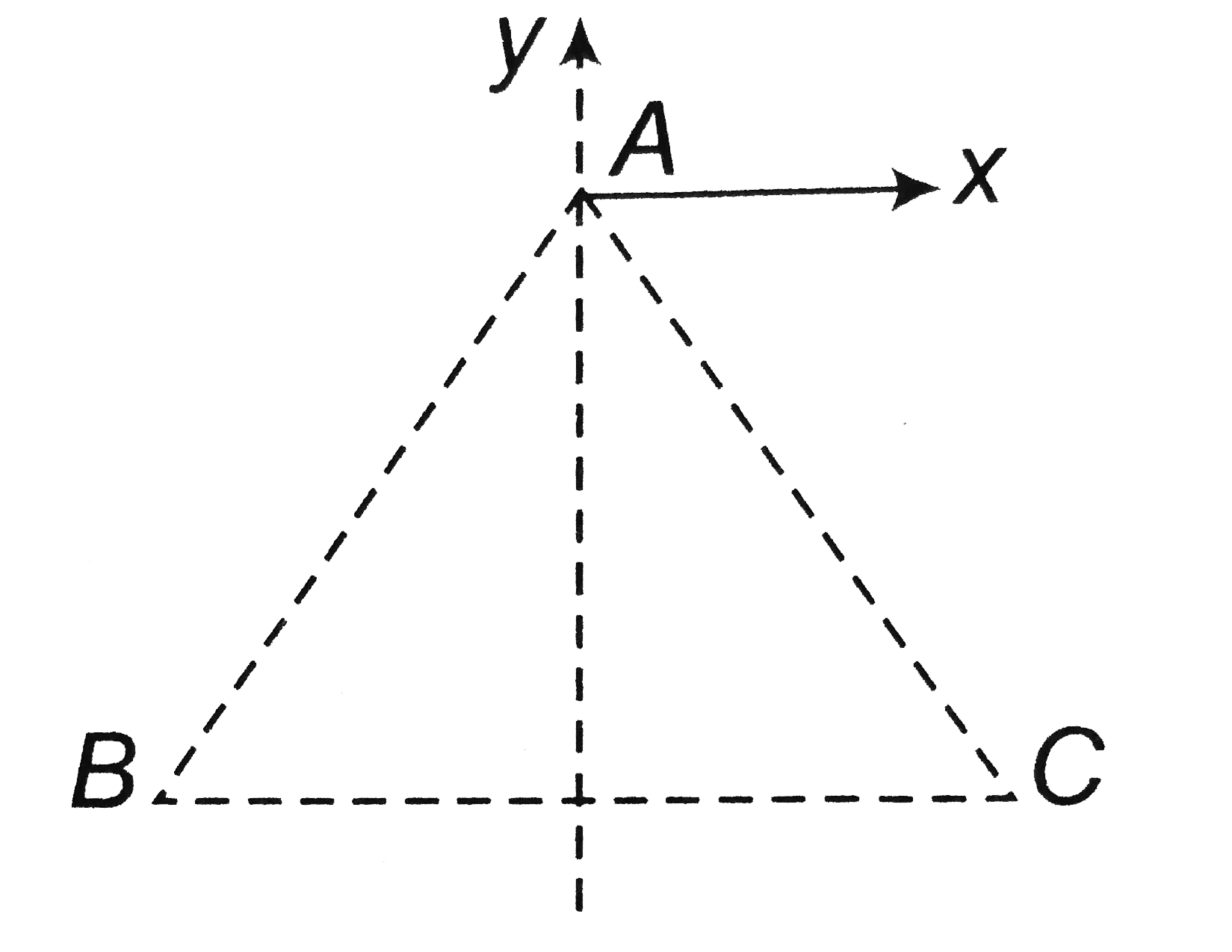
Three similar charges `+q` are placed on `3` corners of an equilateral triangle `ABC` of side `a`. How many minimum charges should be placed on a circle of radius `a` with centre at `A` so that resultant force on the charge placed at the centre is `(q^(2))/(4pi epsilon_(0)a^(2))` along `x`-axis?

A

4

B

6

C

3

D

Any number

Text Solution

Verified by Experts

The correct Answer is:
C

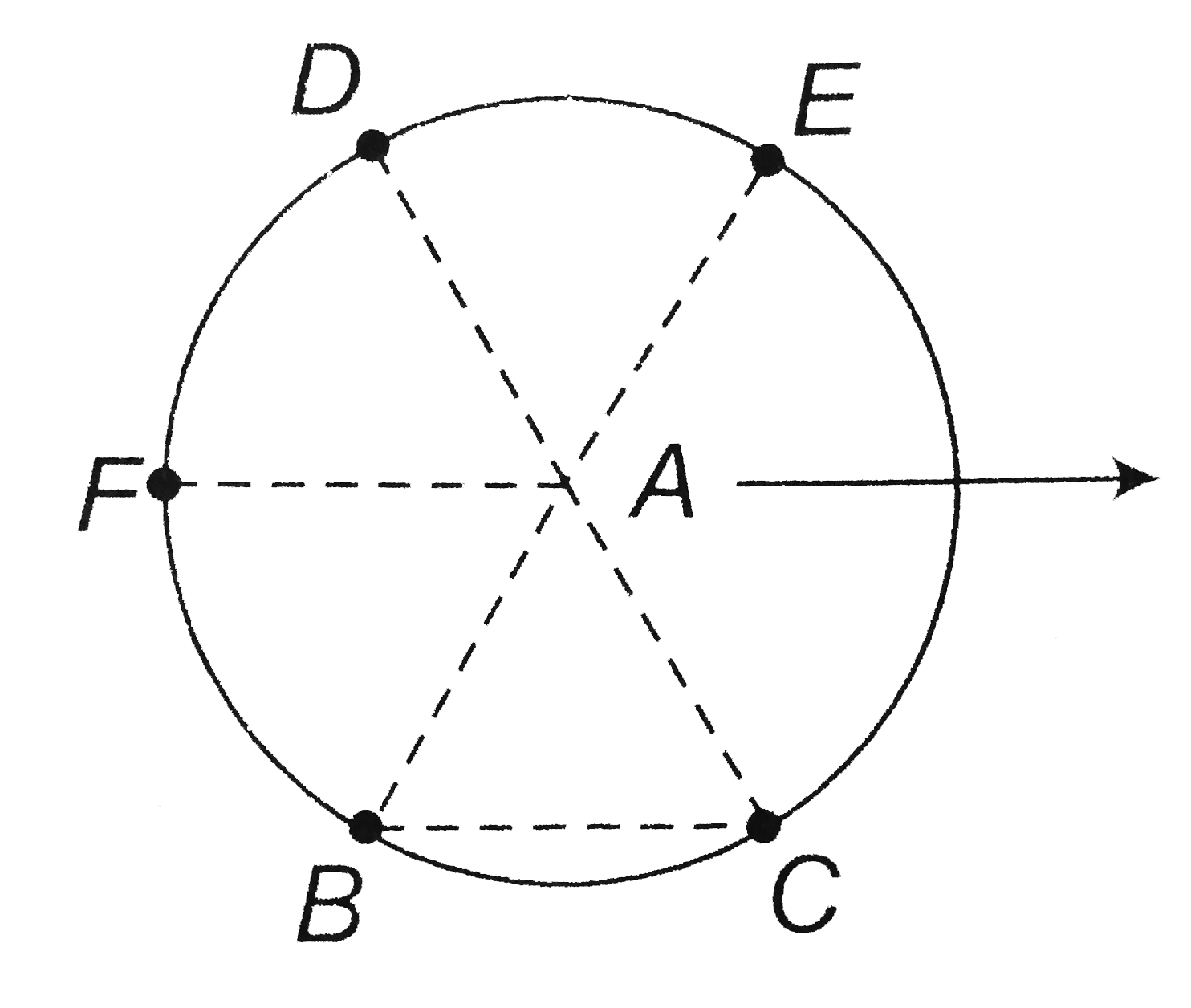
Two similar charges should be placed at `D` and `E` so that resultant force at `A` is zero. A similar charge should not be placed at `F`, so that resultant force at a`A` will be `(q^(2))/(4pi epsilon_(0)a^(2))` towards `x`-axis
Promotional Banner

Topper's Solved these Questions

  • ELECTRIC CHARGE, FIELD & FLUX

    A2Z|Exercise Assertion Reason|7 Videos
  • DUAL NATURE OF RADIATION AND MATTER

    A2Z|Exercise Section D - Chapter End Test|30 Videos
  • ELECTRIC POTENTIAL & CAPACITANCE

    A2Z|Exercise Section D - Chapter End Test|29 Videos

Similar Questions

Explore conceptually related problems

Three charges each 20muC are placed at the corners of an equilateral triangle of side 0.4m The potential energy of the system is

Electric charges q, q, –2q are placed at the corners of an equilateral triangle ABC of side l. The magnitude of electric dipole moment of the system is

Three point charges q are placed at three vertices of an equilateral triangle of side a. Find magnitude of electric force on any charge due to the other two.

Charge of 5 mu C each are placed at the corners of an equilateral triangle of side 10 cm. Then the force on each charge is :-

Three identical charges are placed at corners of a equilateral triangel of side l. If force between any two charges is F, the work required to double the dimensiions of triangle is

Three charge -q,+q and -q are placed at the cornors of an equilateral triangle of side a The resultant electric froce an a charge +q placed at a the centroid O of the triangle is

Three charges each of value q are placed at the corners of an equilateral triangle. A fourth charge Q is placed at the centre of the triangle. If Q = -q :

A2Z-ELECTRIC CHARGE, FIELD & FLUX-Section D - Chapter End Test
  1. A solid conducting sphere of radius a has a net positive charge 2Q. A ...

    Text Solution

    |

  2. Two small spheres of masses M(1)and M(2) are suspended by weightless i...

    Text Solution

    |

  3. Three similar charges +q are placed on 3 corners of an equilateral tri...

    Text Solution

    |

  4. A solid metallic sphere has a charge +3Q. Concentric with this sphere ...

    Text Solution

    |

  5. The following diagram shows the electric field lines between two oppos...

    Text Solution

    |

  6. The magnitude of electric field intensity at point B(2,0,0) due to dip...

    Text Solution

    |

  7. An electric dipole is placed in a uniform electric field vec(E ) of ma...

    Text Solution

    |

  8. Two infinitely large charged planes having uniform suface charge densi...

    Text Solution

    |

  9. Figure, shown above, shows three situations involving a charged partic...

    Text Solution

    |

  10. There are three concentric thin spheres of radius a,b,c (agtbgtc). The...

    Text Solution

    |

  11. A alpha particle is released from rest 10 cm from a large sheet carryi...

    Text Solution

    |

  12. A ring of radius R has charge -Q distributed uniformly over it. Calcul...

    Text Solution

    |

  13. In a figure shown find the ratio of the linear charge densites lambda(...

    Text Solution

    |

  14. A sphere of radius R carries charge such that its volume charge densit...

    Text Solution

    |

  15. A point charge Q is located on the axis of a disc of radius R at a dis...

    Text Solution

    |

  16. It has been experimentally observed that the electric field in a large...

    Text Solution

    |

  17. A metallic shell has a point charge 'q' kept inisde its cavity. Which ...

    Text Solution

    |

  18. Three poistive charges of equal value q are placed at the vertices of ...

    Text Solution

    |

  19. Assertion: A charged by cannot attract another uncharged body. Reaso...

    Text Solution

    |

  20. Assertion: A charge particle is free to move along electric field. It ...

    Text Solution

    |

