Home
Class 12
PHYSICS
A ring of radius R has charge -Q distrib...

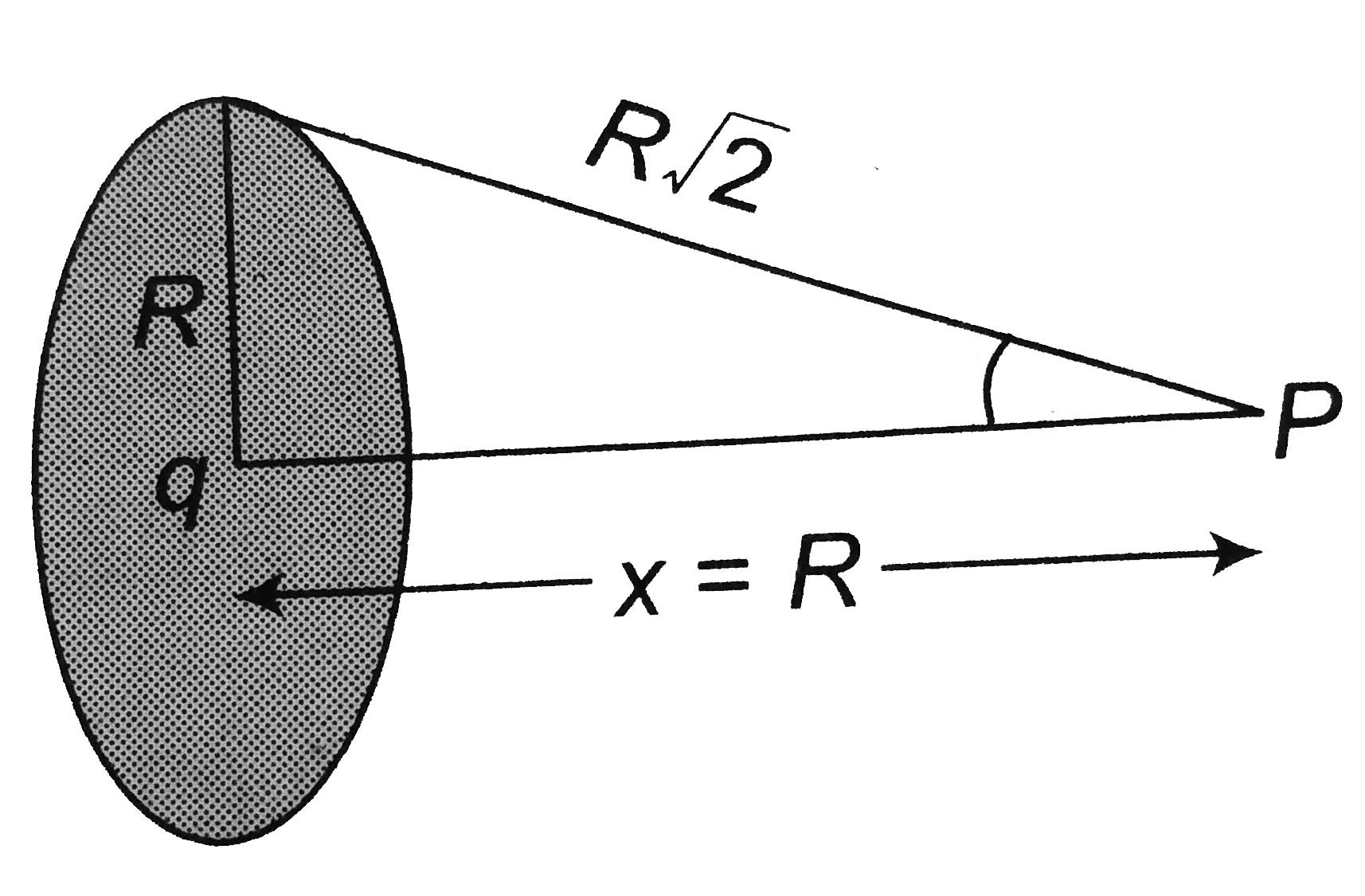
A ring of radius R has charge `-Q` distributed uniformly over it. Calculate the charge that should be placed at the center of the ring such that the electric field becomes zero at a point on the axis of the ring at distant R from the center of the ring.

A

`(Q)/(2)sqrt(3)`

B

`(Q)/(4)sqrt(2)`

C

`(Q)/(3)sqrt(2)`

D

`(Q)/(4)sqrt(3)`

Text Solution

Verified by Experts

The correct Answer is:
B

Electric field at point `P` due to charge of ring is
`E=(kQx)/((R^(2)+x^(2))^(3//2))`
At `x= R:E= (kQ)/(2sqrt(2)R^(2))` directed towards the centre.

Electric field at `P` due to centre charge: `(kq)/(R^(2))` for net field to be zero at `P`:
`(kq)/(R^(2))=(kQ)/(2sqrt(2)R^(2))implies q=(Q)/(2sqrt(2))=(Q)/(4)sqrt(2)`
Promotional Banner

Topper's Solved these Questions

  • ELECTRIC CHARGE, FIELD & FLUX

    A2Z|Exercise Assertion Reason|7 Videos
  • DUAL NATURE OF RADIATION AND MATTER

    A2Z|Exercise Section D - Chapter End Test|30 Videos
  • ELECTRIC POTENTIAL & CAPACITANCE

    A2Z|Exercise Section D - Chapter End Test|29 Videos

Similar Questions

Explore conceptually related problems

A thin semi-circular ring of radius r has a positive charge q distributed uniformly over it. The net field vecE at the centre O is

A ring of radius a contains a charge q distributed. uniformly ober its length. Find the electric field at a point. on the axis of the ring at a distance x from the centre.

Charges q is uniformly distributed over a thin half ring of radius R . The electric field at the centre of the ring is

Over a thin ring of radius R a charge q is distributed none-uniformly. Calculate the work done of the force field in displacing a point charge q' from centre of the ring to infinity.

A half ring of radius R has a charge of lambda per unit length. The electric force on 1C charged placed at the center is

A ring of radius R with a uniformly distributed charge q as shown in figure. A charge q_(0) , is now placed at the centre of the ring. Find the increment in-the tension in ring.

A ring of radius R is with a uniformly distributed charge Q on it .A charge q is now placed in the centre of the ring .Find the increment in tension in the ring.

A2Z-ELECTRIC CHARGE, FIELD & FLUX-Section D - Chapter End Test
  1. Two small spheres of masses M(1)and M(2) are suspended by weightless i...

    Text Solution

    |

  2. Three similar charges +q are placed on 3 corners of an equilateral tri...

    Text Solution

    |

  3. A solid metallic sphere has a charge +3Q. Concentric with this sphere ...

    Text Solution

    |

  4. The following diagram shows the electric field lines between two oppos...

    Text Solution

    |

  5. The magnitude of electric field intensity at point B(2,0,0) due to dip...

    Text Solution

    |

  6. An electric dipole is placed in a uniform electric field vec(E ) of ma...

    Text Solution

    |

  7. Two infinitely large charged planes having uniform suface charge densi...

    Text Solution

    |

  8. Figure, shown above, shows three situations involving a charged partic...

    Text Solution

    |

  9. There are three concentric thin spheres of radius a,b,c (agtbgtc). The...

    Text Solution

    |

  10. A alpha particle is released from rest 10 cm from a large sheet carryi...

    Text Solution

    |

  11. A ring of radius R has charge -Q distributed uniformly over it. Calcul...

    Text Solution

    |

  12. In a figure shown find the ratio of the linear charge densites lambda(...

    Text Solution

    |

  13. A sphere of radius R carries charge such that its volume charge densit...

    Text Solution

    |

  14. A point charge Q is located on the axis of a disc of radius R at a dis...

    Text Solution

    |

  15. It has been experimentally observed that the electric field in a large...

    Text Solution

    |

  16. A metallic shell has a point charge 'q' kept inisde its cavity. Which ...

    Text Solution

    |

  17. Three poistive charges of equal value q are placed at the vertices of ...

    Text Solution

    |

  18. Assertion: A charged by cannot attract another uncharged body. Reaso...

    Text Solution

    |

  19. Assertion: A charge particle is free to move along electric field. It ...

    Text Solution

    |

  20. Assertion: Column's law can be derived from Gauss's law. Reason: Gau...

    Text Solution

    |

