Home
Class 12
PHYSICS
A uniform magnetic field B and a uniform...

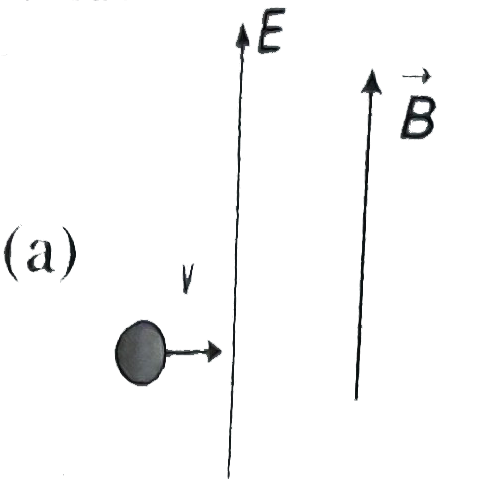
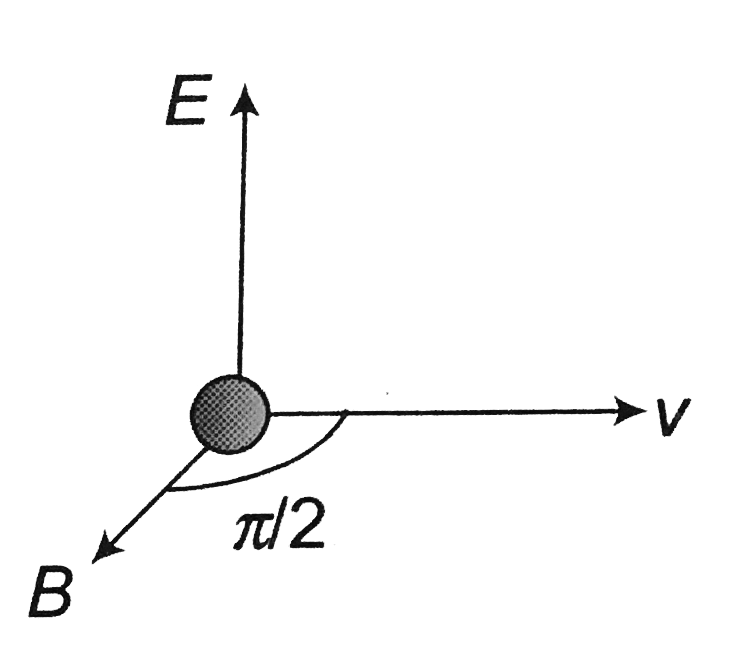
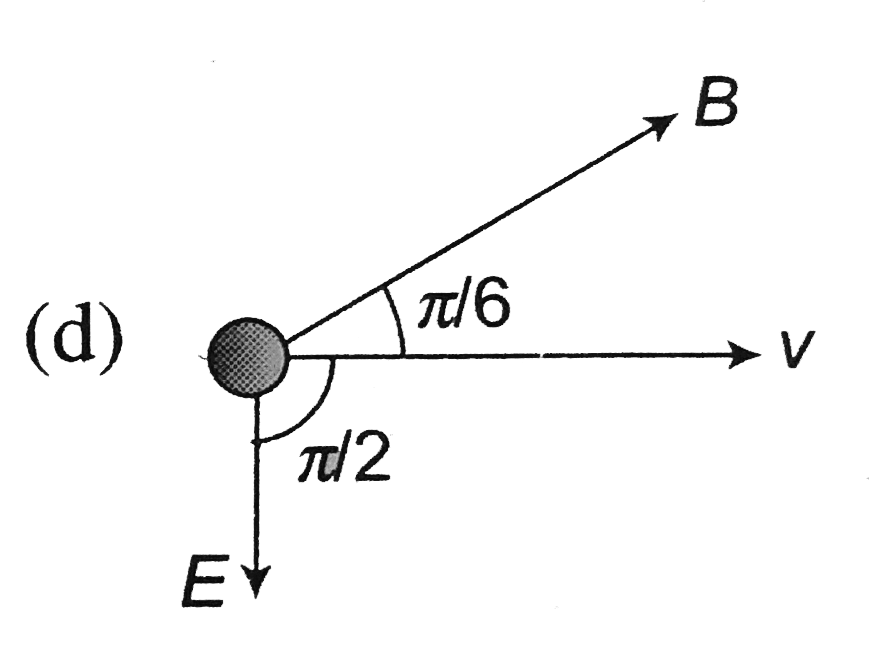
A uniform magnetic field `B` and a uniform electric field `E` act in a common region. An electron is entering this region of space. The correct arrangement for it to escape undeviated is

A

B

C

D

Text Solution

AI Generated Solution

The correct Answer is:

To determine the correct arrangement for an electron to escape undeviated in the presence of uniform electric and magnetic fields, we can follow these steps: ### Step-by-Step Solution: 1. **Understand the Forces Acting on the Electron**: - The force due to the electric field \( E \) acting on the electron is given by: \[ F_E = Q \cdot E \] - The force due to the magnetic field \( B \) acting on the electron when it is moving with velocity \( v \) is given by: \[ F_B = Q \cdot (v \times B) \] - Here, \( Q \) is the charge of the electron (which is negative). 2. **Condition for Undeviated Motion**: - For the electron to move undeviated, the net force acting on it must be zero. This means that the electric force must be equal in magnitude and opposite in direction to the magnetic force: \[ F_E + F_B = 0 \quad \Rightarrow \quad F_E = -F_B \] 3. **Direction of Forces**: - The electric force \( F_E \) acts in the direction of the electric field \( E \). - The magnetic force \( F_B \) acts in the direction given by the right-hand rule (for a positive charge), but since we are dealing with an electron (negative charge), the direction of \( F_B \) will be opposite to that predicted by the right-hand rule. 4. **Analyzing Each Arrangement**: - **Option A**: If \( E \) is in one direction and \( B \) is perpendicular to it, the forces will not cancel. Hence, this option is not valid. - **Option B**: Similar analysis shows that the forces will not balance. Hence, this option is not valid. - **Option C**: If the electric field \( E \) is in one direction and the magnetic field \( B \) is perpendicular to it, the forces can balance if they are in opposite directions. This option is valid. - **Option D**: The forces will not cancel out as they are not in opposite directions. Hence, this option is not valid. 5. **Conclusion**: - The only arrangement that allows the electron to escape undeviated is **Option C**. ### Final Answer: The correct arrangement for the electron to escape undeviated is **Option C**.

To determine the correct arrangement for an electron to escape undeviated in the presence of uniform electric and magnetic fields, we can follow these steps: ### Step-by-Step Solution: 1. **Understand the Forces Acting on the Electron**: - The force due to the electric field \( E \) acting on the electron is given by: \[ F_E = Q \cdot E ...
Promotional Banner

Topper's Solved these Questions

  • SOURCE AND EFFECT OF MAGNETIC FIELD

    A2Z|Exercise Force On A Current Carrying Conductor In Magnetic Field|42 Videos
  • SOURCE AND EFFECT OF MAGNETIC FIELD

    A2Z|Exercise Magnetic Dipole|32 Videos
  • SEMICONDUCTOR ELECTRONICS

    A2Z|Exercise EXERCISE|29 Videos
  • WAVE OPTICS

    A2Z|Exercise Section D - Chapter End Test|29 Videos

Similar Questions

Explore conceptually related problems

A uniform electric field and a uniform magnetic field are acting along the same direction in a certain region. If an electron is projected in the same direction then the electron

A uniform electric field and a uniform magnetic field are acting along the same direction in a certain region. If an electron is projected along the direction of the fields with a certain velocity then

A uniform electric field and a uniform magneitc field exist in a region in the same direction An electron is projected with velocity pointed in the same direction the electron will

A particle moves in a region having a uniform magnetic field and a parallel, uniform electric field. At some instant, the velocity of the particle is perpendicular to the field directjion. The path of the particle will be

An electric field (vec E) and a magnetic field (vec B)exist in a region . The fields are not perpendicular to each other.

A2Z-SOURCE AND EFFECT OF MAGNETIC FIELD-Section D - Chapter End Test
  1. A uniform magnetic field B and a uniform electric field E act in a com...

    Text Solution

    |

  2. Wires 1 and 2 carrying currents i(1) and i(2) respectively are incline...

    Text Solution

    |

  3. A particle of mass M and charge Q moving with velocity vec(v) describe...

    Text Solution

    |

  4. A particle of charge -16xx10^(-18) coulomb moving with velocity 10 ms^...

    Text Solution

    |

  5. Two charged plates A and B are at the same electrical potential, and p...

    Text Solution

    |

  6. Two long conductors, separated by a distance d carry current I(1) and ...

    Text Solution

    |

  7. Two concentric coils each of radius equal to 2 pi cm are placed at rig...

    Text Solution

    |

  8. Two thin, long, parallel wires, separated by a distance d carry a curr...

    Text Solution

    |

  9. A conducting circular loop of radius r carries a constant current i. I...

    Text Solution

    |

  10. A proton moving with a constant velocity passes through a region of sp...

    Text Solution

    |

  11. A charged particle fo mass m and charge q enters along AB at point A ...

    Text Solution

    |

  12. Two thin long parallel wires seperated by a distance 'b' are carrying...

    Text Solution

    |

  13. The charge on a particle Y is double the charge on particle X.These tw...

    Text Solution

    |

  14. A battery is connected between two points A and B on the circumference...

    Text Solution

    |

  15. A proton , a deutron and alpha )- particle having the same kinetic en...

    Text Solution

    |

  16. Three long straight and parallel wires carrying currents are arranged...

    Text Solution

    |

  17. Two straight horizontal parallel wires are carrying the same current i...

    Text Solution

    |

  18. A proton and an alpha-particle enter a uniform magnetic field moving w...

    Text Solution

    |

  19. A proton (mass = 1.67xx10^(-27) kg and charge 1.6xx10^(-19) C) enters ...

    Text Solution

    |

  20. An alpha particle travels in a circular path of radius 0.45 m in a mag...

    Text Solution

    |

  21. A unifrom magnetic field B is acting from south to north and is of m...

    Text Solution

    |
