Home
Class 12
PHYSICS
A rod of length l rotates with a small b...

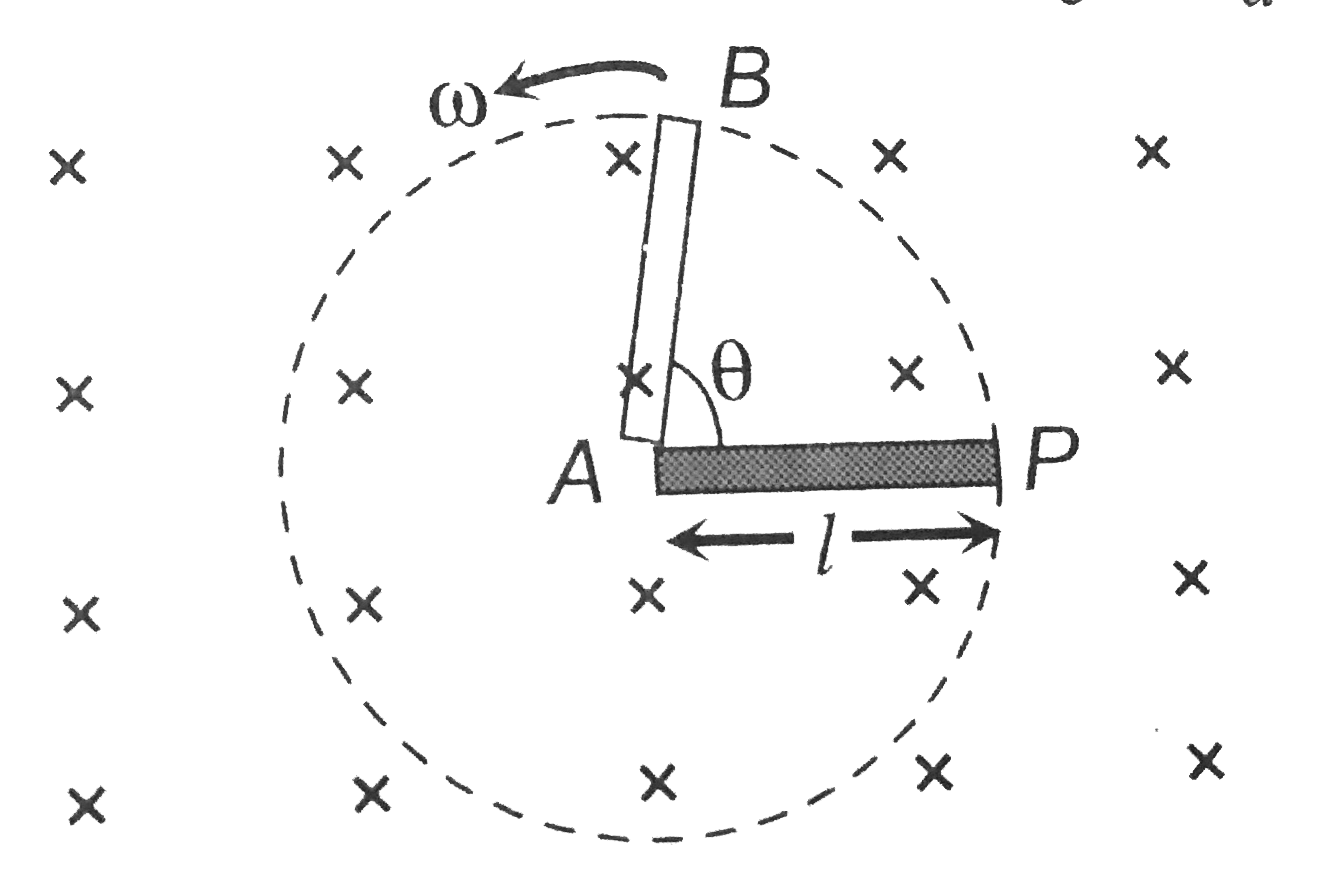
A rod of length l rotates with a small but uniform angular velocity `omega` about its perpendicular bisector. A uniform magnetic field B exists parallel to the axis of rotation. The potential difference between the centre of the rod and an end is

A

`(1)/(2)Bomegal^(2)`

B

`(3)/(4)Bomegal^(2)`

C

`Bomegal^(2)`

D

`2Bomegal^(2)`

Text Solution

Verified by Experts

The correct Answer is:
A

If in time `t`. The rod turns by an angle `q`. The area genrated by the rotation of rod will be
`=(1)/(2)lxxltheta=(1)/(20l^(2)theta`
so the flux linked with the area genrated by the ratation of rod
`varphi=B((1)/(2)l^(2)theta)cos0=(1)/(2)Bl^(2)theta=(1)/(2)Bl^(2)omegat`
and so `e=(dvarphi)/(dt)=(d)/(dt)((1)/(2)Bl^(2)omegat)=(1)/(2)Bl^(2)omega`
Promotional Banner

Topper's Solved these Questions

  • ELECTROMAGNETIC INDUCTION

    A2Z|Exercise Inductor Circuits|31 Videos
  • ELECTROMAGNETIC INDUCTION

    A2Z|Exercise Applications Of Emi|58 Videos
  • ELECTROMAGNETIC INDUCTION

    A2Z|Exercise Section D - Chapter End Test|30 Videos
  • ELECTRIC POTENTIAL & CAPACITANCE

    A2Z|Exercise Section D - Chapter End Test|29 Videos
  • ELECTROMAGNETIC WAVES AND COMMUNICATION SYSTEM

    A2Z|Exercise Section D - Chapter End Test|30 Videos

Similar Questions

Explore conceptually related problems

(a) A metal rod of length L rotates about an end with a uniform angular velocity omega . A uniform magnetic field B exists in the direction of the axis of rotation. Calculate the emf induced between the ends of the rod. Neglect the centripetal force acting on the free electrons as they move in circular paths. (b) A rod of length L rotates with a small but uniform angular velocity omega about its perpendicular bisector. A uniform magnetic field B exists parallel to the axis of rotation. Find the potential difference (i) between the centre of rod and one end and (ii) between the two ends of the rod.

A rod of length l rotates with a uniform angular velocity omega about its perpendicular bisector. A uniform magnetic field B exists parallel to the axis of rotation. The potential difference between the two ends of the lrod is

A conducting rod of length 2l is rotating with constant angular speed w about its perpendicular bisector. A uniform magnetic field B exists parallel to the axis of rotation. The e.m.f. induced between two ends of the rod is

A conducting disc of radius r rotaes with a small but constant angular velocity omega about its axis. A uniform magnetic field B exists parallel to the axis of rotation. Find the motional emf between the centre and the periphery of the disc.

A conducting rod rotates with a constant angular velocity 'omega' about the axis which passes through point 'O' and perpendicular to its length . A uniform magnetic field 'B' exists parallel to the axis of the rotation . Then potential difference between the two ends of the rod is :-

A rod of length l is rotated with angular speed omega about an axis passing through the centre of rod and perpendicular to its length. A uniform magnetic field B is applied parallel to the axis of rotation, Potential difference developed between the ends of the rod is

A metal rod length l rotates about on end with a uniform angular velocity omega . A uniform magnetic field vecB exists in the direction of the axis of rotation. Calculate the emf induced between the ends of the rod. Neglect the centripetal force acting on the free electrons as they money in circular paths.

A metal rod of length 2 m is rotating with an angular velocity of 100 rad//sec in a plane perpendicular to a uniform magnetic field of 0.3 T . The potential difference between the ends of the rod is

A2Z-ELECTROMAGNETIC INDUCTION-Motional And Rotational Emf
  1. A rectangular loop is being pulled at a constant speed v, through a re...

    Text Solution

    |

  2. The figure shows four wire loops, with edge length of either L or 2L. ...

    Text Solution

    |

  3. A rod of length l rotates with a small but uniform angular velocity om...

    Text Solution

    |

  4. Two circular coils can be arranged in any of the three situation shown...

    Text Solution

    |

  5. The back e.m.f. induced in a coil, when current change from 1 ampere t...

    Text Solution

    |

  6. An e.m.f. of 5 "volt" is produced by a self-inductance, when the curre...

    Text Solution

    |

  7. Calculate the energy stored in an inductor of inductance 50 mH when a ...

    Text Solution

    |

  8. The current passing through a choke coil of 5 henry is decreasing at t...

    Text Solution

    |

  9. Average energy stored in a pure inductance L when current i flows thro...

    Text Solution

    |

  10. A solenoid has 2000 turns wound over a length of 0.3 m. Its cross-sect...

    Text Solution

    |

  11. A coil is wound as a transformer of rectangular cross section. If all ...

    Text Solution

    |

  12. Two coils of self-inductance L(1) and L(2) are placed closed to each o...

    Text Solution

    |

  13. The coefficient of self-inductance of a solenoid is 0.18 mH. If a crud...

    Text Solution

    |

  14. In a transformer , the coefficient of mutual inductance between the pr...

    Text Solution

    |

  15. When the current in a coil changeg from 8 amperes to 2 amperes in 3xx1...

    Text Solution

    |

  16. The mutual inductance between two coils is 1.25 henry. If the current ...

    Text Solution

    |

  17. A coil of wire of a certain radius has 600 turns and a self-inductance...

    Text Solution

    |

  18. When the number of turns in a coil is doubled without any change in th...

    Text Solution

    |

  19. The average e.m.f. induced in a coil in which the current changes from...

    Text Solution

    |

  20. If a current of 3.0 amperes flowing in the primary coil is reduced to...

    Text Solution

    |

