Home
Class 12
PHYSICS
Statement I: Thin films such as soap bub...

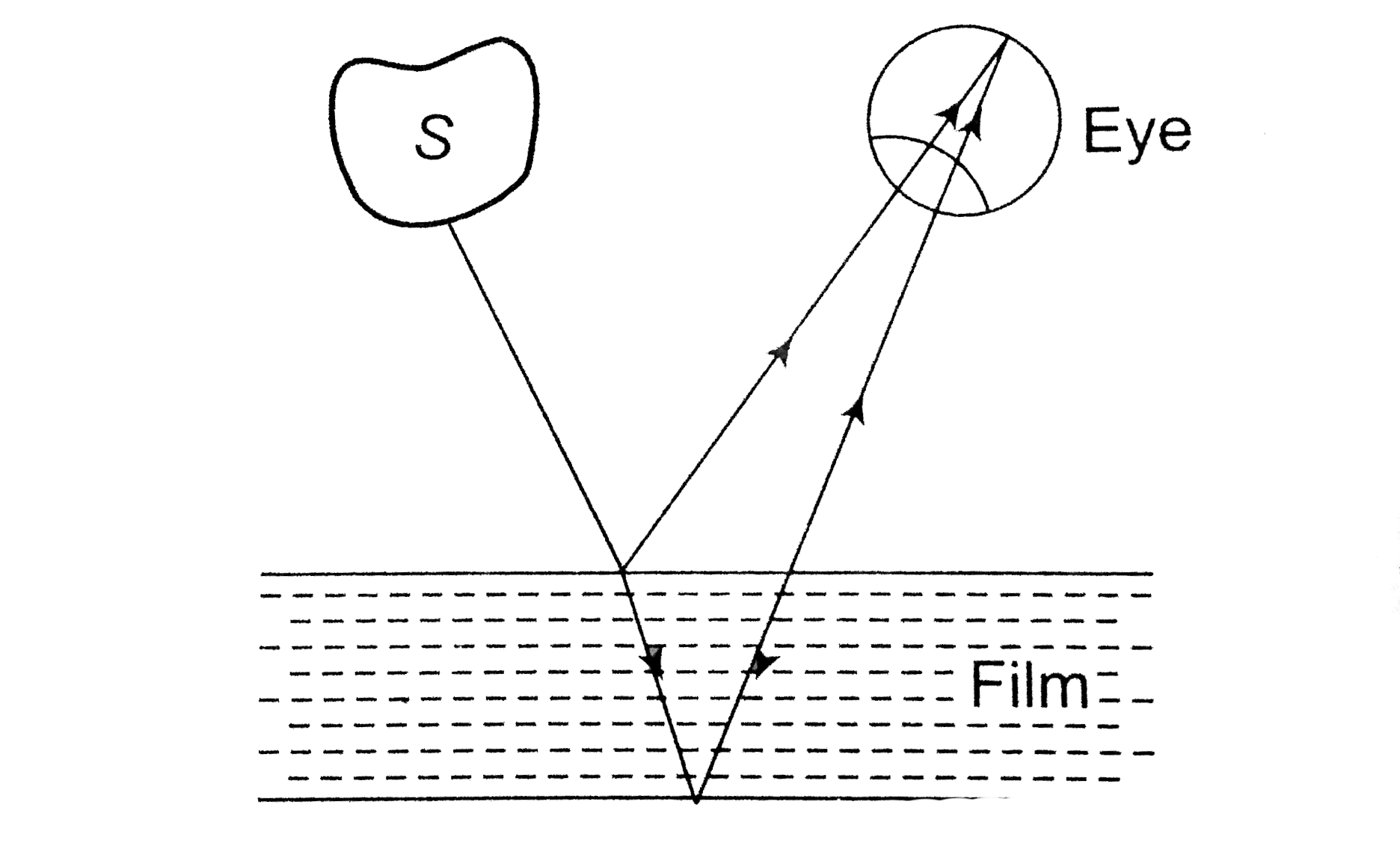
Statement I: Thin films such as soap bubble or a thin layer of oit on watar show beautiful colors when illuminated by white light.
Statement II: It happens due to the interference of light reflected form the upper surface of thin film.

A

(a) If both the assertion and reason are true and reason explains the assertion assertion.

B

(b) If both assertion and reason are true but reason does not explain the assertion

C

(c) If assertion is true but reason is false.

D

(d) If assertion is false but reason is true.

Text Solution

Verified by Experts

The correct Answer is:
C

When a thin film of oil spreads over the surface of water is seen in broad-day light, brilliant colours are seen in the film. A similar colour pattern is seen in soap bubbles. These colours arise due to interference of sun-light reflected from the upper and lower surfaces of the film
Promotional Banner

Topper's Solved these Questions

  • WAVE OPTICS

    A2Z|Exercise Section D - Chapter End Test|29 Videos
  • WAVE OPTICS

    A2Z|Exercise AIIMS Questions|25 Videos
  • SOURCE AND EFFECT OF MAGNETIC FIELD

    A2Z|Exercise Section D - Chapter End Test|30 Videos

Similar Questions

Explore conceptually related problems

Why does a soap buuble show beautiful colours, when illuminated by white light ?

Assertion (A) : Thin films such as soap bubble or a thin layer of oil on water show beautiful colours when illuminated by white light. Reason (R ): The colours are obtained by dispersion of light

The colours seen in the reflected white light from a thin oil film are due to

Statement -1: If an exceedingly thin soap film is seen in reflected light, it may appear dark Statement -2 : Three is a phase difference of pi from the rays reflected from front and rear faces of the film.

Thin films, including soap bubbles and oil slicks, show patterns of alternating dark and bright regions resulting from interference among the reflected light waves. If two waves are in phase their crest and troughs will coincide. The interference will be constructive and the aplitude of the resultant wave will be greater than the amplitude of either constituent wave. if the two waves are out of phase, the crests of one wave will coincide with the troughs of the other wave. The interference will be destructive and the amplitude of the resultant wave will be less than that of either constituent wave. at the interface between two transparent media some light is reflected and some light is refracted. * When incident light, reaches the surface at point a, some of the light is reflected as ray R_(a) and and some is refracted following the path ab to the back of the film. *At point b some of the light is refracted out of the film and part is reflected back refracted out of the fiml as ray R_(c) . R_(a) and R_(c) are parallel. However, R_(c) has travelled the extra distance within the film of abc. if the angle of incidence is small then abc is approximately twice the film's thickness. if R_(a) and R_(c) are in phase they will undergo constructive interference and the region ac will be bright if R_(a) and R_(c) are out of phase, they will undergo destructive interference. * Refraction at an interface never changes the phase of the wave. * For reflection at the interface between two media 1 and 2, if n_(1)ltn_(2) the reflected wave will change phase by pi . if n_(1)gtn_(2) the reflected wave will not undergo a phase change. for reference n_(air)=1.00 * if the waves are in phase after refection at all interfaces, then the effects of path length in the film are Constructive interference occur when (n= refractive index) 2t=mlamda//n" "m=0,1,2,3... .. Destructive interference occurs when 2t=(m+1//2)lamda//n" "m=0,1,2,3... Q. A 600 nm light is perpendicularly incident on a soap film suspended in air. The film is 1.00 mum thick with n=1.35. Which statement most accurately describes the interference of the light reflected by the two surfaces of the film?

Interference of light, Thin film interference and Introduction to YDSE

Assertion (A) : The soap film in sun light is colourful Reason (R ) : Thin films produce interference of light

This question has a paragraph followed by two statements, Statement - 1 and Statement - 2. Of the given four alternatives after the statements, choose the one that describes the statements. A thin air film is formed by putting the convex surface of a plane-convex lens over a plane glass plate. With monochromatic light, this film gives an interference pattern due to light reflected from the top (convex) surface and the bottom (glass plate) surface of the film. Statement - 1: When light reflects from the air-glass plate interface, the reflected wave suffers a phase change of pi . Statement - 2 : The centre of the interference pattern is dark.

