

Home
Class 11
PHYSICS
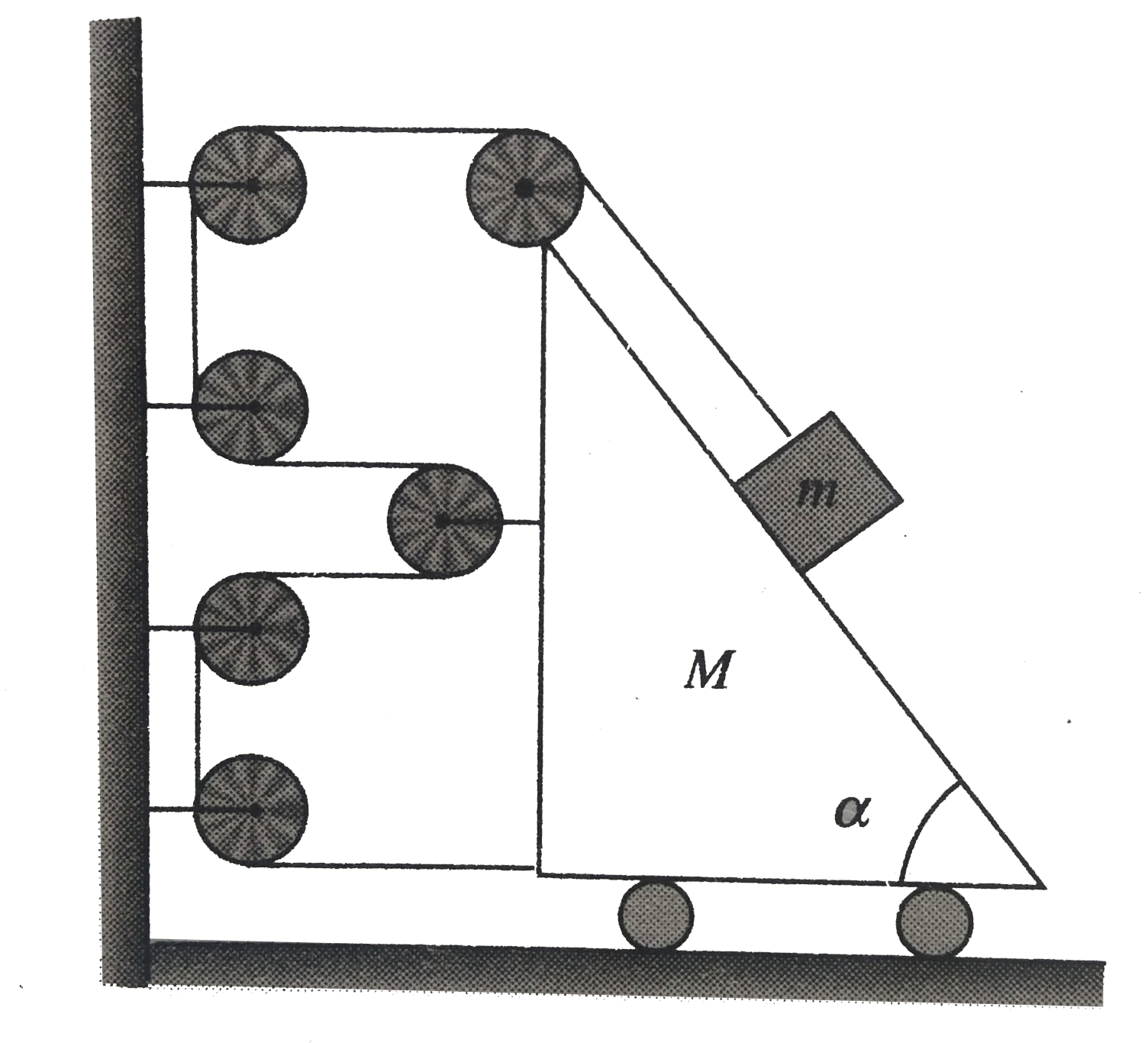
If the acceleration of wedge in the show...

If the acceleration of wedge in the shown arrangement is a `ms^(-2)` towards left, then at this instant, acceleration of the block (magnitude only) would be

Promotional Banner

Similar Questions

Explore conceptually related problems

In the arrangement shown, the pulleys and the strings are ideal.The acceleration of the block B is

Wedge B is pulled by an acceleration 2g towards left. Find the acceleration of block A-

In the arrangement shown, the pulleys are smooth and the strings are inextensible. The acceleration of block B is :

In the arrangement shown in fig., all pulleys are smooth and massless. When the system is released from the rest, acceleration of block 2 and 3 relative to 1 are 1 ms^(-2) downwards and 5ms^(-2) downwards, respectively. Acceleration of block 3 relative to 4 is zero. Find the absoulte acceleration of block 2.

In the arrangement shown in fig., all pulleys are smooth and massless. When the system is released from the rest, acceleration of block 2 and 3 relative to 1 are 1 ms^(-2) downwards and 5ms^(-2) downwards, respectively. Acceleration of block 3 relative to 4 is zero. Find the absoulte acceleration of block 2.

In the arrangement shown in fig., all pulleys are smooth and massless. When the system is released from the rest, acceleration of block 2 and 3 relative to 1 are 1 ms^(-2) downwards and 5ms^(-2) downwards, respectively. Acceleration of block 3 relative to 4 is zero. Find the absolute acceleration of block 1.

In the arrangement shown in fig., all pulleys are smooth and massless. When the system is released from the rest, acceleration of block 2 and 3 relative to 1 are 1 ms^(-2) downwards and 5ms^(-2) downwards, respectively. Acceleration of block 3 relative to 4 is zero. Find the absoulte acceleration of block 4.

In the arrangement shown in fig., all pulleys are smooth and massless. When the system is released from the rest, acceleration of block 2 and 3 relative to 1 are 1 ms^(-2) downwards and 5ms^(-2) downwards, respectively. Acceleration of block 3 relative to 4 is zero. Find the absoulte acceleration of block 3.

In the arrangement shown in fig., all pulleys are smooth and massless. When the system is released from the rest, acceleration of block 2 and 3 relative to 1 are 1 ms^(-2) downwards and 5ms^(-2) downwards, respectively. Acceleration of block 3 relative to 4 is zero. Find the absoulte acceleration of block 4.