Home
Class 11
CHEMISTRY
The graph relates. In K(eq.) vs.(1)/(T) ...

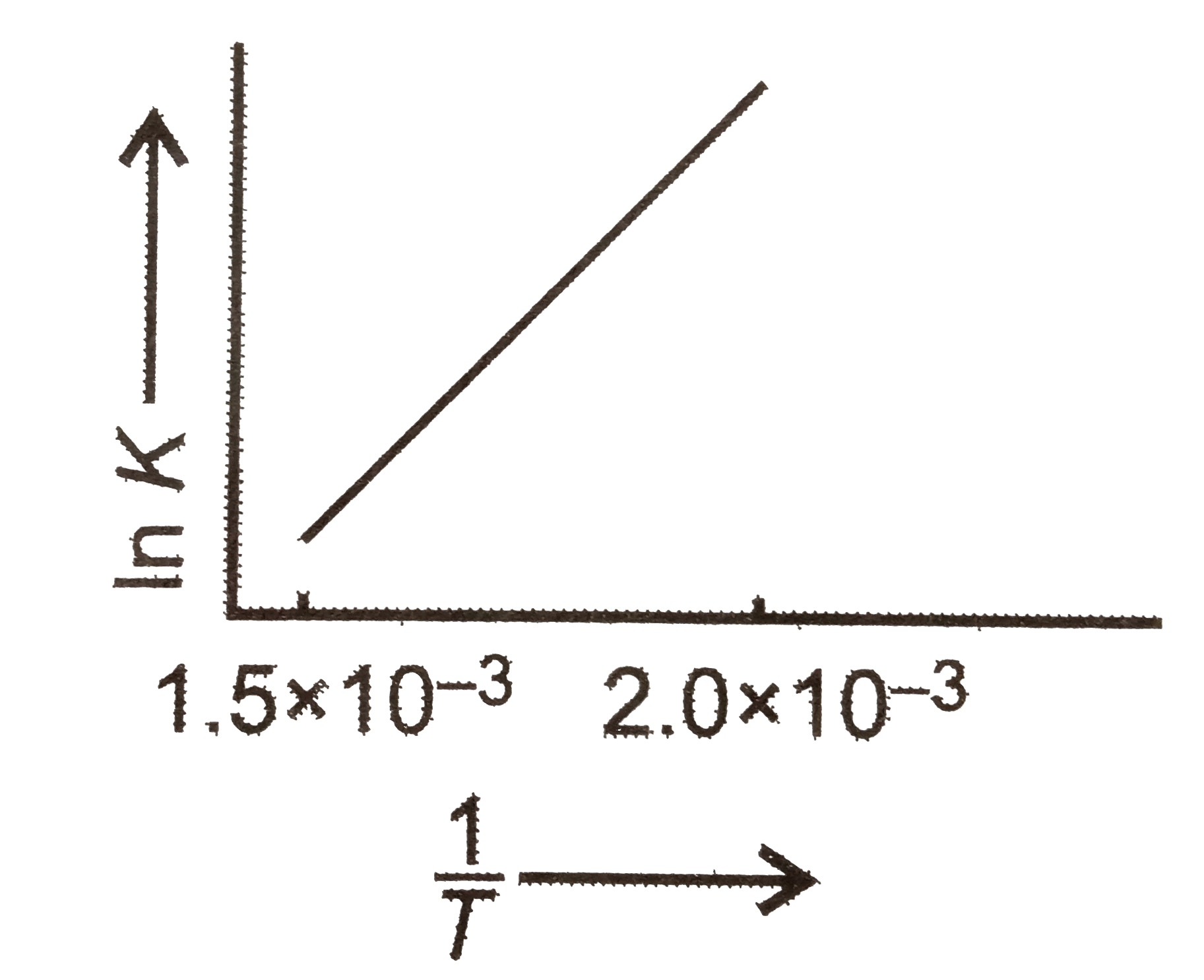
The graph relates. In `K_(eq.) vs.(1)/(T)` for a reaction. The reaction must be:

A

exothermic

B

endothermic

C

`DeltaH` is negligible

D

high spontaneous at ordinary temperature

Text Solution

Verified by Experts

In `(K_(2))/(K_(1))=(DeltaH)/(R )[(T_(2)-T_(1))/(T_(1)T_(2))]`
Since `K` increase with decrease of temperature and thus `DeltaH=-ve`.
Promotional Banner

Topper's Solved these Questions

  • CHEMICAL EQUILIBRIUM

    P BAHADUR|Exercise Integer|12 Videos
  • CHEMICAL EQUILIBRIUM

    P BAHADUR|Exercise Comprehension|22 Videos
  • CHEMICAL BONDING

    P BAHADUR|Exercise Exercise 7|11 Videos
  • GASEOUS STATE

    P BAHADUR|Exercise Exercise -9|1 Videos

Similar Questions

Explore conceptually related problems

A schematic plot of log K_(eq) vs inverse of temperature for a reaction is shown in the figure. The reaction must be:

A schematic plot of ln K_(eq) versus inverse of temperature for a reaction is shown below The reaction must be

A schematic plot of ln K_(eq) versus inverse of temperature for a reaction is shown below: The reaction must be:

A schematic plot of In K_(eq) versus inverse o ftemperature for a reaction is shown below the reaction must be:

If the graph of concentration of [A] vs T for completion of reaction is a straight line, then the order of reaction is

Plot ln K vs. 1/T for two reactions A and B are given below. Which reaction is more sensitive to temperature :-

The magnitude of the equilibrium constant (K_(eq)) for a cell reaction is related to the magnitude of the standard Gibbs energy change for cell reaction by.

The slope of a line in the graph of log k versus 1/T for a reaction is -5841 K. Calculate energy of activation for the reaction.

Draw the plot of In vs 1/T for a chemical reaction .What does the intercept represent ? What is the relation between slope and E_a ?

P BAHADUR-CHEMICAL EQUILIBRIUM-Exercise
  1. The graph relates. In K(eq.) vs.(1)/(T) for a reaction. The reaction m...

    Text Solution

    |

  2. Write equilibrium constant for the each : (a) N(2)O(4(g))hArr2NO(2(g...

    Text Solution

    |

  3. The equilibrium constant expression for a gas reaction is : K(c) = (...

    Text Solution

    |

  4. The equilibrium constant of the reaction , SO(3(g))hArrSO(2(g))+(1)/...

    Text Solution

    |

  5. Calculate the equilibrium constant for the reaction, H(2(g))+CO(2(g)...

    Text Solution

    |

  6. For the reactions, N(2(g))+3H(2(g))hArr2NH(3(g)). At 400 K, K(p)=41 at...

    Text Solution

    |

  7. Find out the value of K(c) for each of the following equilibrium from ...

    Text Solution

    |

  8. The rate of reversible reaction (change in concentration per second): ...

    Text Solution

    |

  9. Write a stoichiometric equation for the reaction between A(2) and C wh...

    Text Solution

    |

  10. In which case does the reaction go farthest to completion: K=1 K, K=10...

    Text Solution

    |

  11. The equilibrium constant K(c) for A((g))hArrB((g)) is 1.1. Which gas h...

    Text Solution

    |

  12. Calculate the value of equilibrium constant K(p) for the reaction: O...

    Text Solution

    |

  13. Equilibrium constant, K(c) for the reaction, N(2(g))+3H(2(g))hArr2NH...

    Text Solution

    |

  14. The ester , ethyl acetate is formed by the reaction of ethanol and ace...

    Text Solution

    |

  15. Consider the following equations for cell reaction: A+BhArrC+D ….(1)...

    Text Solution

    |

  16. For the gasesous reaction, 2NO(2)hArrN(2)O(4), calculate DeltaG^(@) an...

    Text Solution

    |

  17. DeltaG^(@) for (1)/(2)N(2)+(3)/(2)H(2)hArrNH(3) is -16.5 kJ mol^(-1) a...

    Text Solution

    |

  18. Calculate the values of DeltaE^(@) and DeltaH^(@) for the reaction: ...

    Text Solution

    |

  19. For the reaction at 298 K: A((g))+B((g))hArrD((g))+C((g)) DeltaH^(...

    Text Solution

    |

  20. Calculate the value of equilibrium constant for the reaction: A((g))...

    Text Solution

    |

  21. Calculate the pressure for CO(2) at equilibrium if DeltaG^(@)=31.1kcal...

    Text Solution

    |

