

Home
Class 11
CHEMISTRY
The pressure-volume of various thermodyn...

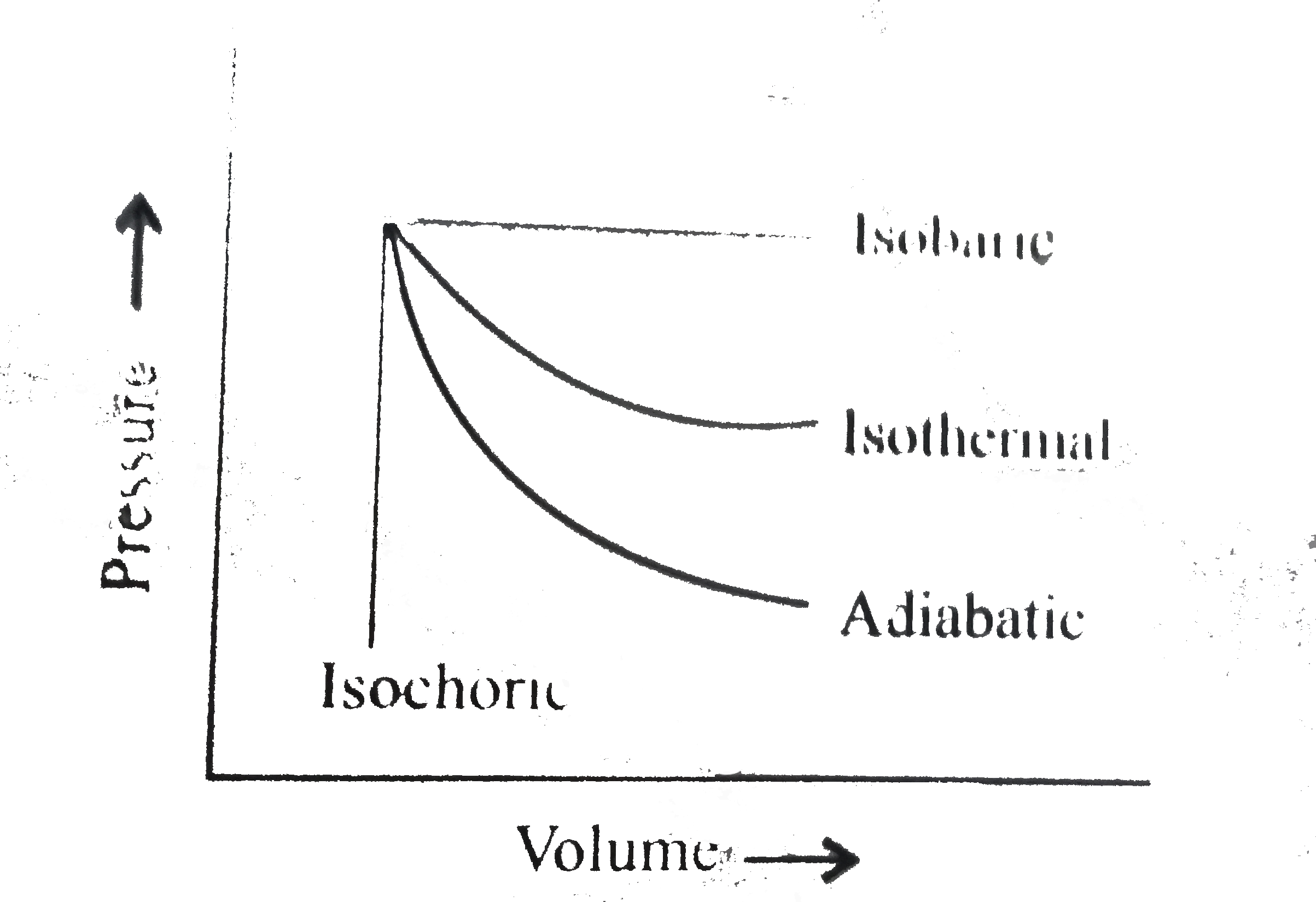
The pressure-volume of various thermodynamic process is shown in graphs:

Work is the mole of transference of energy. It has been observed that reversible work done by the system is the maximum obtainable work.
`w_(rev) gt w_(irr)`
The works of isothermal and adiabatic processes are different from each other.
`w_("isothermal reversible") = 2.303 nRT log_(10) ((V_(2))/(V_(1)))`
`= 2.303 nRT log_(10)((P_(2))/(P_(1)))`
`w_("adiabatic reversible") = C_(V) (T_(1)-T_(2))`
If `w_(1),w_(2),w_(3)` and `w_(4)` are work done in isothermal, adiabatic, isobaric, and isochoric reversible processes, respectively then the correct sequence (for expansion) would be

A

`w_(2)gtw_(1)gtw_(3)`

B

`w_(2)gtw_(3)gtw_(1)`

C

`w_(1)gtw_(2)gtw_(3)`

D

`w_(1)gtw_(3)gtw_(2)`

Text Solution

Verified by Experts

The correct Answer is:
D

Work done in isothermal reversible process is maximum.
Promotional Banner

Topper's Solved these Questions

  • THERMOCHEMISTRY

    P BAHADUR|Exercise Exercise 9 Advance numerical problems|31 Videos

Similar Questions

Explore conceptually related problems

The pressure-volume of varies thermodynamic process is shown in graphs: Work is the mole of transference of energy. It has been observed that reversible work done by the system is the maximum obtainable work. w_(rev) gt w_(irr) The works of isothermal and adiabatic processes are different from each other. w_("isothermal reversible") = 2.303 nRT log_(10) ((V_(2))/(V_(1))) = 2.303 nRT log_(10)((P_(2))/(P_(1))) w_("adiabatic reversible") = C_(V) (T_(1)-T_(2)) Calculate work done when 1 mole of an ideal gas is expanded reversibly form 30L to 60L at a constant temperature of 300k

The pressure-volume of varies thermodynamic process is shown in graphs: Work is the mole of transference of energy. It has been observed that reversible work done by the system is the maximum obtainable work. w_(rev) gt w_(irr) The works of isothermal and adiabatic processes are different from each other. w_("isothermal reversible") = 2.303 nRT log_(10) ((V_(2))/(V_(1))) = 2.303 nRT log_(10)((P_(2))/(P_(1))) w_("adiabatic reversible") = C_(V) (T_(1)-T_(2)) P-V plots for two gases during adiabatic processes are given in the given figure: Plot D and Plot C should correspond to

If w_(1).w_(2),w_(3) and w_(4) are work done in isothermal, adiabatic, isobaric, and isochoric reversible expansion for an ideal gas, respectively, then

The pressure-volume of varies thermodynamic process is shown in graphs: Work is the mole of transference of energy. It has been observed that reversible work done by the system is the maximum obtainable work. w_(rev) gt w_(irr) The works of isothermal and adiabatic processes are different from each other. w_("isothermal reversible") = 2.303 nRT log_(10) ((V_(2))/(V_(1))) = 2.303 nRT log_(10)((P_(2))/(P_(1))) w_("adiabatic reversible") = C_(V) (T_(1)-T_(2)) A thermodynamic system goes in a cyclic process as represented in the following P -V diagram: The network done during the complete cycle is given by the area

The pressure-volume of varies thermodynamic process is shown in graphs: Work is the mole of transference of energy. It has been observed that reversible work done by the system is the maximum obtainable work. w_(rev) gt w_(irr) The works of isothermal and adiabatic processes are different from each other. w_("isothermal reversible") = 2.303 nRT log_(10) ((V_(2))/(V_(1))) = 2.303 nRT log_(10)((P_(2))/(P_(1))) w_("adiabatic reversible") = C_(V) (T_(1)-T_(2)) The q value and work done in isothermal reversible expansion of one mole of an ideal gas from initial pressure of 1 bar to final pressure of 0.1 bar at constant temperature 273K are:

Reversible Isothermal and Adiabatic process

Reversible Isothermal and Adiabatic process

P BAHADUR-THERMODYNAMICS-Exercise
  1. If 20kJ work is done by the water fall per unit volume of water and 30...

    Text Solution

    |

  2. An ideal gas is taken through the cycle A rarr B rarr C rarr A As show...

    Text Solution

    |

  3. The pressure-volume of various thermodynamic process is shown in graph...

    Text Solution

    |

  4. An ideal mono-atomic gas follows the path ABDC. The work done during t...

    Text Solution

    |

  5. In a given process on an ideal gas, dW=0 and dQ is negative, then for ...

    Text Solution

    |

  6. Which of the following pairs of a chemical reaction is certain to resu...

    Text Solution

    |

  7. One mole of a substance is cooled at the rate of 0.4 kJ min^(-1) as sh...

    Text Solution

    |

  8. If a certain mass of gas is made to undergo separately adiabatic and i...

    Text Solution

    |

  9. If separate samples of argon, methane, nitrogen and ammonia, all at th...

    Text Solution

    |

  10. The maximum entropy of mixing occurs when hexane and heptane are mixed...

    Text Solution

    |

  11. Select the correct statements about the following reaction: Fe + HCL...

    Text Solution

    |

  12. Select the correct statements for ideal gases: 1. ((delH)/(delT))(P)...

    Text Solution

    |

  13. 1mole each of CaCl2, Al4C3, Mg2C3 reacts with excess water in separate...

    Text Solution

    |

  14. When a bottle of perfume is opened, odorous molecules mix with air and...

    Text Solution

    |

  15. The Gibbs energy change and standard Gibbs energy change for a reactio...

    Text Solution

    |

  16. The standard change in Gibbs energy for the reaction: H2O hArr H^+ +OH...

    Text Solution

    |

  17. Identify the correct statement for change of Gibbs energy for a system...

    Text Solution

    |

  18. A monoatomic gas is suddenly compressed to 1//8 of its original volume...

    Text Solution

    |

  19. The enthalpy and entropy change for the reaction, Br(2)(l)+Cl(2)(g)r...

    Text Solution

    |

  20. P-V plots for two gases during adiabatic expansion are shown in figure...

    Text Solution

    |