

Home
Class 11
CHEMISTRY
One mole of a substance is cooled at the...

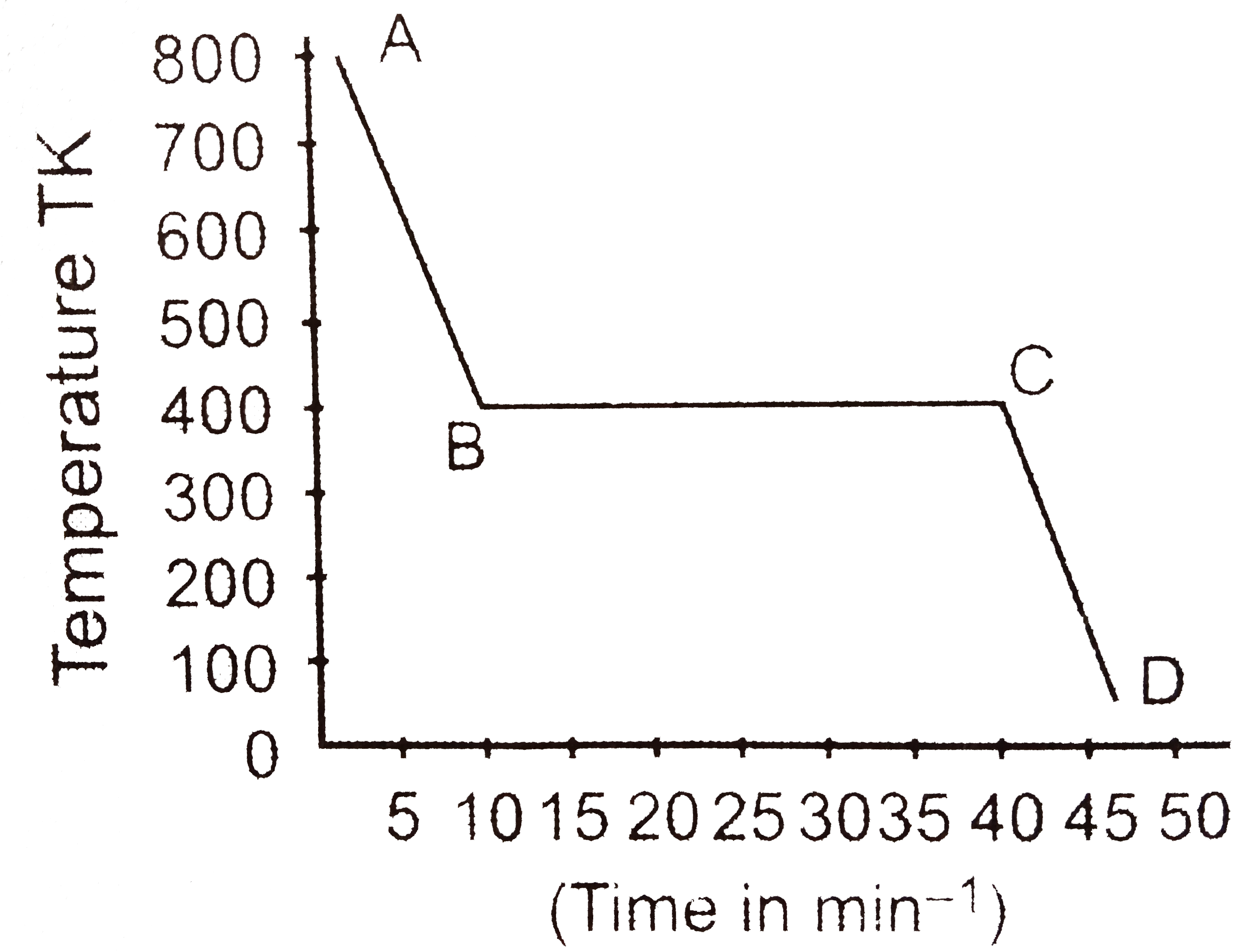
One mole of a substance is cooled at the rate of `0.4 kJ min^(-1)` as shown in the graph. Curve `AB`, points `B` and `C` and curve `CD` represent respectively, the cooling of the liquid, start of freezing, completion of freezing and cooling of the solid based on this data. The entropy of fusion in `J molK^(-1)` is :

A

`10`

B

`20`

C

`30`

D

`40`

Text Solution

Verified by Experts

The correct Answer is:
C

The cooling shows fusion process for `30` minute `(40-10)` at `400K`
`DeltaS=q/T=(0.4xx10^(3)xx30)/400=30 J`
Promotional Banner

Topper's Solved these Questions

  • THERMOCHEMISTRY

    P BAHADUR|Exercise Exercise 9 Advance numerical problems|31 Videos

Similar Questions

Explore conceptually related problems

The curve shown results when a liquid is cooled. What temperature is closest to the freezing point of the liquid ?

A solution containing 0.1 mole of naphthalenen and 0.9 mole of benzenen is cooled out until some benzene freezes out. The solution is then decanted off from the solid and warmed upto 353K where its vapour pressure was found to be 670 torr. The freezing point and and boiling point of benzene are 278.5K and 353K respectively and its enthalpy of fusion is 10.67 Lk "mol"^(-1) . Calculate the temperature to which the solution was cooled originally and the amount of benzene that must have frozen out. Assume ideal behavious.

A solution containing 0.1 mol of naphthalene and 0.9 mol of benzene is cooled out until some benzene freezes out. The solution is then decanted off from the solid and warmed upto 353 K where its vapour pressure was found to be 670 mm . The freezing point and boiling point of benzene are 278.5 K and 353 K respectively, and its enthalpy of fusion is 10.67 KJ "mol"^(-1) . Calculate the temperature to which the solution was cooled originally and the amount of benzene that must have frozen out. Assume ideal behaviour.

The given graph represents the cooling curve of substance X. Which of the following statements are incorrect? I. Process I represents cooling of liquid state of X while process III involves cooling of the solid state. II. The freezing point of substance X is 25^(@)C . III. At 35^(@)C , the substance exists in solid state. IV. Substance X exists both in gaseous and liquid form along the curve QR.

Read the passage given below and answer the following questions: Boiling point or freezing point of liquid solution would be affected by the dissolved solids in the liquid phase. A soluble solid in solution has the effect of raising its boiling point and depressing its freezing point. The addition of non-volatile substances to a solvent decreases the vapor pressure and the added solute particles affect the formation of pure solvent crystals. According to many researches the decrease in freezing point directly correlated to the concentration of solutes dissolved in the solvent. This phenomenon is expressed as freezing point depression and it is useful for several applications such as freeze concentration of liquid food and to find the molar mass of an unknown solute in the solution. Freeze concentration is a high quality liquid food concentration method where water is removed by forming ice crystals. This is done by cooling the liquid food below the freezing point of the solution. The freezing point depression is referred as a colligative property and it is proportional to the molar concentration of the solution (m), along with vapor pressure lowering, boiling point elevation, and osmotic pressure. These are physical characteristics of solutions that depend only on the identity of the solvent and the concentration of the solute. The characters are not depending on the solute’s identity. (Jayawardena, J. A. E. C., Vanniarachchi, M. P. G., & Wansapala, M. A. J. (2017). Freezing point depression of different Sucrose solutions and coconut water.) When a non volatile solid is added to pure water it will:

Read the passage given below and answer the following questions: Boiling point or freezing point of liquid solution would be affected by the dissolved solids in the liquid phase. A soluble solid in solution has the effect of raising its boiling point and depressing its freezing point. The addition of non-volatile substances to a solvent decreases the vapor pressure and the added solute particles affect the formation of pure solvent crystals. According to many researches the decrease in freezing point directly correlated to the concentration of solutes dissolved in the solvent. This phenomenon is expressed as freezing point depression and it is useful for several applications such as freeze concentration of liquid food and to find the molar mass of an unknown solute in the solution. Freeze concentration is a high quality liquid food concentration method where water is removed by forming ice crystals. This is done by cooling the liquid food below the freezing point of the solution. The freezing point depression is referred as a colligative property and it is proportional to the molar concentration of the solution (m), along with vapor pressure lowering, boiling point elevation, and osmotic pressure. These are physical characteristics of solutions that depend only on the identity of the solvent and the concentration of the solute. The characters are not depending on the solute’s identity. (Jayawardena, J. A. E. C., Vanniarachchi, M. P. G., & Wansapala, M. A. J. (2017). Freezing point depression of different Sucrose solutions and coconut water.) Colligative properties are:

Read the passage given below and answer the following questions: Boiling point or freezing point of liquid solution would be affected by the dissolved solids in the liquid phase. A soluble solid in solution has the effect of raising its boiling point and depressing its freezing point. The addition of non-volatile substances to a solvent decreases the vapor pressure and the added solute particles affect the formation of pure solvent crystals. According to many researches the decrease in freezing point directly correlated to the concentration of solutes dissolved in the solvent. This phenomenon is expressed as freezing point depression and it is useful for several applications such as freeze concentration of liquid food and to find the molar mass of an unknown solute in the solution. Freeze concentration is a high quality liquid food concentration method where water is removed by forming ice crystals. This is done by cooling the liquid food below the freezing point of the solution. The freezing point depression is referred as a colligative property and it is proportional to the molar concentration of the solution (m), along with vapor pressure lowering, boiling point elevation, and osmotic pressure. These are physical characteristics of solutions that depend only on the identity of the solvent and the concentration of the solute. The characters are not depending on the solute’s identity. (Jayawardena, J. A. E. C., Vanniarachchi, M. P. G., & Wansapala, M. A. J. (2017). Freezing point depression of different Sucrose solutions and coconut water.) Identify which of the following is a colligative property :

Read the passage given below and answer the following questions: Boiling point or freezing point of liquid solution would be affected by the dissolved solids in the liquid phase. A soluble solid in solution has the effect of raising its boiling point and depressing its freezing point. The addition of non-volatile substances to a solvent decreases the vapor pressure and the added solute particles affect the formation of pure solvent crystals. According to many researches the decrease in freezing point directly correlated to the concentration of solutes dissolved in the solvent. This phenomenon is expressed as freezing point depression and it is useful for several applications such as freeze concentration of liquid food and to find the molar mass of an unknown solute in the solution. Freeze concentration is a high quality liquid food concentration method where water is removed by forming ice crystals. This is done by cooling the liquid food below the freezing point of the solution. The freezing point depression is referred as a colligative property and it is proportional to the molar concentration of the solution (m), along with vapor pressure lowering, boiling point elevation, and osmotic pressure. These are physical characteristics of solutions that depend only on the identity of the solvent and the concentration of the solute. The characters are not depending on the solute’s identity. (Jayawardena, J. A. E. C., Vanniarachchi, M. P. G., & Wansapala, M. A. J. (2017). Freezing point depression of different Sucrose solutions and coconut water.) Assume three samples of juices A, B and C have glucose as the only sugar present in them. The concentration of sample A, B and C are 0.1M, .5M and 0.2 M respectively. Freezing point will be highest for the fruit juice:

A particular substance is being cooled by a stream of cold air (temperature of the air is constant and is 5^(@)C ) where rate of cooling is directly proportional to square of difference of temperature of the substance and the air. If the substance is cooled from 40^(@)C to 30^(@)C in 15 min and temperature after 1 hour is T^(@)C, then find the value of [T]//2, where [.] represents the greatest integer function.

P BAHADUR-THERMODYNAMICS-Exercise
  1. In a given process on an ideal gas, dW=0 and dQ is negative, then for ...

    Text Solution

    |

  2. Which of the following pairs of a chemical reaction is certain to resu...

    Text Solution

    |

  3. One mole of a substance is cooled at the rate of 0.4 kJ min^(-1) as sh...

    Text Solution

    |

  4. If a certain mass of gas is made to undergo separately adiabatic and i...

    Text Solution

    |

  5. If separate samples of argon, methane, nitrogen and ammonia, all at th...

    Text Solution

    |

  6. The maximum entropy of mixing occurs when hexane and heptane are mixed...

    Text Solution

    |

  7. Select the correct statements about the following reaction: Fe + HCL...

    Text Solution

    |

  8. Select the correct statements for ideal gases: 1. ((delH)/(delT))(P)...

    Text Solution

    |

  9. 1mole each of CaCl2, Al4C3, Mg2C3 reacts with excess water in separate...

    Text Solution

    |

  10. When a bottle of perfume is opened, odorous molecules mix with air and...

    Text Solution

    |

  11. The Gibbs energy change and standard Gibbs energy change for a reactio...

    Text Solution

    |

  12. The standard change in Gibbs energy for the reaction: H2O hArr H^+ +OH...

    Text Solution

    |

  13. Identify the correct statement for change of Gibbs energy for a system...

    Text Solution

    |

  14. A monoatomic gas is suddenly compressed to 1//8 of its original volume...

    Text Solution

    |

  15. The enthalpy and entropy change for the reaction, Br(2)(l)+Cl(2)(g)r...

    Text Solution

    |

  16. P-V plots for two gases during adiabatic expansion are shown in figure...

    Text Solution

    |

  17. For an adiabatic expansion of a perfect gas dP//P is equal to :

    Text Solution

    |

  18. The poisson's ratio for O(2) is 1.4. Which of the following are correc...

    Text Solution

    |

  19. Which species possesses negative value of specific heat?

    Text Solution

    |

  20. In which process net work done is zero ?

    Text Solution

    |