

Home
Class 11
CHEMISTRY
Given: for ethylene oxide DeltaH^@f and ...


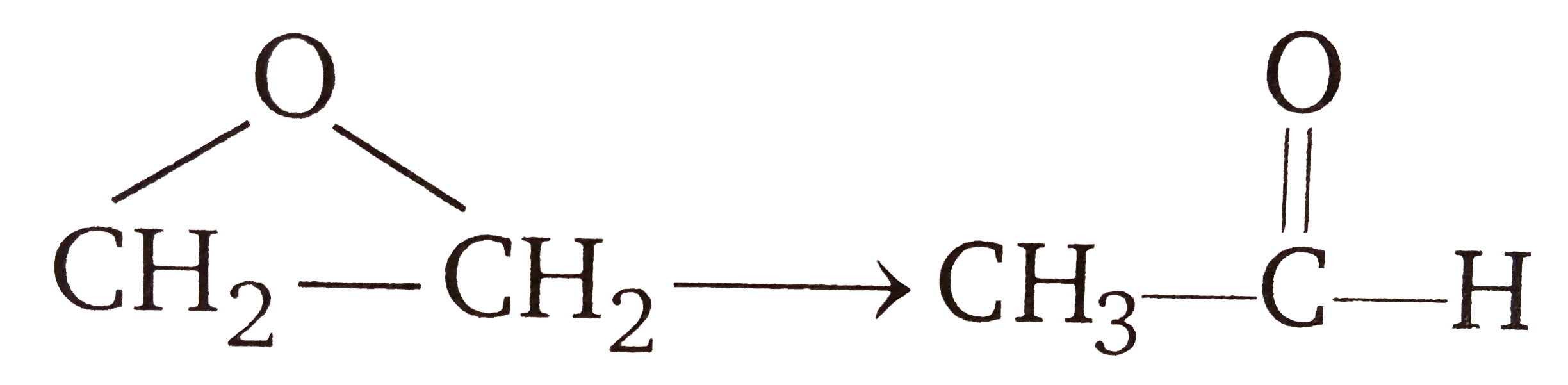
Given: for ethylene oxide `DeltaH^@_f` and `DeltaS^@` are `-51kJmol^(-1), 243Jmol^(-1)K^(-1)` respectively and acetaldehyde `DeltaH^@_f` and `DeltaS^@` are `-166kJmol^(-1)` and `266 J mol^(-1) K^(-1)` respectively, then select the correct statements:

A

`DeltaH^(@)` for the reaction is `-115 kJ mol^(-1)`

B

`DeltaS^(@)=0.0236 k J mol^(-1) K^(-1)`

C

Reaction is thermodynamically favourable

D

High temperature can favour formation of more product.

Text Solution

Verified by Experts

The correct Answer is:
A, B, C, D

`DeltaH^(@)=DeltaH_(f("Product"))^(@)-DeltaH_(f("Reactants"))^(@)`
`=-166-(-51)=-115 kJ mol^(-1)`
`DeltaS^(@)=266-243=23 J`
`DeltaH^(@)=-ve,DeltaS^(@)=+ve` and `DeltaG^(@)=DeltaH^(@)-TDeltaS^(@)` must be `-ve`. Therefore, the reaction will be thermodynamically favourable. for reaction having `-ve DeltaH^(@)` and `+ve`
`DeltaS^(@)`, all temperature conditions will be favourable.
Promotional Banner

Topper's Solved these Questions

  • THERMOCHEMISTRY

    P BAHADUR|Exercise Exercise 9 Advance numerical problems|31 Videos

Similar Questions

Explore conceptually related problems

For a reaction at 25^(@)C enthalpy change (Delta H) and entropy change (Delta S) are -11.7xx10^(3)Jmol^(_1) and -105 J mol^(-1)K^(-1) respectively. The reaction is :

For a reaction at 25^(@)C enthalpy change (DeltaH) and entropy change (DeltsS) are -11.7 K J mol^(-1) and -105J mol^(-1) K^(-1) , respectively. Find out whther this reaction is spontaneous or not?

Calculate the bond enthalpy of HCl. Given that the bond enthalpies of H_(2) and Cl_(2) are 430KJmol^(-1) and 242KJmol^(-1) respectively and Delta_(f)H^(0)HCl is -91KJmol^(-1) )

Given that Bond energy of H_(2) and N_(2) are 400KJmol^(-1) and 240KJmol^(-1) respectively and DeltaH_(f) of NH_(3) is -120KJmol^(-1) calculate the bond energy of N-H bond :-

The values of DeltaH and Delta S of a certain reaction are -400 kJ mol^-1 and -20 kJ mol^-1 K^-1 respectively. The temperature below which the reaction is spontaneous is _________.

For vaporization of water at 1 atmospheric pressure the values of DeltaH and DeltaS are 40.63KJmol^(-1) and 108JK^(-1)mol^(-1) , respectively. The temperature when Gibbs energy change (DeltaG) for this transformation will be zero is

AtoB , DeltaH=4 kcal mol^(-1) , DeltaS=10 cal mol^(-1)K^(-1) . Reaction is spontaneous when temperature is

In conversion of lime-stone to lime, CaCO_(3(s)) to CaO_((s)) + CO_(2(g)) the values of DeltaH^@ and DeltaS^@ are +179.1 kJmol^(-1) and 160.2 J//K respectively at 298K and 1 bar. Assuming that DeltaH^@ and DeltaS^@ do not change with temperature, temperature above which conversion of lime-stone to lime will be spontaneous is :

P BAHADUR-THERMODYNAMICS-Exercise
  1. The open system (s) is (are) which :

    Text Solution

    |

  2. Which of the following statements is/are correct?

    Text Solution

    |

  3. Given: for ethylene oxide DeltaH^@f and DeltaS^@ are -51kJmol^(-1), 24...

    Text Solution

    |

  4. The reversible expansion of an ideal gas under adiabatic and isotherma...

    Text Solution

    |

  5. For an ideal gas, consider only P-V work in going from an initial stat...

    Text Solution

    |

  6. An endotthermic reaction is non-spontaneous at freezing point of water...

    Text Solution

    |

  7. A heat engine absorbs heat Q(1) at temperature T(1) and Q(2) at temper...

    Text Solution

    |

  8. In an irreversible process taking place at constant T and P and in whi...

    Text Solution

    |

  9. The internal energy change when a system goes fromk state A to B is 40...

    Text Solution

    |

  10. The correct relationship between free energy change in a reaction and ...

    Text Solution

    |

  11. An ideal gas expands from 1xx10^(-3)m^(3) to 1xx10^(-2)m^(3) at 300K a...

    Text Solution

    |

  12. For a spontaneous reaction, DeltaG , equilibrium constant (K) and E(ce...

    Text Solution

    |

  13. An ideal gas is allowed to expand both reversibly and irreversibly in ...

    Text Solution

    |

  14. In conversion of lime-stone to lime, CaCO(3(s)) to CaO((s)) + CO(2(g...

    Text Solution

    |

  15. Standard entropy of X(2) , Y(2) and XY(3) are 60, 40 and 50JK^(-1)mol...

    Text Solution

    |

  16. Which one of the following statement is false?

    Text Solution

    |

  17. In thermodynamics, a process is called reversible when

    Text Solution

    |

  18. One mole of a non-ideal gas undergoes a change of state (2.0atm,3.0L,9...

    Text Solution

    |

  19. Two moles of an ideal gas expanded isothermally and reversibly from 1L...

    Text Solution

    |

  20. The enthalpy of vaporisation of a liquid is 30 kJ mol^(-1) and entropy...

    Text Solution

    |