

Home
Class 11
CHEMISTRY
The reversible expansion of an ideal gas...

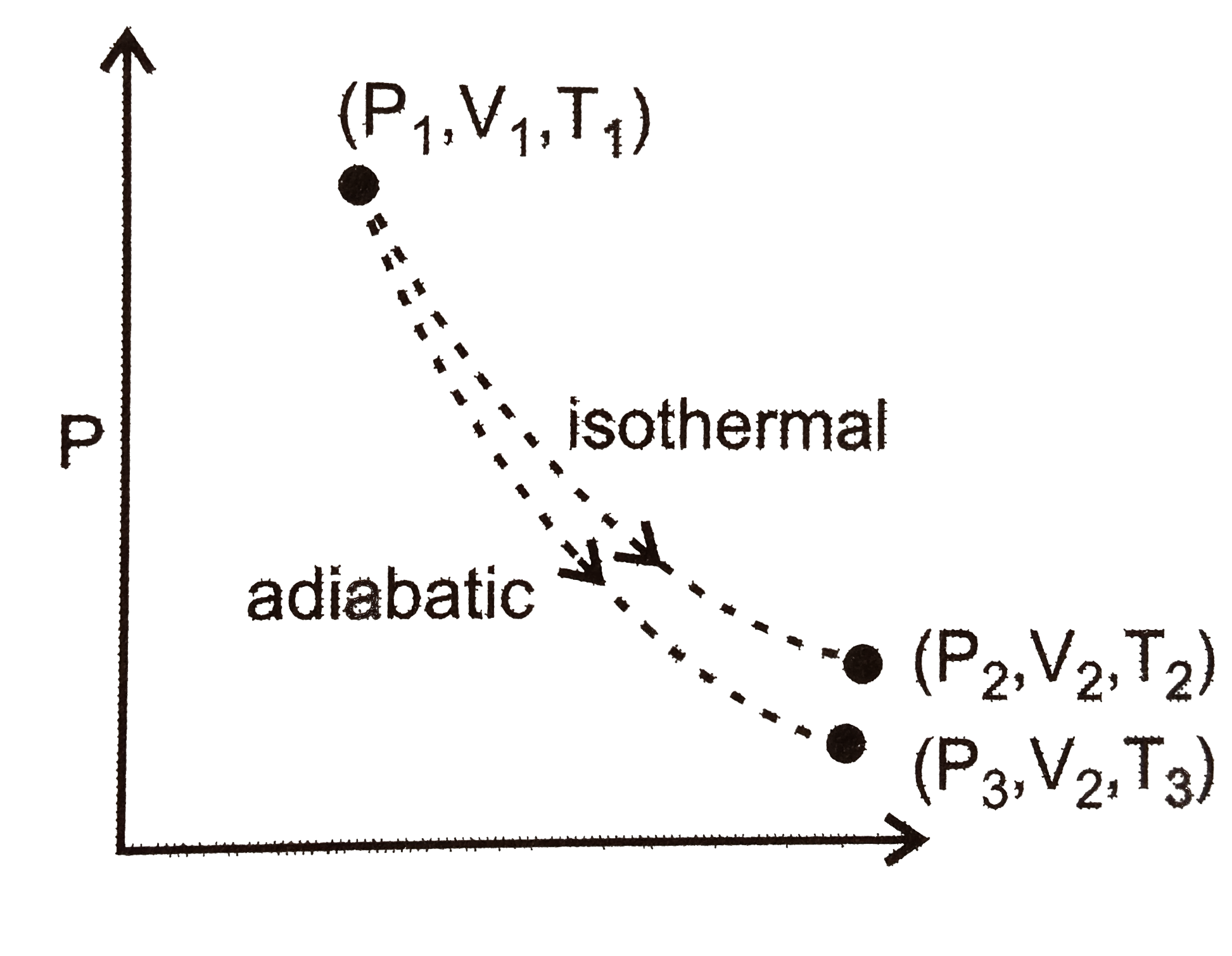
The reversible expansion of an ideal gas under adiabatic and isothermal conditions is shown in the figure. Which of the following statement(s) is (are) correct?

A

`T_(1)=T_(2)`

B

`T_(3)gtT_(1)`

C

`w_("isothermal")gtw_("adiabatic")`

D

`DeltaU_("isothermal")gtDeltaU_("adiabatic")`

Text Solution

Verified by Experts

The correct Answer is:
A, D

For isothermal expansion, `DeltaT=`constant i.e. `T_(1)=T_(2)`
at const temperature, internal energy `(DeltaU)` of the system remains constant i.e.,
`DeltaU_("isothermal")=0`
Reversible expansion work=`-2.303nRT"log"(V_(2))/(V_(1))`
In adiabatic expansion, no heat is allowed to enter `w` is leave the system, hence `q = 0`
`DeltaE=q+w. :. q = 0`
`DeltaE=w`
In expansion, work is doen by the system, hence `w` is negative, accordingly, `DeltaE=-ve`, i.e.,
Internal energy decrease and therefore the temperature of the system falls.
Thus, `T_(3) lt T_(1)`
Thus, `DeltaU_("adiabatic")=-ve`
Thus, `DeltaU_("Isothermal") gt DeltaU_("adiabatic")`
`w_("adiabatic")=R/((gamma-1))(T_(2)-T_(1))`
Thus, Including sign,
`w_("isothermal") lt w_("adiabatic")`
Promotional Banner

Topper's Solved these Questions

  • THERMOCHEMISTRY

    P BAHADUR|Exercise Exercise 9 Advance numerical problems|31 Videos

Similar Questions

Explore conceptually related problems

For irreversible expansion of an ideal gas under isothermal condition, the correct option is:

In reversible isothermal expansion of an ideal gas :

Can a process on an ideal gas be both adiabatic and isothermal. ?

During free expansion of an ideal gas under adiabatic condition,the internal energy of the gas is

During adiabatic expansion of an ideal gas :-

P BAHADUR-THERMODYNAMICS-Exercise
  1. Which of the following statements is/are correct?

    Text Solution

    |

  2. Given: for ethylene oxide DeltaH^@f and DeltaS^@ are -51kJmol^(-1), 24...

    Text Solution

    |

  3. The reversible expansion of an ideal gas under adiabatic and isotherma...

    Text Solution

    |

  4. For an ideal gas, consider only P-V work in going from an initial stat...

    Text Solution

    |

  5. An endotthermic reaction is non-spontaneous at freezing point of water...

    Text Solution

    |

  6. A heat engine absorbs heat Q(1) at temperature T(1) and Q(2) at temper...

    Text Solution

    |

  7. In an irreversible process taking place at constant T and P and in whi...

    Text Solution

    |

  8. The internal energy change when a system goes fromk state A to B is 40...

    Text Solution

    |

  9. The correct relationship between free energy change in a reaction and ...

    Text Solution

    |

  10. An ideal gas expands from 1xx10^(-3)m^(3) to 1xx10^(-2)m^(3) at 300K a...

    Text Solution

    |

  11. For a spontaneous reaction, DeltaG , equilibrium constant (K) and E(ce...

    Text Solution

    |

  12. An ideal gas is allowed to expand both reversibly and irreversibly in ...

    Text Solution

    |

  13. In conversion of lime-stone to lime, CaCO(3(s)) to CaO((s)) + CO(2(g...

    Text Solution

    |

  14. Standard entropy of X(2) , Y(2) and XY(3) are 60, 40 and 50JK^(-1)mol...

    Text Solution

    |

  15. Which one of the following statement is false?

    Text Solution

    |

  16. In thermodynamics, a process is called reversible when

    Text Solution

    |

  17. One mole of a non-ideal gas undergoes a change of state (2.0atm,3.0L,9...

    Text Solution

    |

  18. Two moles of an ideal gas expanded isothermally and reversibly from 1L...

    Text Solution

    |

  19. The enthalpy of vaporisation of a liquid is 30 kJ mol^(-1) and entropy...

    Text Solution

    |

  20. When 1mol of a monoatomic ideal gas at TK undergoes adiabatic change u...

    Text Solution

    |