

Home
Class 11
CHEMISTRY
For an ideal gas, consider only P-V work...

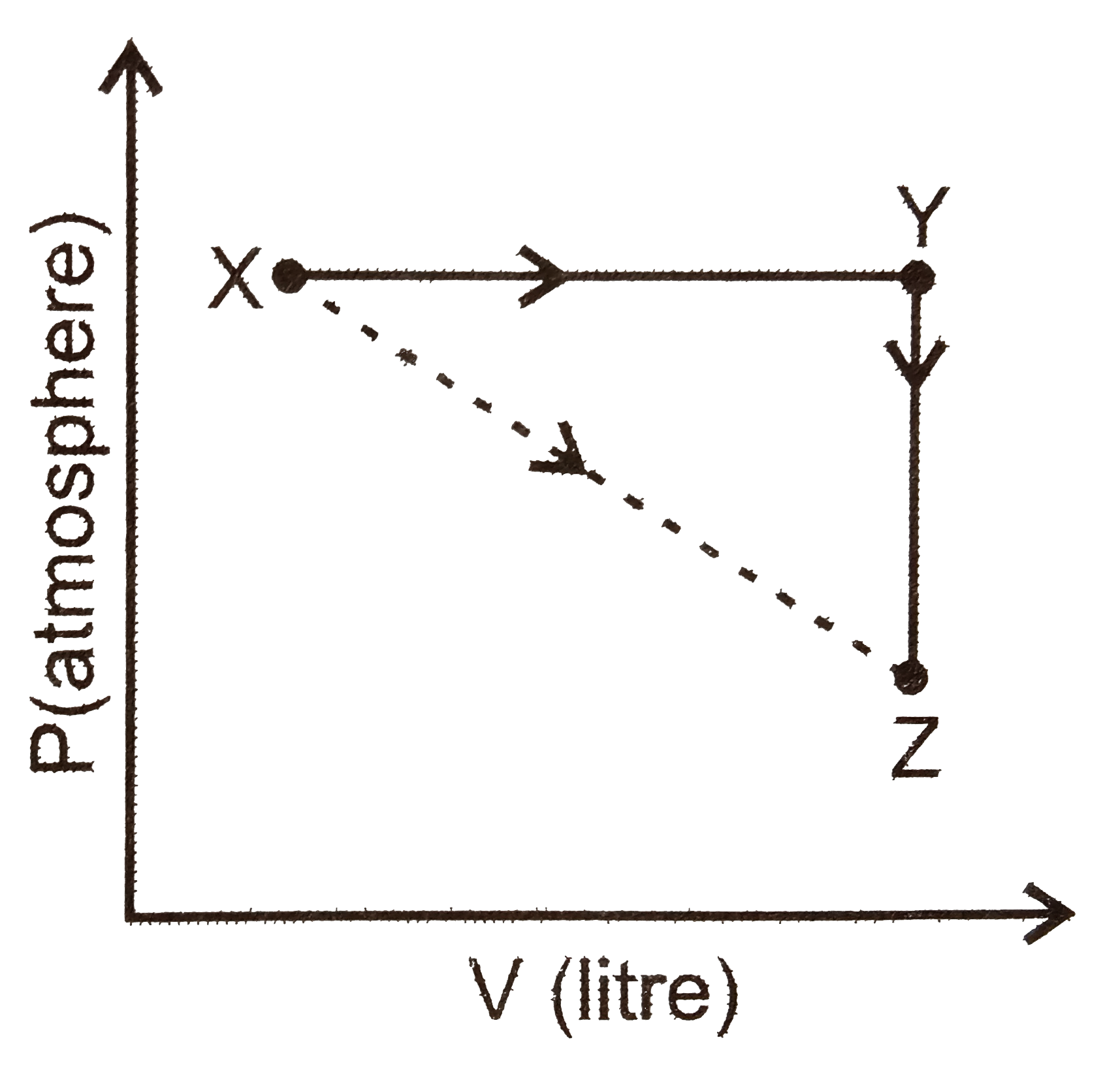
For an ideal gas, consider only `P-V` work in going from an initial state `X` to the final state `Z`. The final state `Z` can be reached by either of the two paths shown in the figure. Which of the following choice(s) is (are) correct? [Take `DeltaS` as change in entropy and `w` as work done]

A

`DeltaS_(XtoZ)=DeltaS_(XtoY)+DeltaS_(YtoZ)`

B

`w_(XtoZ)=w_(XtoY)+w_(YtoZ)`

C

`w_(XtoYtoZ)=w_(XtoY)`

D

`DeltaS_(XtoYtoZ)=DeltaS_(XtoY)`

Text Solution

Verified by Experts

The correct Answer is:
A, C

`DeltaS` is a state function. So, it does not depend on path and only depends on initial and final stages.
`DeltaS_(XtoZ)=Delta_(XtoY)+DeltaS_(YtoZ)`
and `DeltaS_(YtoZ)` is not zero
`:. DeltaS_(XtoYtoZ)!=DeltaS_(XtoY)`
Work is not a state function and depends on path,
`:. w_(XtoZ)=w_(XtoY)+w_(YtoZ)`
`w_(XtoZ)=PdV` (`P` constant)
`w_(YtoZ)=0` (`V` is constant)
`w_(XtoZ)=2.303nRT"log"(V_(2))/(V_(1))`
`w_(XtoYtoZ)=w_(XtoY)+w_(YtoZ)`
As `w_(YtoZ)=0`, hence `w_(XtoYtoZ)=w_(XtoY)`
Promotional Banner

Topper's Solved these Questions

  • THERMOCHEMISTRY

    P BAHADUR|Exercise Exercise 9 Advance numerical problems|31 Videos

Similar Questions

Explore conceptually related problems

An ideal gas undergoes change in its state from the initial state I to the final state F via two possible paths as shown. Then

An ideal gas is taken from an inirial state I to a final state f in such a way that the ratio of the pressure to the absolute temperature remains constant. What will be the work done by the gas ?

P - V diagram of an ideal gas is shown. The gas undergoes from initial state A to final state B such that initial and final volumes are same. Select the correct alternative for given process AB.

Which of the following is correct in terms of increasing work done for the same initial and final state?

A system can be taken from the initial state p_(1),V_(1) to the final state p_(2,V_(2) by two different methods, let DeltaQ and DeltaW represent the heat given to the system and the work done by the system. Which of the following must be the same in both the method?

An ideal gas change from state a to state b as shown in Fig. what is the work done by the gas in the process?

An ideal gas is taken from the state A (P, V) to the state B (P//2, 2 V) along a st. line path as shown in Fig. Select the correct statement from the following:

P BAHADUR-THERMODYNAMICS-Exercise
  1. Given: for ethylene oxide DeltaH^@f and DeltaS^@ are -51kJmol^(-1), 24...

    Text Solution

    |

  2. The reversible expansion of an ideal gas under adiabatic and isotherma...

    Text Solution

    |

  3. For an ideal gas, consider only P-V work in going from an initial stat...

    Text Solution

    |

  4. An endotthermic reaction is non-spontaneous at freezing point of water...

    Text Solution

    |

  5. A heat engine absorbs heat Q(1) at temperature T(1) and Q(2) at temper...

    Text Solution

    |

  6. In an irreversible process taking place at constant T and P and in whi...

    Text Solution

    |

  7. The internal energy change when a system goes fromk state A to B is 40...

    Text Solution

    |

  8. The correct relationship between free energy change in a reaction and ...

    Text Solution

    |

  9. An ideal gas expands from 1xx10^(-3)m^(3) to 1xx10^(-2)m^(3) at 300K a...

    Text Solution

    |

  10. For a spontaneous reaction, DeltaG , equilibrium constant (K) and E(ce...

    Text Solution

    |

  11. An ideal gas is allowed to expand both reversibly and irreversibly in ...

    Text Solution

    |

  12. In conversion of lime-stone to lime, CaCO(3(s)) to CaO((s)) + CO(2(g...

    Text Solution

    |

  13. Standard entropy of X(2) , Y(2) and XY(3) are 60, 40 and 50JK^(-1)mol...

    Text Solution

    |

  14. Which one of the following statement is false?

    Text Solution

    |

  15. In thermodynamics, a process is called reversible when

    Text Solution

    |

  16. One mole of a non-ideal gas undergoes a change of state (2.0atm,3.0L,9...

    Text Solution

    |

  17. Two moles of an ideal gas expanded isothermally and reversibly from 1L...

    Text Solution

    |

  18. The enthalpy of vaporisation of a liquid is 30 kJ mol^(-1) and entropy...

    Text Solution

    |

  19. When 1mol of a monoatomic ideal gas at TK undergoes adiabatic change u...

    Text Solution

    |

  20. The direct conversion of A to B is difficult, hence it is carried out ...

    Text Solution

    |