Home
Class 11
PHYSICS
Three identical particles each of mass "...

Three identical particles each of mass "m" are arranged at the corners of an equiliteral triangle of side "L". If they are to be in equilibrium, the speed with which they must revolve under the influence of one another's gravity in a circular orbit circumscribing the triangle is

Text Solution

Verified by Experts
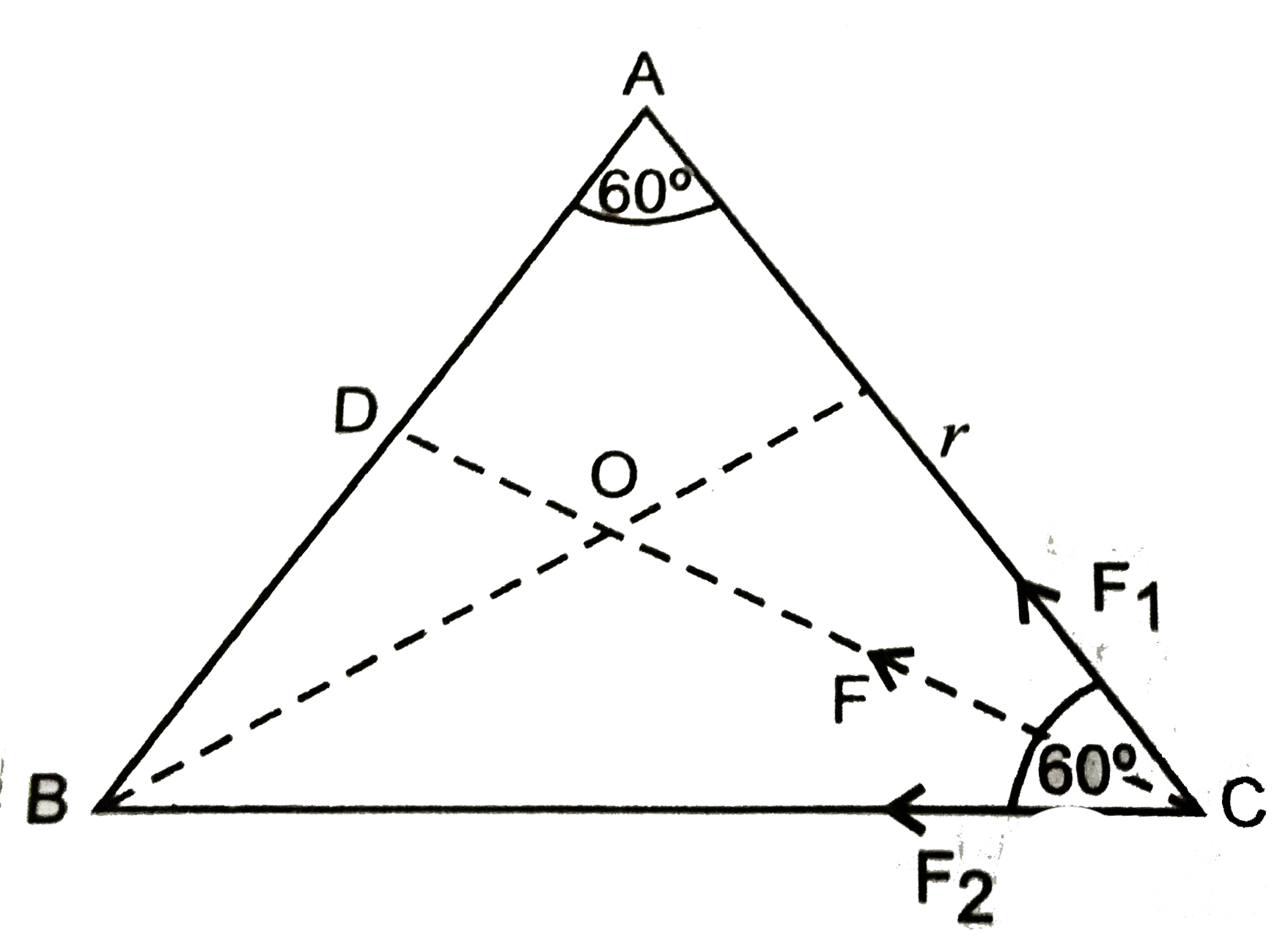
Refer to Fig. force of attraction on body at `C` due to body at `A` is,
`F_(1) = (Gmm)/(r^(2)) = (Gm^(2))/(r^(2))` along `CA`

Force of attraction on body at `C` due to body at
`B` is, `F_(2) (G mm)/(r^(2)) = (G m^(2))/(r^(2))` along `CB`
These force `vec(F_(1))` and `vec(F_(2))` are inclined at an
angle `60^(@)`, the resultant force on the body at `C` is
`F = sqrt(F_(1)^(2) + F_(2)^(2) + 2F_(1) F_(2) cos 60^(@))`
`= sqrt(F_(1)^(2) + F_(2)^(2) + 2 F_(1) F_(2) (1//2))`
`= sqrt(3) F_(1) = sqrt(3) (Gm^(2))/(r^(2))` acting along `CD`
`[ :.F_(1) = F_(2) = (Gm^(2))/(r^(2))]`
Here, `CO = (2)/(3) CD = (2)/(3) AC sin 60^(@)`
`= (2)/(3) r xx sqrt(3)/(2) = (r)/(sqrt(3))`
When each body is describing a circular orbit with centre of orbit at `O`, the force `F` provides the required centripetal force. The redius of the circular orbit is `OC (= r//sqrt(3))`. If `upsilon` is the speed of the body in the circular orbit, then
`(m upsilon^(2))/((r//sqrt(3))) = (sqrt(3) Gm^(2))/(r^(2))` or `upsilon = sqrt((Gm)/(r))`
Promotional Banner

Topper's Solved these Questions

  • GRAVIATION

    PRADEEP|Exercise SOLVED EXAMPLES TYPE H|1 Videos
  • GRAVIATION

    PRADEEP|Exercise SOLVED EXAMPLES TYPE I|1 Videos
  • GRAVIATION

    PRADEEP|Exercise SOLVED EXAMPLES TYPE G|1 Videos
  • BEHAVIOUR OF PERFECT GAS & KINETIC THEORY

    PRADEEP|Exercise Assertion - Reason Type questions|14 Videos
  • KINEMATICS

    PRADEEP|Exercise 1 NCERT Comprehension|4 Videos

Similar Questions

Explore conceptually related problems

Three particle each of mass m are placed at the corners of equilateral triangle of side l Which of the following is/are correct ?

Three particles each of mass m are arranged at the corners of an equililateral triangle of side L . If one of masses is doubled. The shift in the centre of mass of the system

Three particle each of mass m , are located at the vertices of an equilateral triangle of side a. At what speed must they move if they all revolve under the influence of their gravitational force of attraction in a circular orbit circumscribing the triangle while still preserving the equilateral triangle ?

Three particles each of mass m are palced at the corners of an equilateral triangle of side b . The gravitational potential energy of the system of particle is

Six identical particles each of mass m are arranged at the corners of a regular hexagon of side length L . If the mass of one of the particle is doubled, the shift in the centre of mass is

Four identical particles of mass M are located at the corners of a square of side ‘a’. What should be their speed if each of them revolves under the influence of others’ gravitational field in circular orbit circumscribing the square ?

Three particles each of mass 2kg are at the corners of an equilateral triangle of side sqrt 3 m . If one of the particles is removed, the shift in the centre of mass is

Three identical particles each of mass 0.1 kg are arranged at three corners of a square of side sqrt(2) m . The distance of the centre of mass from the fourth corners is

PRADEEP-GRAVIATION-SOLVED EXAMPLES
  1. How far from Earth must a body be along a line joining the sun to the ...

    Text Solution

    |

  2. Three equal masses of m kg each are fixed at the vertices of an equila...

    Text Solution

    |

  3. Three identical particles each of mass "m" are arranged at the corner...

    Text Solution

    |

  4. Assuming the earth of to be a uniform sphere of radius 6400 kg and den...

    Text Solution

    |

  5. If the radius of the earth be increased by a factor of 5, by what fact...

    Text Solution

    |

  6. A planet whose size is the same and mass is 4 times as that of Earth, ...

    Text Solution

    |

  7. A man can jump 2.0 m high on the earth. Up to what height he can jump ...

    Text Solution

    |

  8. If the radius of the Earth shrinks by 2%, mass remaing same, then how ...

    Text Solution

    |

  9. Two lead spheres of 20 cm and 2 cm diametre respectively are planet wi...

    Text Solution

    |

  10. At what height from the surface of earth will the value of g be reduce...

    Text Solution

    |

  11. A body weighs 64 N on the surface of Earth. What is the gravitational ...

    Text Solution

    |

  12. Find the percentage decrease in the wight of the body when taken to a ...

    Text Solution

    |

  13. A body hanging from a spring stretches it by 2 cm at the earth's surfa...

    Text Solution

    |

  14. An object weighs 10 N at north pole of Earth. In a geostationary satel...

    Text Solution

    |

  15. At what depth from the surface of earth, the value of acceleration due...

    Text Solution

    |

  16. Assuming the Earth to be a sphere of uniform mass density, how much wo...

    Text Solution

    |

  17. Find the percentage decrease in the weight of the body when taken 64 k...

    Text Solution

    |

  18. Determine the speed with which the earth would have to rotate on its a...

    Text Solution

    |

  19. Calculate that imaginary angular velocity of the Earth for which effec...

    Text Solution

    |

  20. Suppose Earth is perfect sphere of radius 6.4 xx 10^(6) m. It is rota...

    Text Solution

    |

