Home
Class 11
PHYSICS
Three bars of equal lengths and equal ar...

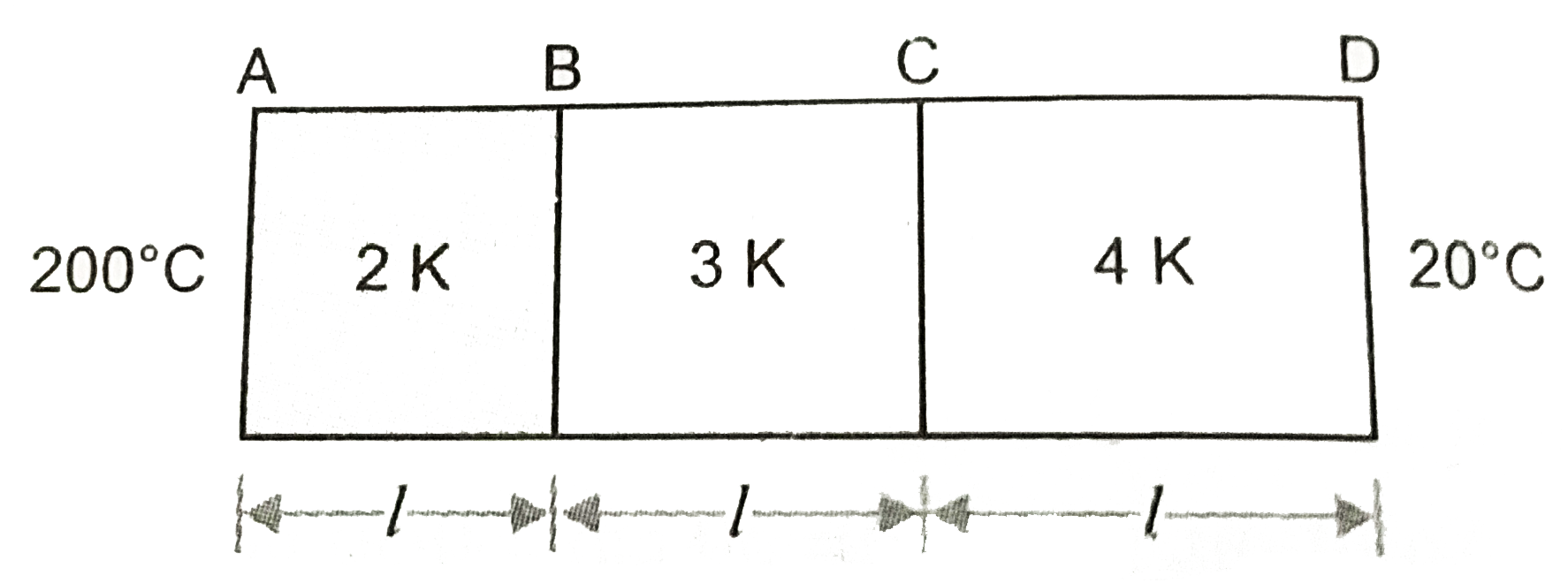
Three bars of equal lengths and equal area of cross-section are connected in series fig. their thermal conducitives are in the ratio `2:3:4`. If at the steady state the open ends of the first and the last bars are at temperature `200^(@)C` and `20^(@)C` respectively, find the temperature of both the junctions.
.

Text Solution

Verified by Experts

Let `theta_(1)` and `theta_(2)` be the temperature of the junctions B and C respectively.
At the steady state, the rate of flow of heat through each bar will be same.
`(Delta Q)/(Delta t) = (2K xx A xx (200-theta_(1)))/(l)`
`=(3KA(theta_(1)-theta_(2)))/(l)` = `(4KA(theta_(2)-20))/(l)`
or `2(200-theta_(1)) = 3(theta_(1)-theta_(2)) = 4 (theta_(2)-20)`
On solving we get, `theta_(1) = 116.9^(@)C, theta_(2) = 61.5^(@)C`.
Promotional Banner

Topper's Solved these Questions

  • PROPERTIES OF BULK MATTER

    PRADEEP|Exercise Conceptual Problems|103 Videos
  • PROPERTIES OF BULK MATTER

    PRADEEP|Exercise Advanced problems for competitions|21 Videos
  • PROPERTIES OF BULK MATTER

    PRADEEP|Exercise Long Answer questions|33 Videos
  • PHYSICAL WORLD AND MEASUREMENT

    PRADEEP|Exercise Competiton Focus Jee Medical Entrance|18 Videos
  • RAY OPTICS

    PRADEEP|Exercise Problem For Practice(a)|25 Videos

Similar Questions

Explore conceptually related problems

Three bars of equal lenghts and equal area of cross-section are connected in series. Their thermal conductivities are in the ratio of 2:4:3 . If the open ends of the first and the last bars are at temperature 200^(@)C and 180^(@)C respectivity in the steady state, calculate the temperature of both the junctions.

Three bars of equal lengths x and equal area of cross-section A are connected in series. Their thermal conductivities are in the ratio 2:4:3. If the open ends of the first and the last bars are at temperatures 200^@C and 18^@C , respectively in the steady state, calculate the temperatures of both the junctions.

Three cylindrical rods A, B and C of equal lengths and equal diameters are joined in series as shown if Fig. Their thermal conductivities are 2K, K and 0.5K, respectively. In steady state, if the free ends of rods A and C are at 100^@C and 0^@C , respectively, calculate the temperature at the two junction points. Assume negligible loss by radiaiotn through the curved surface. What will be the equivalent thermal conductivity?

Twelve conducting rods from the sides of a uniform cube of side l. If in steady state, B and H ends of the cube are at 100^(@)C and 0^(@)C respectively. Find the temperature of the junction 'A' :-

Two rods of same length and cross section are joined along the length. Thermal conductivities of first and second rod are K_(1) and K_(2) . The temperature of the free ends of the first and seconds rods are maintained at theta_(1) and theta_(2) respectively. The temperature of the common junction is

Three rods AB, BC and BD having thermal conductivities in the ratio 1:2:3 and lengths in the ratio 2:1:1 are joined as shown in Fig. The ends A, C and D are at temperature T_1 , T_2 and T_3 respectively Find the temperature of the junction B. Assume steady state.

Three identical rods are joined in series as shown. Their thermal conductivities are K, K//2 and K//3 respectively. At steady, if the free ends of rods are at 100^(@)C and 20^(@)C respectively. Determine the temperature at two junction points. Also find the equivalent thermal conductivity.

Three rods of equal length and equal area of cross section are connected end to end in series. The open end of the first rod (from left) is at a temperature of 300^@C and that of the last rod is at 20^@C in steady state. If the thermal conductivities of rods from left to right are in the ratio of 1: 3: 4, then find the temperatures of both the junctions.

PRADEEP-PROPERTIES OF BULK MATTER-Solved Examples
  1. An iron bar (L(1) = 0.1 m, A(1) = 0.02 m^(2) , K(1) = 79 Wm^(-1) K^(-1...

    Text Solution

    |

  2. One end of a copper rod of uniform cross-section and length 150 cm is ...

    Text Solution

    |

  3. Three bars of equal lengths and equal area of cross-section are connec...

    Text Solution

    |

  4. An electric heater is used in a room of total wall area 137m^(2) to ma...

    Text Solution

    |

  5. A body initially at 64^(@)C cools to 52^(@)C in 5 minutes. The tempera...

    Text Solution

    |

  6. A body initially at 80^(@)C cools to 64^(@)C in 5 minutes and to 52^(@...

    Text Solution

    |

  7. A pan filled with hot food cools from 94^(@)C to 86^(@)C in 2 minutes ...

    Text Solution

    |

  8. A body cools in 7 minutes from 60^(@)C to 40^(@)C. What will be its te...

    Text Solution

    |

  9. Calculate the temperature (in K) at which a perfect black body radiate...

    Text Solution

    |

  10. The temperature of a body in increased from 27^(@)C to 127^(@)C. By wh...

    Text Solution

    |

  11. Due to change in main voltage, the temperature of an electric bulb ris...

    Text Solution

    |

  12. Determine the surface area of the filament of a 100W incandescent lamp...

    Text Solution

    |

  13. An indirectly heated filament is radiating maximum energy of wavelengt...

    Text Solution

    |

  14. A room heater is made of 10 polished thin walled tubes of copper, each...

    Text Solution

    |

  15. Calculate the maximum amount of heat which may be lost per second by r...

    Text Solution

    |

  16. A man, the surface area of whose skin is 2m^(2) , is sitting in a room...

    Text Solution

    |

  17. Light from the moon, is found to have a peak (or wevelenght of maximum...

    Text Solution

    |

  18. The surface temperature of the hot body is 1127^(@)C find the waveleng...

    Text Solution

    |

  19. A layer of ice 29 cm thick has formed on a pond. The temperature of ai...

    Text Solution

    |

  20. A room heater is made of 10 polished thin walled tubes of copper, each...

    Text Solution

    |

