
Home
Class 11
PHYSICS
An equilateral triangle ABC if formed by...

An equilateral triangle ABC if formed by two Cu rods AB and BC and one Al rod

it is heated in such a way that temperature of each rod increases by `Delta T.` Find change in the angle ABC. [Coeff. Of linear expansion for Cu. is `alpha_1,` Coeff. of linear expansion for Al is `alpha_2]`

Text Solution

Verified by Experts
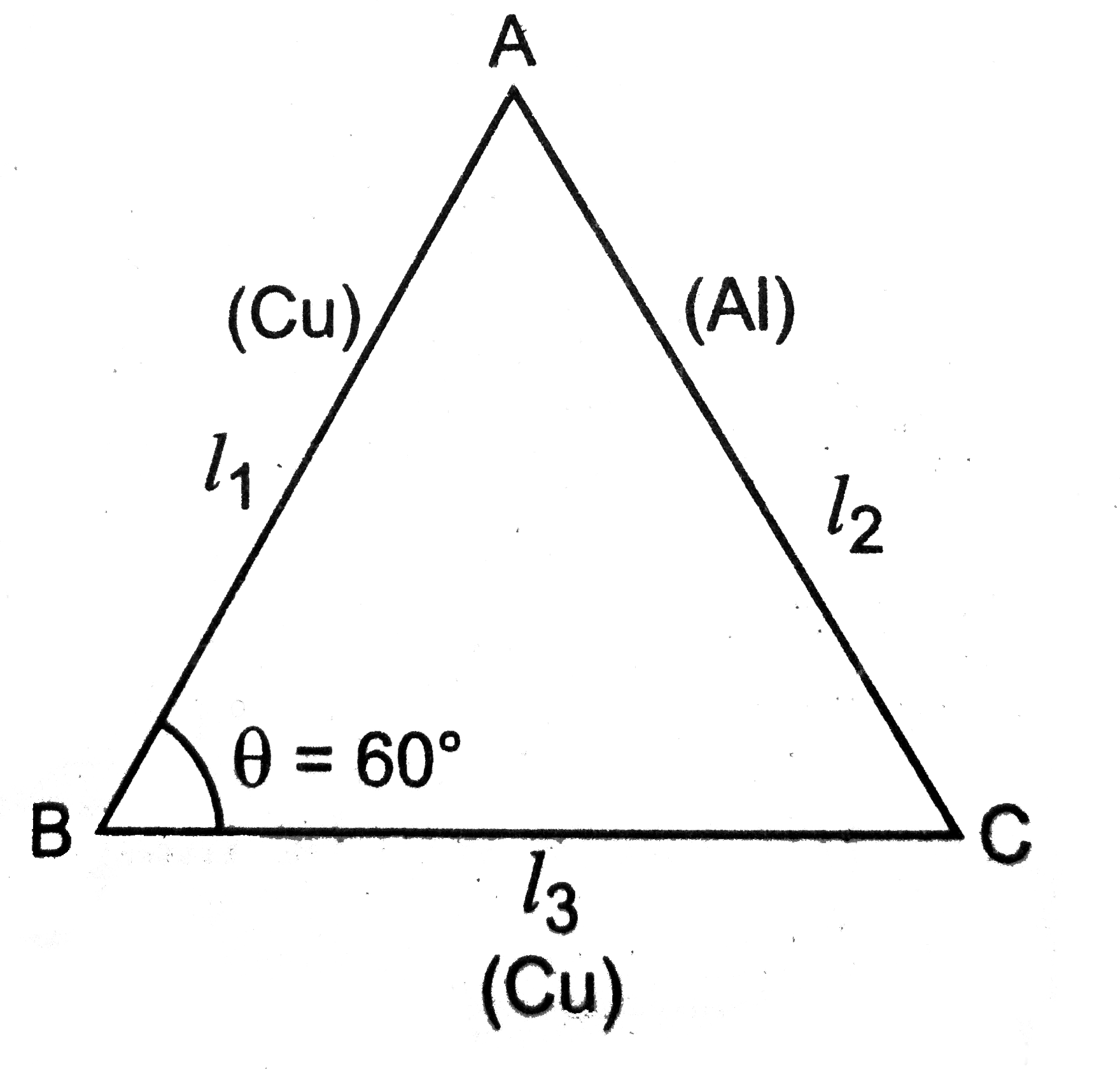
Refer

`cos theta = (l_1^2 + L_3^2 - l_2^2)/(2l_1 l_3)`
`2l_1 cos theta = l_1^2 + l_3^2 - l_2^2`
Differentiating it we have `2(l_1 dl_3 + l_3 dl_1) cos theta -2l_1 l_3 sin theta d theta =2l_1 dl_1 + 2l_3 dl_3 -2l_2 dl_2`
Here, `l_1 = l_2 = l_3 l, dl_1 = l alpha_1 Delta T, dl_2 = l alpha_2 Delta T and dl_3 =l alpha_1 Delta T`
`:. 2(lxxl alpha_1 Delta T + lxx l alpha_1 Delta T) cos theta -2lxxl sin theta d theta`
`=2 l xx lalpha_1 Delta T + 2l xx l alpha_1 Delta T - 2l xx l alpha_2 Delta T`
Dividing it by `2l^2` we get `2 alpha_1 Delta T cos theta - sin theta d theta = 2alpha_1 Delta T - (alpha_2 DeltaT)`
`sin theta d theta = 2 alpha_1 Delta T (cos theta -1) + alpha_2 Delta T`
Using `theta = 60^@` we have `(sqrt3)/(2) d theta = 2 alpha_1 Delta T ((1)/(2) -1) + alpha_2 Delta T = (alpha_2 - alpha_1) DeltaT :. d theta = (alpha_2 - alpha_1) Delta T xx (2)/(sqrt3)`
Promotional Banner

Similar Questions

Explore conceptually related problems

When the temperature of a rod increases from t to t+Delta t , its moment of inertia increases from I to I+Delta I . If alpha is coefficient of linear expansion, the value of Delta I//I is

When the temperature of a rod increases from 1 to t. Delta t,the moment of inertia increases from 1 to 1+Delta.The coefficient of linear expansion of the rod is alpha.The ratio Delta I/I is :

The moment of inertia of a rod about its perpendicular bisector is I . When the temperature of the rod is increased by Delta T , the increase in the moment of inertia of the rod about the same axis is (Here , alpha is the coefficient of linear expansion of the rod )

A meter scale calibarated for temperature T is used to measure the length of a steel rod. Length of steel rod measured by metal scale at temperature 2T is L. Length of the rod measured by metal scale at temperature T is [alpha_(s) :Coefficient of linear expansion of metal scale, alpha_(R ) : Coefficient of linear expansion of steel rod]

The moment of inertia of a rod about its perpendicular bisector is l, when temperature of rod is increased by Delta T, the increase in the moment of inertia of the rod about same axis ( gamma = temperature coefficient of volume expansion)

The moment of ineratia of a uniform thin rod about its perpendicular bisector is I . If the temperature of the rod is increased by Deltat , the moment of inertia about perpendicular bisector increases by (coefficient of linear expansion of material of the rod is alpha ).

Two metallic rods of length l and 3l have coefficient of linear expansion alpha and 3alpha respectively. The coefficient of linear expansion ofr their series combinations, is

A bimetallic strip is composed of two identical strips, one of steel and other of brass. When the temperature of the strip is raised by Delta T , it bends to form arc of curvature R. If the coefficients of linear expansion of steel and brass are alpha_1 and alpha_2 , respectively, then R is

An equilateral triangle ABC is formed by joining three rods of equal length and D is the mid-point of AB . The coefficient of linear expansion for AB is alpha_(1) and for AC and BC is alpha_(2) . The relation between alpha_(1) and alpha_(2) , if distance DC remains constant for small changes in temperture is

